
What if the smartest workwear refresh starts with taking garments out of the order, not adding more? Updating your company workwear works best when each item suits the role, the working environment and how often it’s worn.
If existing kit looks dated, worn or inconsistent, it can be tempting to replace everything at once. But teams may need different garments, and staff preferences, sizing and daily tasks can make a blanket order a poor fit. The aim is a consistent look without choosing clothing that’s impractical to wear.
This guide will help you assess which roles and garments need attention, compare suitable workwear options and choose decoration with the garment fabric, artwork and intended use in mind. You’ll also learn how to gather staff input and plan an order and rollout. RAW Merch has over 25 years of experience in custom clothing and merchandise printing, including screen printing, DTF and sublimation. Start with a clear brief, then build a refresh around what your team needs.
Key Takeaways
- Start updating your company workwear by identifying the problems current garments create, from wear and inconsistent branding to changed roles.
- Audit workwear by role and task before comparing garments. Record condition, sizes, wear frequency and replenishment needs.
- Match garment characteristics and branding methods to the job, and assess protective workwear requirements separately from branding choices.
- Reduce rollout surprises by checking artwork placement, colours, sizes and garment specifications before approving the order.
- Compare suppliers on relevant experience, printing methods, communication and fulfilment needs. Ask how they’ll assess suitability for your brief.
Why update your company workwear? Start with the problems your current kit creates
Faded tops, damaged garments, mixed logo treatments and feedback that clothing feels uncomfortable are all good reasons to review your kit. Roles may have changed too, leaving people with clothing that no longer suits their daily tasks or working environment. A refresh doesn’t have to mean replacing every item. If a garment still fits, works well and looks presentable, the issue may be its branding rather than the garment itself.
Workwear helps create a recognisable team appearance, while practical, comfortable clothing can make it easier for staff to wear that look throughout the working day. Uniforms also carry wider social and cultural meanings, as explored in this overview of uniforms. Keep the aim grounded: choose clothing that works for the people wearing it and apply branding consistently, without expecting uniforms alone to deliver business results.
A workwear refresh is a planned review of garments, fit and branding to decide what to keep, replace or update. That distinction helps you avoid ordering new kit just because one part of the current set needs attention.
What signs show it is time to refresh company workwear?
Inspect garments in use, not just stored samples. Look for fading, holes, worn seams and logos that differ in size, colour or placement. Notice what employees avoid wearing. Repeated complaints or unused items can point to a poor fit between the clothing and the job.
- Check whether garments remain comfortable and suitable for daily tasks.
- Consider the working environment and seasonal needs, including whether staff need layers.
- Ask employees and managers which items perform well and what causes practical frustration.
What should a workwear update achieve?
Set priorities before comparing replacements. You might want better comfort, more consistent branding, clearer role distinctions or a simpler way to reorder frequently used garments. Decide what must remain consistent, such as approved brand colours and logo use, while allowing garment choices to reflect different tasks.
- Separate everyday branded clothing from protective clothing in your brief.
- Don’t assume a logo or uniform makes a garment suitable for a safety-critical task.
- For protective clothing, check the requirements for the work and consult current UK guidance, including relevant Health and Safety Executive information.
With those priorities clear, updating your company workwear becomes a focused review rather than a wholesale replacement. Keep garments that still do their job and direct the refresh towards genuine gaps.
How to audit your company workwear before choosing replacements
Start with the work, not a catalogue. A role-based audit helps you separate genuine gaps from garments that simply need a branding update. It also gives you a clear brief before you compare clothing options or request printing advice.
How do you map workwear needs to different roles?
Group people by what they do and where they do it, rather than relying on job titles alone. Two employees with the same title may have different movement demands, workplace conditions or time outdoors. For each group, record the garments they need, whether they layer clothing, how often each item is worn and what tasks it must support.
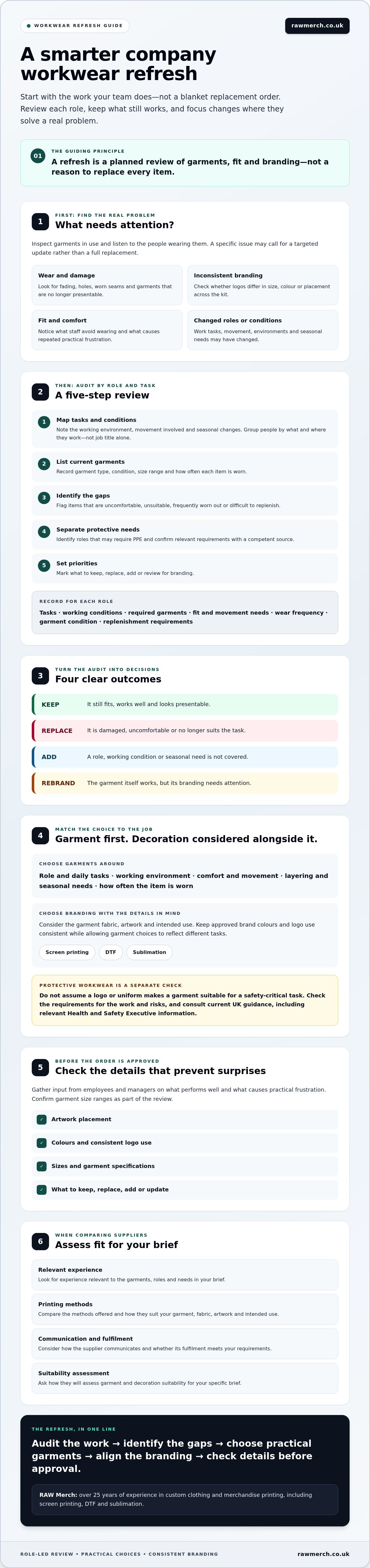
Use this numbered audit process:
- Map tasks and conditions. Note the work environment, movement involved and any seasonal changes.
- List current garments. Record garment type, condition, size range and how often each item is used.
- Identify gaps. Flag items that are uncomfortable, unsuitable, frequently worn out or difficult to replenish.
- Separate protective needs. Identify roles that may require PPE and confirm the relevant requirements with a competent source.
- Set priorities. Mark what to keep, replace, add or review for branding.
For each role, record the tasks, working conditions, required garments, fit and movement needs, wear frequency, condition and replenishment requirements.
For protective equipment, consult current UK guidance from the Health and Safety Executive. Its PPE guidance can help inform your review, but check the requirements that apply to your specific work and risks.
How should you collect sizes and employee feedback?
Confirm the available size range for each garment before collecting preferences. Explain how staff should provide measurements or select sizes, and allow time to resolve questions. Keep sizing information limited to people who need it for the workwear order, and tell employees how it will be used.
Ask a representative group to assess candidate garments in realistic conditions. Gather specific feedback on fit, comfort, reach, bending and laundering experience. A top that feels comfortable while standing still may restrict movement during a full shift. A garment that loses its shape after washing may not suit frequent wear. Record feedback by role, then refine the brief before confirming replacements.
Once your audit is clear, a production partner can help assess whether the garment fabric, artwork and intended use suit the planned decoration. RAW Merch has over 25 years of experience in custom clothing and printing. Explore custom workwear and clothing printing as you prepare your brief.
Compare workwear garments and branding methods for each job
Choose garments around the working day, then consider how branding will look and hold up in use. A T-shirt might suit an indoor team, while staff working outdoors may need options they can layer. These are starting points, not fixed rules. Check garment specifications and ask the printer which decoration methods suit the fabric and artwork.
Which garment factors matter for different working days?
Compare comfort, durability, freedom of movement, layering and care requirements against actual tasks. A garment worn daily may need different consideration from one used occasionally. T-shirts, hoodies, sweatshirts and headwear are options to assess, but don’t assume a particular garment or fabric will meet a role’s needs without checking its specifications.
| Role or working conditions | Garment considerations | Branding considerations |
|---|---|---|
| Indoor, customer-facing work | Consider comfort through a full shift and whether staff need a consistent top layer. | Check logo size, placement and colour across the team’s chosen garments. |
| Active or hands-on tasks | Assess movement, garment durability and care needs in light of the work performed. | Ask whether the planned decoration suits the garment and its intended use. |
| Outdoor or changing conditions | Review layering needs and how often each item will be worn. | Check whether the design remains clear across different garment types and colours. |
| Safety-critical roles | Identify protective clothing requirements separately from everyday uniform choices. | Branding must not be treated as a substitute for appropriate PPE or compliance. |
For protective equipment, assess the work risks and check the official government guidance. Keep this decision separate from choosing branded everyday clothing.
How do you choose a workwear decoration method?
Screen printing, DTF and sublimation are distinct printing methods, not interchangeable guarantees. Their suitability depends on the garment material, artwork and intended use. Choose decoration based on fabric compatibility, design detail and colour, and how the garment will be worn and cared for. Ask the printer to confirm the method for the specific garment and design before approving the order.
- Screen printing: Ask how the artwork and garment work with this method, especially if your brief includes multiple garment types.
- DTF: Confirm that the proposed transfer and placement suit the selected garment and intended use.
- Sublimation: Check fabric compatibility with the printer rather than assuming it suits every clothing option.
Clear artwork helps the printer assess what’s practical. If you need to prepare or review a logo file, see the guide to vector images for merch printing. This garment-first comparison makes updating your company workwear more deliberate, with each choice tied to a role and a confirmed decoration approach.
How to plan a company workwear rollout with fewer surprises
A clear sequence keeps decisions visible before an order is confirmed. Start with the approved brief, review the proposed garments and decoration, check the order details, then plan how items will reach each team. If a staged rollout suits your operation, use it to gather feedback before extending the same choices to other roles. Confirm production and delivery arrangements with your supplier rather than assuming a set timeline.
What should a workwear order brief include?
Make the brief specific enough for a supplier to check garment and decoration suitability. List the roles covered, garment categories, quantities by size, artwork files, logo placement and colours. Include delivery details and any preferences for how garments should be grouped or distributed.
Before approval, ask the production partner to confirm the garment specifications, artwork placement and colour treatment, plus the proposed decoration method. Review available size information carefully. Check how the design appears on each garment type and colour, not just on one example. Clarify minimum quantities, lead times and available options before committing, as these can vary by garment and production requirements.
Keep protective clothing requirements distinct from branded uniform decisions. A rollout plan for everyday clothing shouldn’t replace assessing or providing appropriate PPE.
How can you make the new workwear easier to adopt?
Tell staff what’s changing, when they should expect to receive garments and who to contact if an item doesn’t fit or is missing. Share the agreed sizing and replacement process with the managers who need it. If the operation allows, consider starting with a defined group or role, then use their feedback to resolve practical issues before wider distribution.
Once the brief is approved, use this order sequence:
- Review: Check garment specifications, available sizes, artwork placement and colours.
- Confirm: Approve quantities, size breakdown, decoration method and delivery details with the supplier.
- Distribute: Communicate how garments will be issued and how staff can raise fit or quality concerns.
- Record: Log the final garment choices, artwork files, colours, placements and sizing decisions.
That record matters beyond the first order. It gives managers a reference when staff join, sizes change or garments need replenishing, helping future orders stay consistent. If you manage ongoing stock, discuss fulfilment and distribution needs with the supplier and confirm what they can support.
Planning these checks before updating your company workwear reduces avoidable uncertainty and gives staff a clearer changeover. You can also discuss your brief and printing options with RAW Merch.
Choose a workwear printing partner and take the next step
A strong supplier should help you turn a defined brief into practical garment and decoration choices. Compare more than headline price. Look for relevant experience, clear communication and evidence that the printer will check whether its methods suit your garments, artwork and intended use. This matters especially if your order covers different roles or clothing types.
What should you ask a workwear supplier before ordering?
Use your brief to compare suppliers on the same points. Ask direct questions and make sure the answers address your specific requirements, not just printing in general.
- Garments: Which available options fit the tasks and working conditions in your brief? What size range can you order?
- Decoration: Which printing methods could suit your artwork and chosen garments? How will the supplier confirm compatibility before production?
- Order requirements: What minimum quantities apply, and what production schedule and delivery arrangements can they confirm for this order?
- Communication: Who will clarify garment specifications, artwork placement and details that need approval?
- Ongoing distribution: If you expect repeat orders or need items distributed in a particular way, can the supplier support that workflow? Ask what its fulfilment and distribution services include.
Clear answers help you spot assumptions before you commit. If a detail matters, such as consistent logo placement across garment types, ask how it will be checked and recorded.
How can RAW Merch support a workwear refresh?
Once you’ve assessed suppliers against your brief, consider their relevant experience and production capabilities. RAW Merch is a UK-based custom clothing printer with over 25 years of experience, serving businesses with workwear and branded clothing. Its printing methods include screen printing, DTF and sublimation. These methods aren’t interchangeable, so suitability should be confirmed against the selected garment, artwork and intended use.
For a straightforward comparison, share the roles you’re outfitting, garment categories, size requirements, artwork and any delivery or ongoing distribution needs. Ask which options fit the brief and confirm current garment availability, minimum quantities, production schedule and delivery details before placing an order. That gives you and the supplier a clear basis for the next step.
If you’re updating your company workwear and have a brief ready, discuss your company workwear brief with RAW Merch. You don’t need every detail resolved first. A clear outline of your team’s needs gives the conversation a practical starting point.
Build a workwear refresh your team can rely on
Updating your company workwear starts with a clear brief, not a blanket replacement. Review what each role needs, keep garments that still serve their purpose, and confirm that clothing, sizing and branding suit daily use. Before approving an order, check garment specifications, artwork and decoration choices with your supplier.
A practical refresh also sets you up for more consistent future orders. Record the decisions that matter, from garment options to logo placement, so managers have a useful reference when the team’s needs change.
RAW Merch is a UK-based custom clothing and merchandise printer with over 25 years of experience, serving businesses that need work uniforms. Its printing capabilities include screen printing, DTF and sublimation, with suitability depending on the garment and brief.
Ready to turn your review into a clear production brief? Discuss your company workwear brief with RAW Merch. Take it one practical step at a time, and build a refresh that works for your team.
Frequently Asked Questions
How often should a company update its workwear?
Review workwear when its condition, branding or suitability for the work changes, rather than relying on a fixed replacement interval. Fading, damage, inconsistent logos, changed roles and staff feedback can all signal that an update is needed. Check what employees wear and what needs replenishing. Some garments may remain fit for purpose, so updating your company workwear can mean replacing selected items or refreshing branding rather than ordering an entirely new set.
What should I consider when choosing workwear for different roles?
Match each garment to the tasks and conditions of the role. Consider comfort, movement, how often it’ll be worn, layering needs and care requirements. For example, someone working outdoors may need different layers from a colleague in a customer-facing indoor role. Check garment specifications and size availability before choosing, and ask staff to assess fit and practicality. Identify protective equipment needs separately and consult appropriate UK guidance for the work involved.
Should company workwear be embroidered or printed?
Choose a decoration method based on the garment, artwork and intended use. Printing options such as screen printing, DTF and sublimation each have different suitability, so ask the supplier to confirm compatibility with your chosen garment and design. Embroidery may be another option to discuss with a supplier, but don’t assume it’s available or suitable for every item. Review logo placement and appearance on each garment type before approving the order.
Can branded workwear also meet PPE requirements?
It may be possible to brand a garment that’s suitable for a protective role, but branding alone doesn’t make clothing compliant or appropriate PPE. Assess the hazards and requirements for the job, then check the garment’s specifications and intended use with a competent source. Consult current UK guidance, including the Health and Safety Executive’s PPE information. Confirm with the supplier that any proposed decoration won’t conflict with the garment’s required protective function.
How do I collect employee sizes for a workwear order?
First confirm the size range and sizing information for the specific garments you’re considering. Give staff clear instructions on how to choose a size, and allow them to raise fit questions before quantities are finalised. Where practical, ask a representative group to assess comfort and movement. Explain why sizing details are collected, limit access to people who need them for the order, and handle the information in line with your organisation’s privacy procedures.
What should a company workwear order brief include?
Include the roles covered, garment types, quantities by size, artwork files, logo placement, approved colours and delivery details. Note role-specific needs, such as layering or frequent replenishment. Ask the supplier to confirm garment specifications, decoration suitability, minimum quantities, production schedule and delivery arrangements before you commit. Clear information helps the supplier check the brief and gives your team a written record to refer to when changes or repeat orders are needed.
Can a workwear supplier help with fulfilment and distribution?
Some suppliers provide fulfilment and distribution, but the scope can differ. Ask whether they can support your required process, such as managing stock or sending workwear to the relevant recipients, and confirm the arrangements directly. RAW Merch offers fulfilment and distribution services, but discuss your specific workflow and verify what’s included before relying on it for ongoing workwear orders.