
The cut matters more than the size label. In a comparison of unisex vs women's fit T-shirts, unisex styles generally have a straighter, boxier shape, while women’s-fit T-shirts are more contoured through the bust, waist and hips. A women’s medium is roughly equivalent to a unisex small, so sizing down one size is a useful starting point when switching from your usual women’s size.
Neither fit is better for everyone. You might prefer a relaxed shape, a closer silhouette, or different proportions at the shoulders, sleeves and hem. “Fitted” describes a T-shirt’s silhouette, not necessarily who it is designed for.
This guide explains what unisex fit means, how to compare measurements and convert sizes, and how to choose between unisex, women’s and men’s cuts. It also covers how fit preferences can guide a group order, helping you choose a T-shirt style that works for the people who will wear it.
Key Takeaways
- Compare chest, shoulders and body length, not just the size label, to judge how a T-shirt will sit.
- Use your usual women’s size as a starting point when converting, then refine your choice using garment measurements.
- Choose one shared fit for simpler group ordering, or consider separate cuts when people have different fit preferences.
- Decide whether a relaxed, straight shape or a more contoured silhouette better suits the wearer and the purpose of the T-shirt.
What is a Unisex T-Shirt?
A unisex T-shirt usually uses a shared, straight-cut block, often based on men’s measurements. Compared with women’s fit, it generally offers more room through the chest and waist, with different shoulder and sleeve proportions.
Chest, Waist, Length, and Sleeve Differences
Unisex shirts typically have a straighter torso, broader shoulders and longer body than women’s cuts. A unisex medium can be about 2 inches wider in the chest and 2 to 3 inches longer than a women’s medium. Women’s styles usually taper at the waist, sit shorter and have narrower shoulders, with shorter or more shaped sleeves.
Do unisex T-shirts usually fit larger than women’s T-shirts? Generally, yes, particularly across the chest and in body length. Compare garment measurements, because size labels alone don’t show how the cuts differ.
Women’s and Unisex Fit Blocks
A fit block is the basic shape used to make a garment. Unisex blocks use shared proportions and a straighter side seam, while women’s blocks account for bust, waist and hip measurements with more contouring. Men’s blocks also tend to have a straight torso and broader shoulders, but are shaped around men’s proportions rather than designed as a shared fit.
Necklines and sleeves can change the look, too. Women’s styles may have a scoop or V-neck and shaped sleeves; unisex styles often have a simpler neckline and straighter sleeves. Either can be flattering, depending on the wearer and preferred silhouette.
Sizing and Style Differences
| Fit | Chest and waist | Length and shoulders | Typical style |
|---|---|---|---|
| Unisex | Straighter, roomier | Broader shoulders, longer body | Shared, relaxed cut |
| Women’s | Contoured, tapered | Narrower shoulders, shorter body | Shaped silhouette |
| Men’s | Straighter, roomier | Broader shoulders | Cut around men’s proportions |
Choose by comparing garment measurements and the shape you want, not the label alone.
How Do I Convert Women's Sizing to Unisex Sizing?
Use your usual women’s size as a starting point, not a direct match. Compare garment measurements with your preferred fit in mind.
Women’s-to-Unisex Size Conversion
A women’s medium is roughly equivalent to a unisex small. Sizing down one size is a practical starting point when converting from your usual women’s size, but it is not a fixed formula because brands vary. Compare chest width and body length on the size chart, then decide whether you want a close fit or more room. Measurements from a T-shirt you already find comfortable can help.
Fitted Silhouettes and Unisex Sizing
“Fitted” describes a T-shirt’s silhouette and ease. It doesn’t automatically mean the shirt is designed for women. A fitted unisex shirt can still have a straight cut, while a women’s shirt may contour through the bust and waist. Check the garment’s shape as well as its size label. Fabric, cotton weight and stretch can also affect how closely it sits against your body.
Unisex and Men’s Sizing Equivalence
Unisex T-shirts are generally sized using men’s measurements, so their labels may resemble men’s sizing. But the terms don’t guarantee identical dimensions: each brand’s cut and size chart matter. A unisex shirt usually has shared proportions and a straighter body. Compare chest and length measurements if switching between unisex and men’s shirts, especially across brands.
For a useful comparison, lay a well-fitting T-shirt flat. Measure across the chest and from the highest point of the shoulder to the hem, then compare those figures with the size chart. Follow the chart’s measurement method, since some charts list garment measurements and others list body measurements. Choose a size that matches your preferred room through the chest and desired length, rather than relying on the label alone.
For a group order, use those measurements to settle on a consistent base garment, such as custom T-shirts.
Unisex, Separate Blocks or a Hybrid Structure?
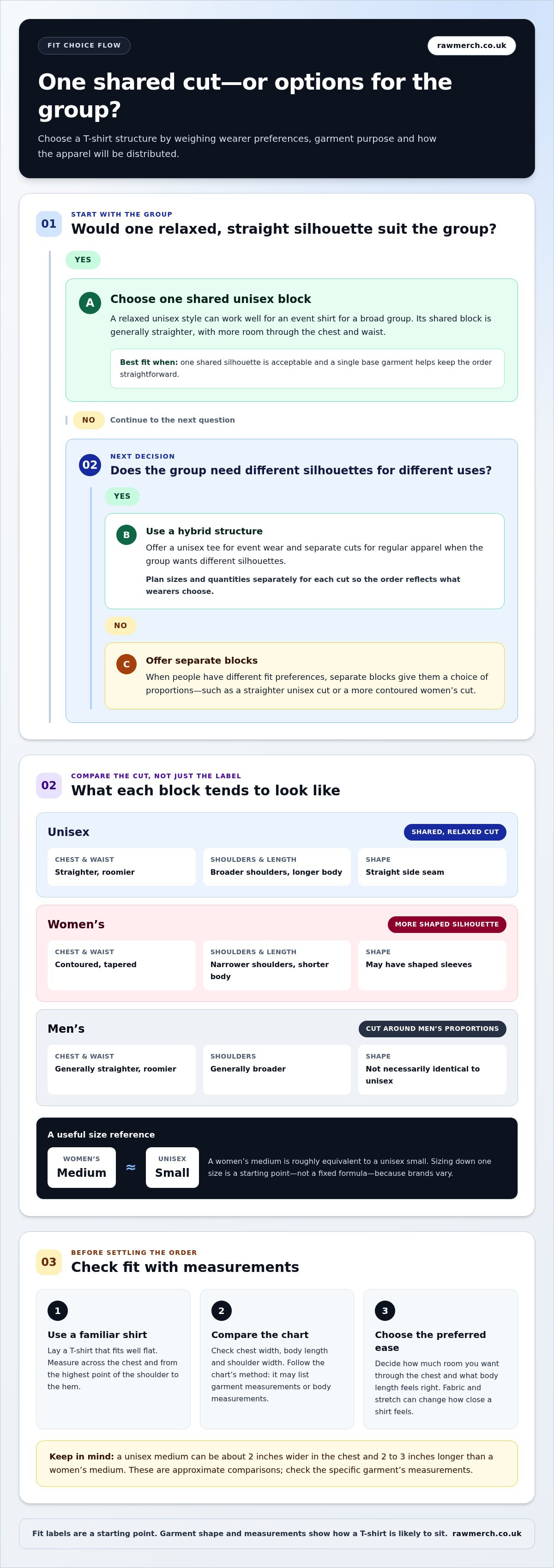
Choose the structure based on wearer preferences, garment purpose and how the apparel will be distributed. For a team order, decide whether one shared cut or separate options will better suit the group.
Fit Based on Personal Preference
Personal preference comes first: some wearers want a relaxed shape, while others prefer a closer fit. A unisex block offers one shared silhouette; separate blocks give people a choice of proportions. Ask wearers whether they prefer room through the body or a more shaped fit. Then compare sample measurements, including chest width and body length, with shirts they already like.
Fit Choices for Custom T-Shirts
For custom T-shirts, match the cut to the purpose and intended wearer. A relaxed unisex style can suit an event shirt for a broad group. A shorter, narrower cut may work better for someone who prefers a more fitted shape. Before choosing the style, compare the size chart and garment measurements, not just labels such as medium.
A hybrid approach offers options rather than asking one cut to suit every preference. For example, a team could choose unisex tees for event wear and separate cuts for regular apparel. This makes sense when the group wants different silhouettes. It also means organising sizes and quantities separately for each cut, so the order reflects what wearers actually choose.
For many group orders, a unisex T-shirt is a straightforward default: one block can simplify sizing and ordering. Choose separate cuts when people specifically want different fits. For a mixed group, gather preferences first, then record each person’s chosen cut and size. If the group is small, dividing quantities between blocks can make ordering more complex, so weigh that against the value of offering a choice.
Decision guide: choose unisex for one shared, relaxed fit; separate blocks for distinct preferences; or a hybrid when event and everyday apparel need different cuts.
Women’s, unisex and men’s T-shirt fit preferences
Fit preference is individual, not a reliable shortcut based on gender. In one poll, 22 women chose ladies-style T-shirts, while 5 chose unisex styles and 5 chose men’s styles. That preference snapshot shows why a clothing choice should start with wearers’ opinions, not assumptions about who will like each garment.
Ask what people want from the finished T-shirt: a close silhouette, a straight shape or roomier everyday wear. Then collect each wearer’s preferred style and size before placing the order. For example, someone who likes a straight fit can choose a unisex style, while someone who wants more contour can opt for a women’s cut. A men’s style is another option for those who prefer its proportions.
Brands use different blocks and size charts, so labels alone won’t settle the fit. For a group, compare garment measurements across the styles you’re considering. Pay attention to shoulder width, chest and length, then let people review those details alongside the cut. This makes the choice more specific: a wearer can say they want narrower shoulders or a less shaped body, rather than simply asking for a “better fit”.
A clear fit decision also helps with printing plans. First, establish which styles the group wants. Next, record sizes separately for each chosen cut. Finally, check that the garments suit the people wearing them, whether the T-shirts are for a team, event or business. One unisex option keeps the range simpler; offering more cuts supports varied preferences but means organising each style separately.
Choose the cut around the people who’ll wear it, then make the design a shared part of the result. Create custom T-shirts for your group with a fit structure suited to its preferences.
RAW Merch: Custom T-Shirts & Hoodies
Once you’ve chosen the cut and sizing approach for your group, RAW Merch can produce custom T-shirts and hoodies for event wear, team clothing or business apparel. Decide whether one unisex fit suits everyone or whether you want to offer a choice of cuts. Then gather preferred sizes and garment measurements to guide your selection.
A clear fit plan helps keep the order suited to the people who’ll wear it. To turn your choice into custom clothing, contact RAW Merch to discuss your project.
Make Your Fit Choice Work for the Whole Project
Your choice between unisex vs women’s fit T-shirts can shape how people feel wearing a shared design. Make a clear plan by noting the intended wearer, the setting and the fit preferences that matter most. For a team or event, gather those preferences before choosing a garment structure. This gives your clothing project a practical direction, rather than leaving fit as a last-minute detail.
Consider the wider presentation, too. Promotional items or headwear can complement a coordinated clothing project when they suit its purpose. Keep the selection focused on what people will use and wear, and let fit guide your next design decisions.
RAW Merch can help you take the next step with your project. Contact RAW Merch about T-shirt fits to discuss the direction you have in mind. A considered fit choice gives your design a strong starting point. Make it a project your group can wear with confidence.
Frequently Asked Questions
What is a Women’s Cut T-Shirt?
What about the fit of women’s styles?
Women’s styles can feel closer or more shaped than a straight-cut T-shirt, but the exact fit depends on the garment. In everyday women's fashion from retailers like Love Delina, cuts are typically tailored to complement natural curves. When comparing unisex vs women's fit T-shirts, consider whether you want the fabric to drape loosely or follow your shape. A close-fitting style may work well under a jacket, while a roomier shape can suit casual wear. Consider how it feels in motion, too.
What is a unisex size in women’s sizes?
A women’s medium is roughly equivalent to a unisex small as a starting point. That comparison doesn’t guarantee the same fit, because brands use different measurements and proportions. If you usually wear a women’s medium, compare the unisex size chart with a shirt you own. Choose based on the garment’s chest and length measurements, as well as how much room you prefer.
What is unisex style?
Unisex describes a garment cut and labelled for wearers of different genders. In T-shirts, it commonly refers to a shared cut rather than a shape patterned around each wearer’s proportions. For example, a group choosing matching shirts might select one unisex style for a consistent look. The label describes the intended fit category, not a guarantee that the shirt fits everyone identically.
What is the difference between unisex and women's fit T-shirts?
The choice between unisex vs women's fit T-shirts largely comes down to proportions and preferred silhouette. A unisex T-shirt typically uses a shared, straighter block; a women’s-fit style is generally shaped around different body proportions. Think about where you want more room and how you want the shirt to sit. Measurements from a familiar T-shirt can help you pin down your preference.
How do unisex and women's T-shirt cuts differ in shoulder, waist and hip shape?
Unisex cuts generally have straighter side seams and shared shoulder proportions, with less shaping through the waist and hips. Women’s cuts are often more contoured in those areas. To compare two garments, lay each flat and look at the shoulder line and side seams. This helps you see whether the shape is straight or tapered before deciding how you want it to fit.