

78.5% of UK shoppers have abandoned their online shopping carts due to high shipping prices, yet many businesses still treat logistics as an afterthought. When you see a low unit price for a hoodie, it's rarely the final figure you'll pay. The hidden costs of custom merchandise, such as screen printing setup fees ranging from £15 to £30 per colour, can quickly drain your budget if you aren't prepared. At RAW Merch, we've spent over 25 years delivering quality because we know what you want; we deliver on time everytime.
You want a clear price, but the final invoice often feels like a moving target. We agree that transparency is the only way to build a brand that lasts. This guide will show you how to manage the 20% UK VAT rate and the new EU customs rules, including the €3 duty per item starting July 2026. You'll learn how to avoid the £50 digitizing fees and £15 small run charges that catch beginners off guard. We are giving you the facts on UK shipping rates and new 2026 labelling laws so you can secure high-quality products without a single surprise fee at checkout.
Key Takeaways
- Learn why the lowest online quote usually isn't the final invoice you'll receive at checkout.
- Identify the hidden costs of custom merchandise like screen setup fees and artwork prep to keep your project on budget.
- Prepare for 2026 logistics reality by understanding how VAT and weight-based shipping impact your total distribution costs.
- Protect your brand's reputation by avoiding "cheap" garments that fail the wash test and cost double to replace in the long run.
- Boost your bottom line by standardising your clothing styles and consolidating small orders into one efficient bulk run.
The Unit Price Myth: Why Your Quote Isn't the Final Bill
Don't let a low unit price fool you. It's the oldest trick in the industry. You see a t-shirt advertised for £3 and think you've found a bargain, but by the time you reach the checkout, that price has often doubled. The hidden costs of custom merchandise are any expenses that go beyond the base garment price. This includes technical setup, art prep, and logistics. At RAW Merch, we've spent 25 years being straight with our clients. We know what you want; we deliver on time everytime. A transparent quote is the mark of a professional partner. Anything else is just a "discount site" trap designed to bury markups in the fine print.
When planning your budget, you must look at the Total Cost of Ownership (TCO) rather than just the unit price. If you buy 100 shirts but pay £50 in processing fees and another £40 for artwork optimization, your per-item cost isn't what you thought it was. High-quality Promotional merchandise should be an investment, not a series of financial surprises. Understanding the full breakdown allows you to protect your brand and your bottom line from the start.
Visible Costs vs. Stealth Expenses
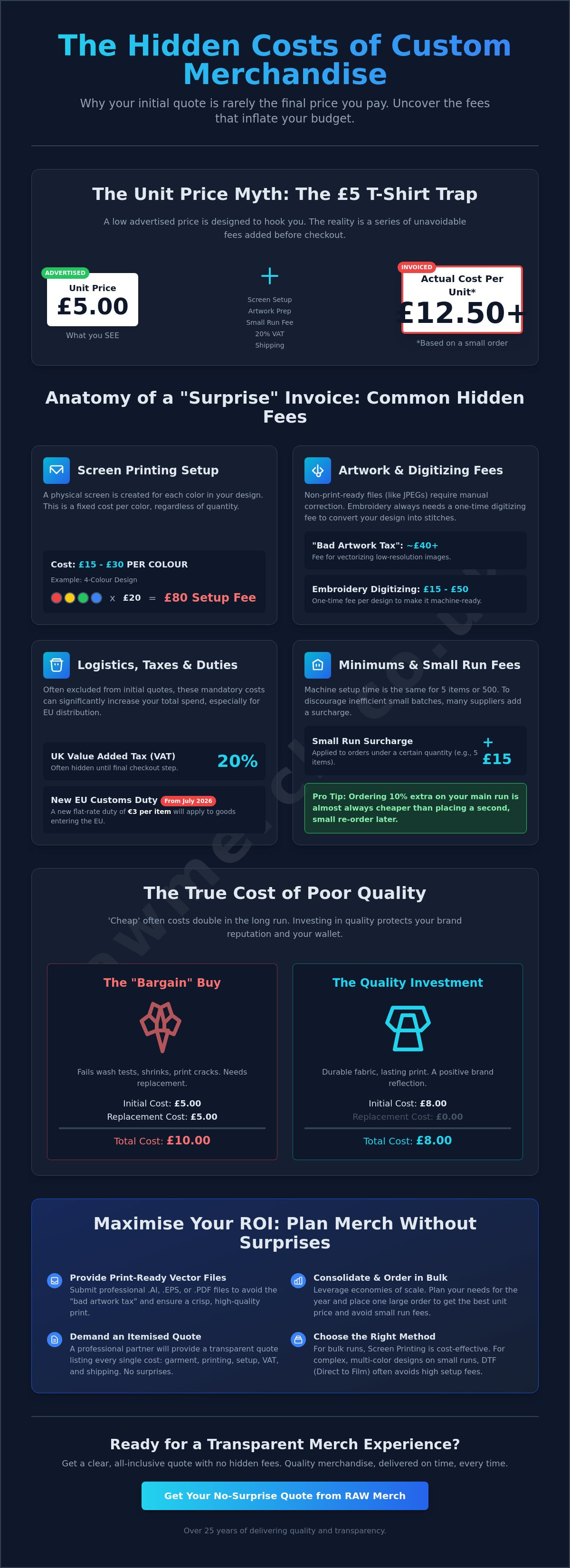
You expect to pay for the garment and the clothing printing. You don't always expect the stealth expenses that appear on the final invoice. For screen printing, you will face setup fees of £15 to £30 per colour because each one requires a separate physical screen. If you want embroidery, there is a one-time digitizing fee between £15 and £50 to make your file machine-ready. Then there is the 20% UK VAT. Many discount sites hide this until the very last click. We recommend asking for a no-obligation quote that includes every penny. If a supplier can't show you the full breakdown upfront, they aren't the partner you need.
The Role of Quantity in Real Pricing
Economy of scale is the engine of the printing industry. In screen printing, the setup time is the same whether you print 10 shirts or 1,000. This is why small runs carry a heavy financial burden. For example, as of January 2026, some UK companies charge a £15 fee just for orders of 5 items or fewer to cover machine calibration. The setup time often exceeds the actual production time for these tiny batches. Ordering 10% extra usually costs less than coming back for a second small run later. Plan your year ahead to hit those bulk price breaks and keep your per-item cost as low as possible.
Technical Setup and Design: The Fees You Didn't See Coming
Technical errors are the fastest way to blow your marketing budget. When you send a low-resolution JPEG from your phone, you are essentially asking for a manual labour surcharge. Most people don't realise that 90% of UK manufacturers bear the cost of samples reaching £200 to £300, and poor art prep makes this even more expensive. This "bad artwork tax" is a major part of the hidden costs of custom merchandise. If your file isn't print-ready, a technician has to rebuild it. This takes time, and in 2026, time is money. To truly improve your business marketing strategy, you need to account for these technical hurdles before the machines start running.
Vectoring and File Preparation
Your printer cannot use blurry social media icons. High-quality clothing printing requires precision. If you don't understand what is a vector based image, you might end up paying a designer to fix your files. A vector file allows us to scale your logo to any size without losing quality. Providing professional .AI or .EPS files from the start removes the risk of technical surcharges. It ensures your hoodies look as sharp as your creative vision intended. We know what you want; we deliver on time everytime.
Screen Printing vs. DTF Setup Costs
Choosing the wrong method can double your bill. Screen printing is the gold standard for bulk, but it carries a physical cost. You will pay a setup fee of £15 to £30 per colour because each shade requires its own screen. A five-colour design means five setup fees before a single shirt is printed. For smaller runs or complex, multi-coloured designs, Direct to Film (DTF) is often better. DTF avoids these per-colour fees, though the unit price is slightly higher. We can help you choose the right method when you contact us for a no-obligation quote.
Sampling is your insurance policy. While a physical sample might feel like an extra expense, it prevents a 500-unit disaster. Embroidery digitizing fees usually range from £15 to £50. This is a one-time cost to convert your logo into a format the machine can read. Once it's done, it's done. Paying for this setup and a single sample now saves you hundreds in potential errors later. Don't skip the prototype phase just to save a few pounds today; it's the most expensive mistake you can make.
Logistics and Shipping: The UK Distribution Reality
Shipping is often the most overlooked part of a merch budget. You might have calculated the unit price and setup fees, but if you don't account for the physical weight of your order, your margins will vanish. In 2025, 84% of UK and European businesses saw a cost increase of over 10% for last-mile delivery. This is a critical part of the hidden costs of custom merchandise. Shipping 500 hoodies is a completely different financial animal than shipping 500 t-shirts. A single medium parcel up to 2kg costs £9.30 for Royal Mail First Class as of January 5, 2026. When you multiply that across a large distribution, the numbers add up fast.
VAT is another area where people get caught out. The standard UK VAT rate is 20%, yet many online "starting at" prices conveniently omit this. If you are selling to the EU, the rules are even tighter. From July 1, 2026, the EU is removing the €150 customs duty exemption. You'll face a flat €3 duty per item plus a €2 handling fee starting in November 2026. We know what you want; we deliver on time everytime. We help you navigate these logistics so your final bill doesn't include a nasty tax surprise.
Fulfillment and Storage Solutions
Storing boxes in your spare room or office isn't free; it's a drain on your efficiency. Professional fulfillment is often the smarter move for touring acts or growing online stores. It reduces the risk of lost or damaged stock which can wipe out your profits. If you are planning a tour, check out our guide on band merchandise for specific advice on road logistics. Outsourcing your distribution means your gear is handled by experts who understand the UK shipping landscape, keeping your brand reputation solid.
Expedited Shipping and Deadlines
The "Panic Fee" is a self-inflicted cost. Waiting until the last minute can easily double your delivery expenses. Standard lead times of 7 to 10 days exist to protect your budget and ensure quality control. If you are planning for UK festivals or product launches, follow a strict lead time checklist. Shipping represents 15% to 25% of total operational costs for ecommerce businesses. Don't let a late decision push that number higher. YOU WANT IT, WE CREATE IT! But give us the time to do it right so you don't pay for unnecessary air freight or courier surcharges.
The True Cost of Poor Quality: Why 'Cheap' Often Costs Double
Buying cheap is the most expensive mistake you can make. If your logo peels off after one cycle in the washing machine, you hasn't saved money; you've thrown it away. The hidden costs of custom merchandise often manifest as "wash test" failures that destroy your brand reputation. When a fan buys a hoodie at a gig and it falls apart, they don't blame the manufacturer; they blame you. We have over 25 years of experience in the industry. We know that getting it right the first time is the only way to protect your budget. YOU WANT IT, WE CREATE IT!
A 5% error rate on a "budget" order of 1,000 items means 50 pieces of unusable stock. If you have to replace those items and pay for additional shipping, your initial savings vanish instantly. Beyond the physical loss, there is the intangible cost of a damaged reputation. In 2026, UK consumers are more focused on quality and sustainability than ever. The EU is even introducing regulations to ban the destruction of unsold textiles, pushing brands toward better production practices. We deliver on time everytime because we don't cut corners on quality. The true cost of merchandise is measured by the successful use of the final product, not the initial unit price.
Fabric Choice vs. Longevity
There is a massive difference between promotional-grade and retail-grade garments. A cheap, thin t-shirt might look okay in a mockup, but it won't survive the season. If you want a product that sells for double the price at a festival, you need a fabric that feels premium. Choosing bestsellers that fans will actually wear for years is a strategic move. High-quality clothing printing requires a stable surface. If the fabric shrinks or warps, the print goes with it. Investing in better fabric now prevents the hidden costs of custom merchandise associated with returns and replacements later.
Printing Technique Durability
New regulations like the Product Regulation and Metrology Act 2025, which came into effect on January 1, 2026, require accurate labelling of weight and unit count. Working with a seasoned expert ensures your products meet these legal standards from day one. Don't risk your brand on low-quality shortcuts that fail the first time they hit the water. Contact us for a no obligation quote and get the quality your brand deserves.
Maximising Your ROI: How to Plan Merch Without Surprises
Effective planning is your best defense against the hidden costs of custom merchandise. If you want to maximise your return on investment, you have to stop thinking in small, reactive batches. Consolidation is the key. Ordering for the entire year instead of four quarterly runs significantly reduces your total spend. You save on multiple shipping fees, which can account for 15% to 25% of your operational costs, and you hit much higher quantity breaks. Standardising your garments is another pro move. Use the same brand and style for different designs. This allows your printer to buy in bulk, passing the savings directly to you.
Part of this planning involves selecting the right products for your goals; for a deeper look at your options, BRAND NEW Promotions | Top Promo Supplier in North Texas details the various types of promotional materials and why they are vital for business growth.
Working with a partner is always better than using a faceless platform. Direct communication avoids the technical errors that lead to expensive reprints. We are seasoned experts who understand the UK market inside and out. We don't just take your order; we make sure it's right. YOU WANT IT, WE CREATE IT! We provide transparent quoting so you can protect your budget from the start.
Strategic Bulk Ordering
Don't guess your quantities. Identify the sweet spots in quantity breaks, typically at 50, 100, and 250 units. If you're close to a threshold, ordering those extra 10 shirts often lowers the unit price enough to make them virtually free. You can mix garment sizes without incurring extra setup fees, provided the design size stays the same. Plan your merch calendar at least 6 months in advance. This avoids the "Panic Fees" and keeps your budget predictable throughout 2026.
The RAW Merch Advantage
We've spent over 25 years in the industry building a reputation for reliability. Our no-nonsense quoting means we tell you the real cost upfront, including VAT and technical fees. There's no guesswork and no surprises at checkout. We know what you want; we deliver on time everytime. Our experience ensures your Creative vision becomes a high-quality reality without the stress of unforeseen expenses.
Before you pay any deposit, use this final checklist to flush out any potential hidden costs of custom merchandise:
- Does this quote include the 20% UK VAT?
- Are all screen setup or digitizing fees clearly listed?
- What is the exact lead time to avoid expedited shipping charges?
- Can I see a digital proof or physical sample before the full run?
- Is the delivery cost based on the total weight of the hoodies or t-shirts?
Take Control of Your 2026 Merch Strategy
You now have the tools to navigate the complex production landscape of 2026. Don't let low-ball unit prices or technical file errors drain your marketing budget. By standardising your garments and planning for the new EU customs rules starting in July 2026, you can completely avoid the hidden costs of custom merchandise. Quality is the only way to protect your brand's reputation and ensure your fans keep wearing your gear for years. At RAW Merch, we bring over 25 years of industry expertise to every order. We are specialists in screen printing, DTF, and embroidery, backed by reliable UK-based fulfillment and distribution. Our team ensures your creative vision becomes a reality without the stress of surprise fees. We know what you want; we deliver on time everytime.
Get a transparent, no-obligation quote for your custom merch today!
Your brand deserves results that last. Let's build a merch run that works for your business and your budget.
Frequently Asked Questions
What is a standard setup fee for screen printing in the UK?
The average cost for screen printing setup in the UK is £15 to £30 per colour. Each colour in your design requires a separate physical screen, so a four-colour design would incur four individual setup fees. These are fixed costs that apply regardless of the order size. At RAW Merch, we provide a full breakdown upfront so you can manage the hidden costs of custom merchandise without surprises.
Do I have to pay VAT on all custom merchandise orders?
Yes, the standard UK VAT rate in 2026 is 20% and applies to most custom merchandise and printing services. If your business turnover exceeds the £90,000 registration threshold, you must register for VAT. For international orders, new EU rules from July 1, 2026, also add a €3 customs duty per item. We ensure your quote includes these legal requirements so your final invoice is accurate.
Why is there a minimum order quantity (MOQ) for some items?
Minimum order quantities exist to make the production process cost-effective for your budget. Setting up industrial machines for screen printing or embroidery takes significant time and labor. For very small orders, manufacturers often charge a specific fee, such as £15 for runs of 3 items or fewer, to cover these setup costs. Meeting the MOQ ensures you get the best possible unit price for your clothing printing.
Can I avoid design fees by providing my own artwork?
You can avoid art preparation fees by providing print-ready vector files. If you send a low-resolution JPEG, a technician must manually rebuild it, which triggers a design surcharge. Providing files in .AI or .EPS format ensures your logo is sharp and ready for the machines. We know what you want; we deliver on time everytime. High-quality files are the best way to keep your project on budget.
How much should I budget for shipping bulk hoodies?
Shipping costs typically represent 15% to 25% of total operational costs for UK ecommerce businesses. As of January 5, 2026, a medium parcel up to 2kg costs £9.30 via Royal Mail First Class. Hoodies are heavy and bulky, so they cost significantly more to distribute than t-shirts. Factor in the weight of your total order early to avoid one of the most common hidden costs of custom merchandise.
What happens if my merchandise arrives with a print error?
Reliable partners stand by their work and replace items that don't meet the agreed quality standards. A 5% error rate on a cheap order is a massive hidden expense if you have to pay for replacements and extra shipping. We use our 25 years of experience to get it right the first time. Quality control is built into our process to protect your brand reputation and your project timeline.
Are there extra costs for printing in multiple locations on a shirt?
Yes, each additional print location requires a separate setup and machine run. Printing on the front, back, and sleeve means the garment must be loaded and calibrated three times. Each location usually involves its own set of screens or digitizing fees for embroidery. Consolidating your design into one or two locations is a smart way to keep your production costs manageable while maintaining a high-end look.
Is it cheaper to provide my own blank garments for printing?
It is rarely cheaper or safer to provide your own blanks for professional printing. Most printers prefer to supply the garments because they know how the fabric reacts to specific inks and heat settings. If you provide your own items, the printer cannot guarantee the print durability or replace damaged stock from their own inventory. We source the best garments to ensure your custom merchandise meets our strict quality standards.