

Standard plastisol prints simply don't cut it anymore if you want your apparel to command premium retail prices. Modern buyers instantly feel the difference between generic promotional clothing and genuine retail-grade merchandise. If you've ever worried about muddy artwork, premature cracking in the wash, or ruined garments from improper curing, you aren't alone. That's why investing in professional specialty ink screen printing uk production has become the ultimate advantage for brands, businesses, and touring acts looking to maximise their merch margins.
This 2026 guide gives you the practical technical roadmap needed to select the ideal specialty finish for your creative vision, from tactile 3D puff and breathable discharge to striking metallic formulations. You'll discover the essential fabric compatibility rules, vector preparation standards, and production checkpoints that ensure your bulk garment runs arrive completely retail-ready and built to endure repeated commercial laundering.
Key Takeaways
- Compare high-impact tactile finishes like 3D puff, zero-feel discharge, and metallic pigments to turn standard custom apparel into high-margin retail products.
- Understand the critical fabric weight and fibre requirements needed for flawless specialty ink screen printing uk production without fabric puckering or dye migration.
- Prepare production-ready vector artwork with calibrated stroke weights and underbase allowances to stop expanding specialty inks from muddying fine details.
- Identify the core curing parameters and screen mesh counts required to guarantee retail wash-fastness across 50 or more home laundry cycles.
- Protect your production schedule and bottom line by partnering with an established UK specialist backed by over 25 years of print shop expertise.
What Is Specialty Ink Screen Printing in the UK Apparel Industry?
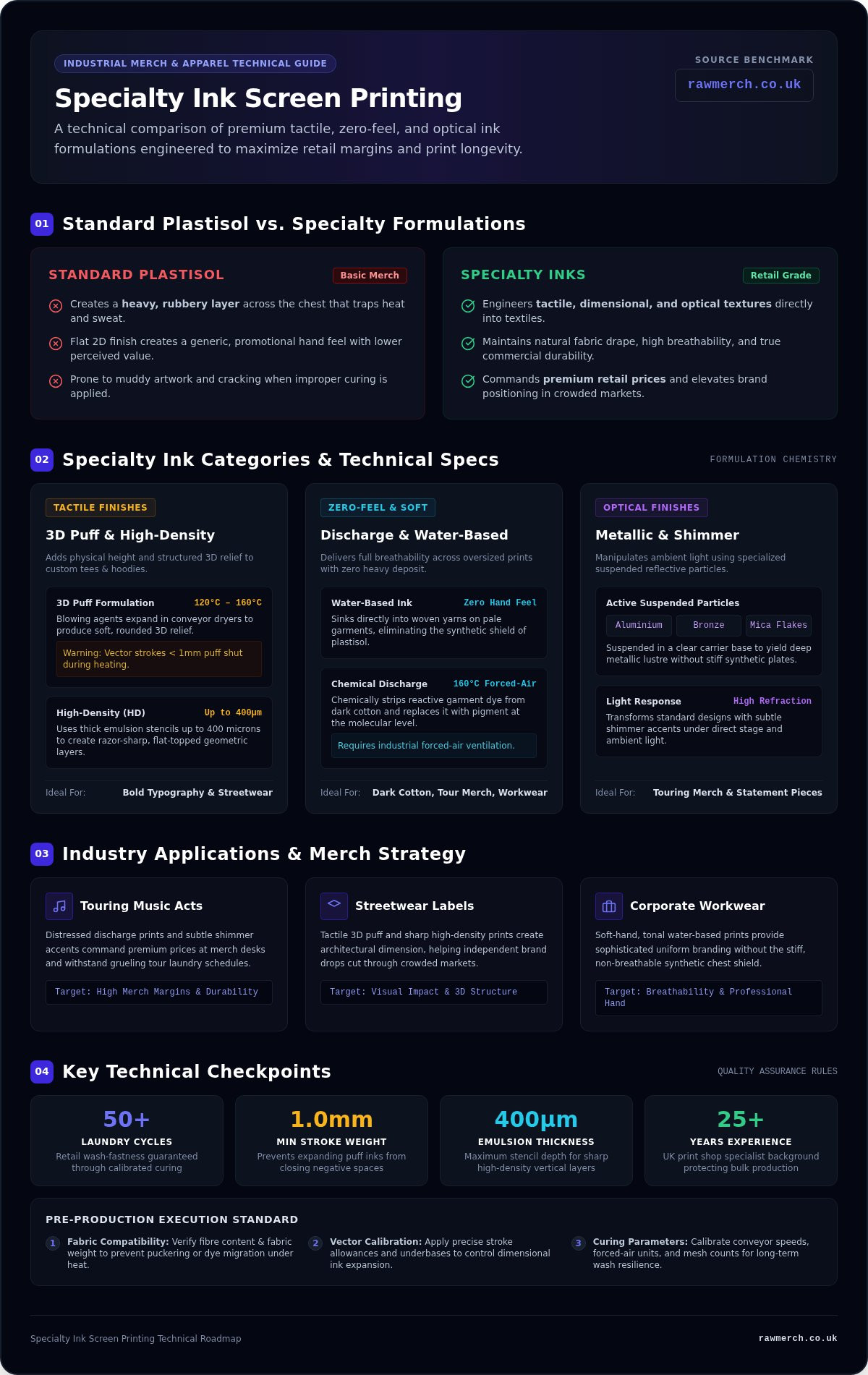
Specialty ink screen printing uk apparel decorators use isn't just about putting pigment onto fabric. It is an industrial manufacturing process that engineers specific tactile, dimensional, and optical textures directly into textiles. While hobbyists might dabble with craft jars in home studios, true commercial garment production requires industrial carousel presses, calibrated conveyor dryers, and precise chemical formulations. Specialty screen printing inks modify traditional carrier bases with expanding agents, reflective particles, or chemical discharge salts. This technical shift transforms standard custom apparel into high-end fashion goods that command genuine retail value.
Standard Plastisol vs. Specialty Formulations
Standard plastisol remains the dependable industry workhorse for bold, flat graphics. However, covering a chest with dense plastisol creates a heavy, rubbery layer that traps heat and sweat. Specialty inks solve this problem by altering the physical hand feel, vertical profile, or light response of the finished print. Understanding modern garment screen printing processes and ink formulations allows production teams to push far beyond standard flat designs. Whether activating foaming agents that expand under heat or replacing the garment dye at a molecular level, specialty inks immediately elevate custom clothing into high-margin merchandise.
Why UK Brands and Bands Choose Specialty Inks
Moving away from standard flat prints directly drives profitability for apparel lines across Britain. Independent labels, businesses, and touring artists rely on specialty techniques to achieve distinct commercial advantages:
- Touring Music Acts: Distinctive aesthetics, such as distressed discharge prints or subtle shimmer accents, command premium merch desk prices and easily survive gruelling tour schedules.
- Streetwear Labels: Tactile 3D puff and sharp high-density prints create architectural dimension, helping new collections cut through a crowded market.
- Corporate Workwear: Soft-hand, tonal water-based prints deliver a sophisticated brand impression on company uniform clothing without the stiff, synthetic shield of traditional prints.
Executing these techniques consistently across hundreds of garments demands experienced press operators. Choosing a reliable partner for specialty ink screen printing uk production ensures your visual concept converts cleanly into durable, retail-ready garments.
Comparing the Most Popular Specialty Inks for Custom Apparel
Selecting the right ink formulation dictates how a finished garment wears, breathes, and survives commercial laundering. Unlike flat plastisol, specialty formulations either build physical height on top of the fabric or react chemically with the yarn fibres. Matching the ink chemistry to garment design prevents heavy ink deposits from compromising fabric drape. Sourcing experienced specialty ink screen printing uk services ensures your apparel feels intentional, premium, and durable.
Tactile Finishes: Puff Ink and High-Density Printing
Tactile inks bring tangible three-dimensional depth to custom t-shirts & hoodies. Puff ink incorporates blowing agents that expand inside the conveyor dryer between 120°C and 160°C, creating soft, rounded 3D relief. It is ideal for bold typography and throwback streetwear aesthetics. However, tight negative spaces and fine vector strokes under one millimetre can puff shut during heating. For razor-sharp, architectural edges, high-density printing uses thick emulsion stencils up to 400 microns to build vertical, flat-topped geometric layers.
Zero-Feel and Soft Finishes: Discharge and Water-Based Inks
When you need total breathability across an oversized chest print, water-based and discharge inks outperform heavy plastisol. Water-based inks sink directly into woven yarns, leaving virtually zero hand feel on pale garments. For dark cotton shirts, discharge inks chemically strip the reactive garment dye and replace it with pigment during a 160°C forced-air cure. Following strict HSE guidance for the printing industry regarding forced air ventilation ensures these active chemical bases cure safely and cleanly on industrial presses.
Visual and Optical Inks: Metallic, Shimmer, and Reflective
Optical inks manipulate ambient light through specialized suspended particles. Metallic and shimmer inks suspend real aluminium, bronze, or mica flakes within a clear carrier, producing rich metallic lustre without the stiff crinkling of heat-applied foil. Phosphorescent glow inks charge under ambient light, delivering vibrant illumination on festival merchandise. Retroreflective inks incorporate microscopic glass beads to bounce direct light, providing striking visibility for modern streetwear and night-time urban workwear.
If you are deciding between dimensional puff or zero-feel discharge for your next project, explore the production options at RAW Merch to select the ideal finish for your artwork.
Garment Selection and Fabric Compatibility for Specialty Inks
Blank garment selection makes or breaks advanced print finishes. An ink formula that looks flawless on premium combed cotton can fail completely on a synthetic blend. Fibre composition directly dictates ink absorption, chemical discharge reactions, and edge definition. Garment weave density also impacts how evenly raised puff inks expand during curing. Lightweight shirts under 150 GSM often pucker under dense prints, whereas midweight blanks between 180 and 240 GSM offer the structural stability required for specialty ink screen printing uk decorators rely on.
Why 100% Combed Cotton Is Essential for Discharge Inks
Discharge printing relies entirely on an active chemical reaction with natural cellulose fibres. The discharge agent destroys the reactive dye in the cotton yarn, resetting it to its raw ecru state before depositing the replacement pigment. Synthetic polyester threads cannot be discharged. If you attempt this process on a 50/50 poly-cotton blend, the synthetic fibres retain their original colour, producing a faded, heathered appearance. For crisp, vibrant discharge results, always specify 100% combed ring-spun, reactive-dyed cotton blanks.
Handling Polyester and Blended Hoodies with Specialty Inks
Poly-cotton fleeces present a different technical challenge: dye migration. When synthetic yarns pass through curing tunnels above 130°C, the disperse dyes in the polyester gasify and bleed directly into wet ink layers. Applying a low-bleed blocker or a dedicated barrier underbase prevents white puff or bright metallic inks from turning a dull, muddy grey. Heavyweight streetwear hoodies weighing 350 to 450 GSM hold up exceptionally well to dense metallic shimmer and plastisol-based puff inks, maintaining crisp outer edges without distortion.
Wash Durability and Aftercare for Specialty Prints
Commercial specialty prints are built to endure prolonged wear. Selecting durable fabrics that align with the WRAP Sustainable Clothing Guide helps prolong the physical life of both the garment blank and the applied print. Properly cured specialty inks withstand 50 or more home laundry cycles when basic garment care rules are followed:
- Wash garments inside out on a cool cycle at 30°C to shield suspended metallic flakes from drum abrasion.
- Avoid harsh chemical bleaches and biological detergents that can degrade water-based binder networks.
- Hang dry naturally instead of using high-heat tumble dryers to prevent delicate puff and high-density ink edges from cracking.
Matching the correct blank to your chosen chemistry ensures your finished apparel remains vibrant and intact from the first merch drop to the fiftieth wash.
Artwork Preparation and Technical Setup for Specialty Print Runs
Specialty inks behave entirely differently on press compared to standard flat ink formulas. A file configured for standard plastisol will fail if sent straight to screens burning for puff or metallic flakes. Vector artwork must account for physical ink expansion, screen mesh tolerances, and opacity requirements. Understanding the mechanical differences behind clean vector files is essential, so review our guide explaining what is a vector image before supplying final production assets. Precision prepress setup prevents costly production delays during commercial specialty ink screen printing uk operations.
Vector Formatting and Stroke Width Rules
Supplying native vector artwork ensures razor-sharp stencil exposure on commercial screens. Different specialty inks require exact adjustments to vector line weights:
- Puff Formulations: Open up internal negative spaces and thin out strokes. Puff ink expands both vertically and horizontally under heat, causing line weights below 1.5 points to bleed together.
- Metallic and Shimmer Inks: Thicken fine vector strokes to at least 2 points. Dense, suspended metallic flakes struggle to pass cleanly through narrow stencil apertures.
- High-Density Graphics: Eliminate delicate distress textures and soft gradients. High-density stencils require clean, bold geometry with distinct outer boundaries to maintain sharp vertical walls.
Screen Mesh Selection and Viscosity Management
Screen mesh selection directly controls deposit thickness. Coarse screens between 34T and 43T (86 to 110 US mesh) allow large metallic flakes, glass microspheres, and heavy puff bases to clear the mesh without clogging. In contrast, thin discharge inks run smoothly through finer meshes up to 90T or 120T, capturing high-resolution details and fine typographic elements. Press operators balance squeegee durometer, angle, and downward pressure to lay down the exact wet ink deposit required for uniform chemical activation in the dryer.
Combining Standard Plastisol with Specialty Accents
The most striking apparel graphics use specialty inks as deliberate focal accents rather than coating the whole garment. Laying flat plastisol colour fills alongside raised puff highlights creates rich, tactile contrast that elevates the finished piece. See how thoughtful print treatments increase retail sales margins across tour products in our deep dive on band merchandise.
Ready to bring dimensional textures to your next clothing run? Get in touch with RAW Merch to review your artwork requirements before going to press.
Sourcing Commercial Specialty Screen Printing in the UK with RAW Merch
Flawless specialty printing demands rigorous press calibration, continuous testing, and decades of textile experience. An ambitious concept can easily turn into ruined stock if managed by inexperienced operators. RAW Merch delivers over 25 years of direct garment printing expertise to UK clients, turning complex creative ideas into dependable, retail-ready runs. From high-volume touring merchandise to custom branded uniform clothing, uncompromised quality control remains the core standard across every press setup. Partnering with a dedicated UK specialist guarantees your specialty ink screen printing uk production delivers maximum retail impact without costly shop-floor surprises.
Why 25+ Years of Print Experience Matters on Complex Inks
Specialty inks leave zero room for error during high-speed conveyor curing. Puff formulations collapse if under-cured and scorch if overheated. Discharge agents fail to strip garment dye if tunnel airflow drops. Decades on the print shop floor give RAW Merch technicians the exact instincts needed to dial in squeegee angles, mesh tensions, and flash-curing cycles for tricky fabric blends. That deep technical experience ensures your thousandth printed shirt matches the pre-production sample down to the millimetre.
Turnkey Production: From Garment Sourcing to Distribution
Managing apparel production means coordinating moving parts efficiently. RAW Merch provides comprehensive end-to-end support to keep your operations running on schedule:
- Targeted Garment Sourcing: Direct access to premium UK blank distributors, securing fabrics verified for reactive discharge compatibility and heavy puff adhesion.
- Industrial In-House Printing: Modern automated carousels capable of running complex multi-stage specialty jobs alongside traditional plastisol or DTF methods.
- Fulfilment and Logistics: End-to-end packing, relabelling, and logistical distribution built specifically to service touring music acts and growing clothing lines.
How to Plan Your Next Specialty Print Order
Getting your specialty run into production starts with thorough preparation. Define your garment quantities, preferred blank styles, and target retail price points early. Review your production-ready vector assets to ensure line weights match your chosen ink chemistry, keeping puff strokes open and metallic details bold. Once your art is prepped, our experienced team will review your specs, verify fabric blends, and schedule your press run seamlessly.
Request your custom specialty print quote from RAW Merch today to start producing standout retail apparel that commands top margins.
Turn Your Creative Apparel Concepts into Retail Reality
Elevating your clothing line begins with looking beyond standard flat prints. Specialty finishes provide the tactile depth, breathability, and optical impact needed to command higher retail margins. Achieving consistent results comes down to matching your ink chemistry to fabric fibres, preparing vector assets with proper stroke tolerances, and maintaining rigorous thermal curing controls on press.
When you are ready to invest in high-calibre specialty ink screen printing uk production, choosing the right partner makes all the difference. Backed by over 25 years of specialist UK garment printing and manufacturing experience, RAW Merch manages complete production under one roof, combining automated screen printing, DTF, and tour-ready fulfilment. Our dedicated team is trusted by touring bands, corporate businesses, and fashion labels nationwide to deliver complex runs without compromise. Upgrade your custom merchandise with specialty screen printing at RAW Merch and build a collection that truly stands out.
Frequently Asked Questions
What is specialty ink screen printing?
Specialty ink screen printing uses chemically engineered inks that produce unique tactile dimensions, breathable finishes, or light-reactive visual effects on textiles. Unlike standard flat plastisol, these formulations incorporate expanding puff additives, zero-hand discharge activators, or reflective particles. Sourcing professional specialty ink screen printing uk services allows clothing brands and touring acts to create premium, high-margin retail apparel that stands out in a crowded market.
Does puff screen printing ink crack or peel after washing?
No, properly cured puff ink does not crack, peel, or collapse in the wash. Retail-grade durability requires heating the garment to between 150°C and 160°C so the blowing agent expands and the resin cures completely. When applied to stable midweight garments and washed inside out at 30°C without aggressive tumble drying, puff prints reliably withstand 50 or more home laundry cycles without losing structural loft.
Can discharge ink be printed on black polyester t-shirts?
No, discharge ink cannot be printed successfully on 100% polyester or synthetic blends. Discharge chemistry relies on an active chemical reaction that only strips dye from natural cellulose cotton fibres. Synthetic polyester threads will resist the discharge salt, leaving a faint, discoloured mark rather than clean pigment replacement. For polyester garments, decorators use low-bleed plastisol barrier bases or dedicated silicone inks to prevent dye migration.
Are specialty inks suitable for detailed vector artwork?
Some specialty inks handle fine details well, while others require simplified vector art. Thin discharge inks hold high mesh counts up to 120T, capturing crisp typography and photographic halftones cleanly. In contrast, 3D puff and heavy metallic flakes require coarse screens between 34T and 43T. Puff ink also expands horizontally on the press, which means tiny negative spaces and thin lines under 1.5 points will easily merge shut.
Can you combine specialty ink with standard screen printing on one garment?
Yes, combining specialty ink with standard plastisol or water-based inks on the same garment is an industry standard technique. Press technicians set up dedicated screens for each ink formulation. Standard inks provide opaque base colours or intricate background graphics, while specialty inks highlight logos, typography, or accent details. This hybrid approach delivers dynamic visual contrast and striking physical texture without overloading the garment with excessive weight.
Why is metallic screen printing ink different from foil transfer printing?
Metallic screen printing ink suspends genuine bronze, aluminium, or mica flakes directly into a liquid binder that cures onto the fabric. This process creates a soft, flexible shimmer that moves naturally with the garment. Foil transfer printing applies a solid metallic sheet using heat-activated adhesive. While foil produces a mirror-like shine, it feels stiffer, breathes poorly, and tends to flake or dull much faster in domestic laundry cycles.
How do specialty screen printing inks affect minimum order quantities?
Specialty screen printing inks generally require commercial production batches due to the press setup involved. Preparing dedicated coarse screens, mixing reactive chemical additives, and dialling in precise conveyor temperatures make single-piece runs unfeasible. For reliable commercial specialty ink screen printing uk production, minimum order quantities typically start at 25 units. This batch threshold ensures accurate colour matching, optimal curing calibration, and strong per-unit cost efficiency across custom t-shirts, hoodies, and workwear.