

Most "vintage" shirts produced today look like cheap replicas because they ignore the technical relationship between ink chemistry and fabric. You've likely felt the frustration of a bulk order arriving with prints that feel like a thick sheet of plastic. They're too bright, too stiff, and they look nothing like the heritage pieces they're supposed to emulate. Mastering vintage style t-shirt printing requires more than just a "distressed" filter on your artwork. It demands a professional understanding of how to make new apparel look and feel like a well-loved favourite from decades ago.
We understand that you need retail-quality merchandise that gets softer with every wash. You want a finish that looks authentic and lasts; not something that cracks or peels after one cycle. This 2026 guide reveals the technical secrets to achieving a high-end, retro aesthetic for your custom apparel projects. We'll cover everything from garment selection and ink discharge techniques to communicating complex distress levels to your UK production partner. It's time to stop settling for "modern-bright" and start delivering the weathered, premium look your brand deserves.
Key Takeaways
- Learn how to master the soft-touch hand-feel and distressed textures that define authentic vintage style t-shirt printing.
- Discover why water-based inks and technical DTF crackle effects are the professional standard for achieving a retail-quality, lived-in look.
- Identify the specific fabric weights and cotton textures that ensure your garments become more comfortable with every wash.
- Understand the "Less is More" design philosophy to effectively use garment colours as part of your retro artwork.
- Leverage 25 years of UK industry expertise to scale your merchandise projects with logistical punctuality and high-volume reliability.
What Defines Authentic Vintage Style T-Shirt Printing?
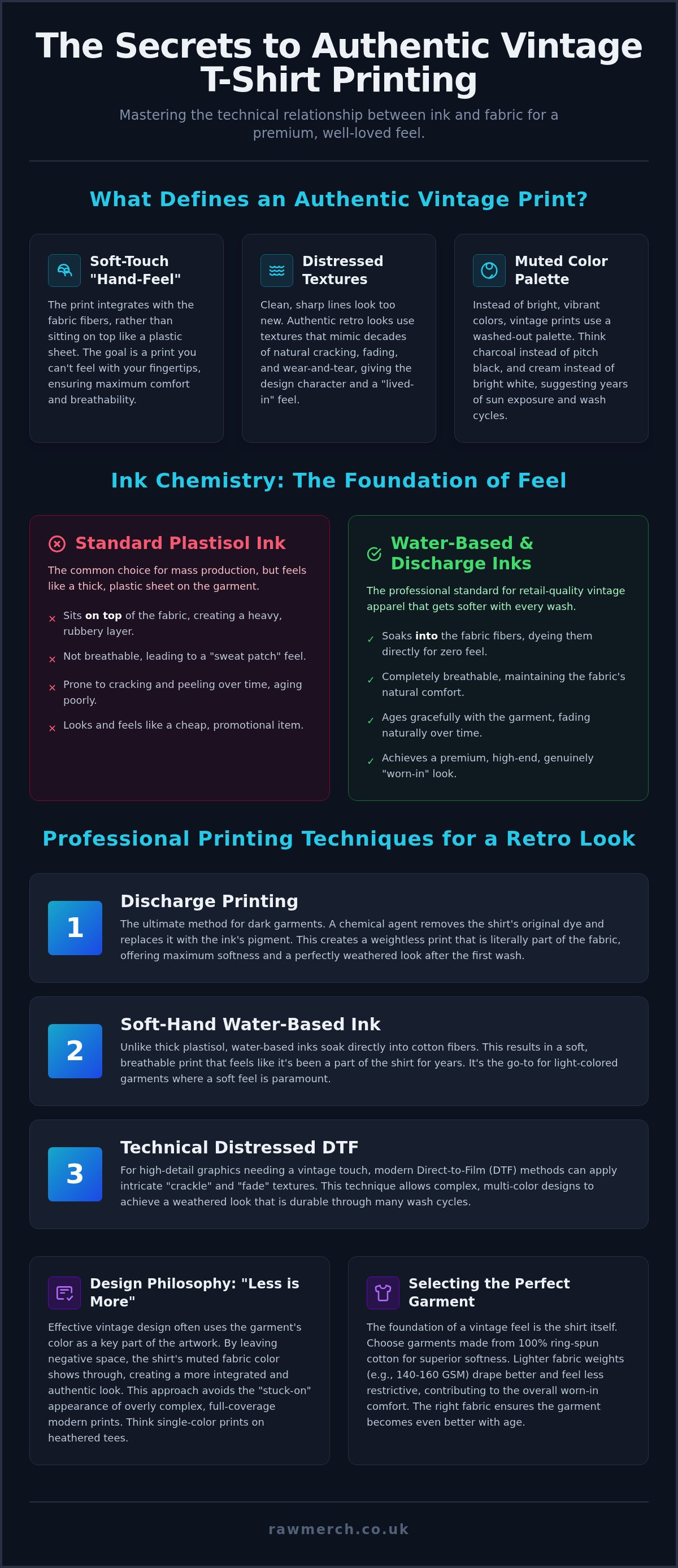
Authenticity isn't just a look; it's a physical sensation. Traditional mass production often relies on thick plastisol inks that sit on top of the fabric like a rubber sheet. Authentic vintage style t-shirt printing prioritises a "soft-touch" hand-feel where the ink integrates with the fibres. This is achieved through specific screen printing techniques that reduce ink deposits or use discharge methods to dye the fabric directly. The goal is a print that you can't feel with your fingertips.
Clean, sharp lines often look too new for a retro project. To get a lived-in look, we use distressed textures that mimic decades of cracking and natural fading. Mastering vintage style t-shirt printing in 2026 also means moving toward muted, washed colour palettes. Think charcoal instead of pitch black, and cream instead of bright white. These tones suggest a garment that has survived years of sun exposure and repeated wash cycles.
This aesthetic is the gold standard for high-end band merchandise. Fans don't want a stiff, promotional giveaway. They want a souvenir that feels like it's been in their collection since the 1980s. It's about creating an item that looks better the more it's worn. When the print ages gracefully alongside the fabric, you create a piece of clothing that people actually want to wear every day.
The Evolution of the Retro Aesthetic
The style has shifted significantly across different eras. 70s rock tees featured thin, single-colour prints. 90s streetwear introduced bolder, multi-colour graphics with a slightly heavier feel. Today, we've moved away from the thick, "bulletproof" prints of the early 2000s in favour of breathable, lightweight designs. Vintage style printing is a method that replicates decades of wear through modern technology.
Why 'Vintage' is a MOFU Powerhouse
Choosing a retro aesthetic is a strategic business move. These garments carry a higher perceived value in retail environments. Brands can command premium prices because the quality is evident to the touch. Unlike trendy graphics that date quickly, vintage styles don't go out of fashion. They tap into a deep emotional connection. Fans feel a sense of history when they wear classic merch styles. This ensures the garment stays in their wardrobe for years rather than ending up in a bin.
Technical Methods for Achieving the Retro Look
You can't achieve a genuine 70s rock aesthetic using standard production settings. Real vintage style t-shirt printing relies on technical precision and specific ink chemistry. Choosing the right method determines whether your merch looks like a premium retail item or a cheap promotional giveaway. We focus on methods that integrate the design into the fabric rather than letting it sit heavily on top.
Discharge printing is the ultimate choice for dark garments. This process uses a chemical agent to remove the original fabric dye, replacing it with your chosen pigment. Because the ink replaces the dye rather than adding a new layer, the print has zero weight. It's essentially part of the shirt. For bulk orders where comfort is non-negotiable, this is the expert's choice. It creates that sought-after weathered look that only improves after the first wash.
While screen printing is king, other methods have their place in 2026. Sublimation is perfect for all-over vintage patterns on polyester-blend tees. If you need high-detail graphics with a weathered look, distressed DTF (Direct to Film) allows us to apply intricate "crackle" textures that hold up through repeated washes. If you aren't sure which method fits your project, our team can help you choose the best printing process for your specific brand goals.
Ink Chemistry: Water-Based vs. Plastisol
Standard plastisol ink is often too heavy for retro projects. It creates a rubbery barrier that prevents the fabric from breathing. We prefer water-based inks because they soak directly into the cotton fibres. This creates a soft, breathable finish that feels like a shirt you've owned for a decade. If plastisol must be used for colour vibrance, we incorporate "soft-hand" additives to reduce the thickness and improve the drape of the garment.
Advanced Distressing Techniques
We use several digital and physical techniques to break up clean lines and create character. Digital distressing involves adding "grime" or "scuff" layers to your artwork before production. We also utilise halftone printing, a technique famously used in artistic screen printing to create gradients with tiny dots. This replicates the look of old comic books and concert posters. For complex, photographic designs, simulated process printing allows us to achieve a faded, multi-colour look without the stiff, heavy ink load of traditional methods.
Selecting the Perfect Garment for a Worn-In Feel
The print is only half the battle. High-quality vintage style t-shirt printing starts with the blank garment. If you choose a standard, bright white promotional tee, your retro design will never look authentic. You need a base that complements the ink and drapes correctly on the body. The texture of the fabric determines how the ink is absorbed and how the garment will age over time.
Ring-spun cotton is the premium choice for comfort. It's smooth and provides a consistent surface for water-based inks. However, if you're aiming for a "true" budget retro feel, open-end cotton has a slightly coarser texture that replicates old-school merch perfectly. It feels substantial and a bit rougher to the touch, which many streetwear brands prefer for that rugged, heritage vibe.
For the ultimate faded aesthetic, look for garment-dyed blanks. These shirts are dyed after they've been sewn. This process results in subtle colour variations at the seams and a soft, pre-shrunk feel. It gives you that "faded by the sun" look before the print even hits the fabric. In 2026, sustainability is a core requirement. We prioritise organic cotton and recycled blends to ensure your retro merch meets modern environmental standards without sacrificing the classic feel.
Understanding Fabric Weights and Textures
Lightweight "Softstyle" garments, typically around 150gsm, work best for 70s-inspired summer collections. They drape loosely and feel thin but durable. Conversely, heavyweight "Boxy" fits (200gsm+) are dominating the UK streetwear market in 2026. These heavier fabrics offer a structured silhouette that screams 90s vintage. They handle high-density prints and digital distressing without losing their shape or puckering.
Top Garment Recommendations
Gildan remains a cornerstone of the vintage market. Their range covers everything from basic promotional weights to premium, heavy-duty options. Check out our ultimate guide to custom t-shirt printing to find your perfect base. While 100% cotton is the standard for vintage style t-shirt printing, tri-blend fabrics are the fastest way to get an ultra-soft, heathered appearance. These blends of polyester, cotton, and rayon naturally take on a vintage look because the different fibres absorb ink at different rates, creating a textured, multi-tonal finish.
How to Design Artwork for Vintage Merch
Designing for vintage style t-shirt printing is an exercise in intentional imperfection. Modern digital design often focuses on razor-sharp lines and high-contrast colours. Authentic retro merch does the opposite. You must build character into the file before it ever reaches the production floor. This means moving away from "perfect" digital renders and embracing textures that suggest a history of wear and tear.
The "Less is More" rule is your most powerful tool. Instead of printing a solid block of ink, use the shirt colour as part of the design. By knocking out sections of your artwork to let the fabric show through, you create a natural distress effect. This also reduces the physical weight of the print, ensuring that soft hand-feel we discussed earlier. Typography is equally vital. To nail the era, you must match your fonts to the decade:
- 70s: Bubbly, psychedelic serifs and heavy, rounded letterforms.
- 80s: Sharp, geometric sans-serifs or "chrome" effect scripts.
- 90s: Rough grunge textures, typewriter styles, or classic collegiate block lettering.
Preparing your files correctly ensures these details actually show up on the final garment. If your distress textures are too fine, they might "fill in" during the screen printing process. We recommend keeping your "crackle" gaps at a minimum of 1pt thickness to maintain clarity. If you need a hand getting your files production-ready, contact our expert team today to discuss your requirements.
Vector vs. Raster for Vintage Effects
We generally recommend using vector images for the core elements of your logo. Vectors allow for infinite scaling without loss of quality, which is essential for clean screen setups. However, for authentic distressing, high-resolution raster textures are superior. You can overlay "grime" or "scuff" raster masks onto your vector shapes to create that weathered appearance. Just ensure your raster elements are at least 300dpi at full print size.
Colour Separation for Retro Prints
Classic merch rarely uses a full-colour CMYK palette. For a genuine look, limit your design to 1-3 spot colours. This mimics the technical constraints of old-school print shops. Swap out pure, bright white for "off-white" or "cream" tones. This simple change immediately suggests age and removes the "new shirt" glare. Remember that on dark shirts, the base colour will slightly influence the ink transparency, which often adds to the natural, faded charm of the finished product.
Scaling Your Vintage Vision with RAW Merch
Executing a single retro design is one thing; scaling that aesthetic across a bulk order for a national tour or a retail launch is another. Many printers handle a "distressed" look on a one-off basis. Very few have the technical infrastructure to maintain consistent, high-quality vintage style t-shirt printing across hundreds or thousands of units. We've spent over 25 years perfecting this balance. Our team understands that for high-volume band merchandise, the tenth shirt must look and feel exactly like the thousandth.
Our UK-based production facility provides the oversight needed for complex 2026 quality standards. We don't outsource your creative vision to third-party platforms. Every stage of the process happens under our roof. This ensures fast turnaround times and logistical punctuality that overseas competitors simply cannot match. If your tour starts on a specific date, your merch will be there. We also offer end-to-end fulfilment. We store your stock and ship it directly to your customers, removing the logistical headache from your plate.
Choosing the right technique is where our no-nonsense expert advice becomes your biggest asset. We don't just take orders; we provide solutions. If your artwork is too dense for the fabric you've chosen, we'll tell you. We help you navigate the technical choices between water-based inks, discharge printing, and distressed DTF to ensure the final product matches your vision. This proactive approach saves you time, money, and the frustration of a failed production run.
Why Experience Matters in Vintage Printing
The most common pitfall in custom apparel is the "bulletproof" print. This happens when a printer lacks the experience to manage ink viscosity and mesh counts. You end up with a thick, plastic-y slab on the chest that ruins the vintage feel. Our 25 years of industry tenure mean we've already solved these problems. We know how to achieve that elusive soft-hand finish that fans actually want to wear. We facilitate your creative vision without the unnecessary complication of trial and error.
Get Your Custom Quote Today
Our process is designed for efficiency. Upload your design, select your garment, and let us handle the technical heavy lifting. We specialise in bulk orders for bands, brands, and businesses looking for a reliable long-term partner. Whether you need a limited run of heavyweight streetwear or a massive replenishment of tour tees, we offer competitive bulk pricing and uncompromising quality. GET A QUOTE FOR YOUR VINTAGE PRINTS NOW and see the difference that professional expertise makes.
Dominate the Retro Market in 2026
Authentic retro apparel is about more than just a faded logo. It requires a precise combination of soft-touch ink chemistry, specific fabric weights, and intentional design textures. By choosing water-based inks and garment-dyed blanks, you ensure your merchandise feels like a premium heritage piece from the first wear. Mastering vintage style t-shirt printing allows your brand to bypass the cheap, plastic-y feel of standard promotional gear and deliver retail-quality results that fans truly value. High-end aesthetics demand technical precision; don't leave your brand's reputation to chance.
With over 25 years of experience as specialist band merch printers, RAW Merch provides the technical expertise needed to scale your creative vision. We are a UK-based and operated team committed to logistical punctuality and uncompromising quality control. We understand the physical nature of the products and the needs of serious creators. START YOUR VINTAGE MERCH PROJECT WITH RAW MERCH today and build a collection that stands the test of time. Your fans are waiting for gear they'll never want to take off. Let's make it happen.
Frequently Asked Questions
What is the best printing method for a vintage t-shirt look?
Discharge printing is the gold standard for vintage style t-shirt printing on dark garments. This method removes the fabric's dye and replaces it with pigment, resulting in a print with no physical weight. For lighter shirts, water-based screen printing is the preferred choice. Both methods ensure a soft, breathable finish that integrates into the cotton fibres rather than sitting on top like a plastic layer.
Can I get a vintage distressed effect with DTF printing?
You can absolutely achieve a retro look with DTF (Direct to Film) by incorporating digital "crackle" or "grime" textures into your artwork. While DTF typically has a slightly more noticeable feel than water-based ink, using distressed designs breaks up the ink surface. This creates a flexible, weathered appearance that maintains high levels of detail. It is an excellent alternative for complex, multi-coloured vintage graphics.
Which t-shirt blanks are best for a retro feel?
The best blanks for a retro aesthetic are heavyweight, boxy-fit shirts or garment-dyed options. Heavyweight cotton (200gsm+) provides the structured silhouette popular in 90s streetwear. Garment-dyed shirts offer a pre-faded appearance with soft, weathered seams. Brands like Gildan offer various weights that serve as the perfect foundation for your project. Choosing a textured, open-end cotton can also add to the authentic heritage feel.
Do vintage style prints fade faster than normal prints?
Vintage style prints don't necessarily fade faster; they are simply designed to age alongside the garment. Water-based and discharge inks actually become softer after several washes, enhancing the authentic "lived-in" feel. Unlike standard plastisol prints that might crack or peel in an unattractive way, these technical methods ensure the graphic remains a permanent, breathable part of the fabric for the life of the shirt.
What is the minimum order quantity for vintage style printing?
RAW Merch specialises in high-volume production for bands, brands, and businesses across the UK. We focus on bulk orders to ensure we can provide the technical precision and logistical punctuality required for major launches or tours. While we don't offer one-off retail printing, our bulk services allow us to maintain consistent quality across hundreds or thousands of units. Contact our team directly to discuss your specific volume requirements.
How do I prepare my artwork to look vintage?
To prepare artwork for vintage style t-shirt printing, you should add digital textures like scuffs or cracks in your design software. Limit your palette to one or three colours to mimic traditional screen printing constraints. Use "knockouts" where the shirt colour shows through the design to create natural distress. Ensure your texture gaps are at least 1pt thick so the fine details don't fill in during the production process.
Is water-based ink better than plastisol for retro designs?
Water-based ink is superior for retro designs because it creates a "soft-hand" finish that plastisol cannot match. Standard plastisol often feels thick and rubbery, which contradicts the breathable, weathered aesthetic of vintage apparel. Water-based pigments soak into the fabric, making the print feel like part of the garment. If plastisol is required for specific colours, we use soft-hand additives to reduce the weight and improve the drape.
How long does bulk vintage t-shirt printing take in the UK?
As a UK-based and operated specialist, we prioritise fast turnaround times and logistical punctuality. Because we handle all production and fulfilment in-house, we eliminate the delays associated with overseas shipping or third-party outsourcing. Lead times depend on your specific order volume and design complexity. We recommend contacting our team as soon as your artwork is ready to ensure your vintage merch arrives in time for your tour or launch.