

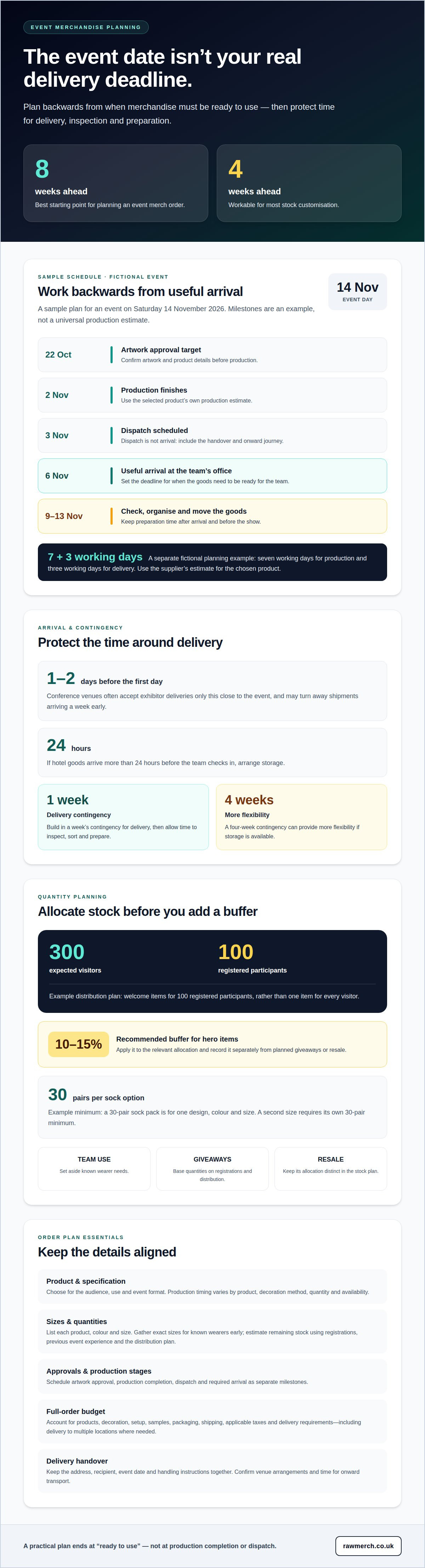
The event date isn’t your real delivery deadline. Planning your merch order for an event works best when you start 8 weeks ahead; 4 weeks is workable for most stock customisation. Set the arrival date earlier if your team needs time to inspect, sort or transport the goods.
You don’t need every apparel size settled before planning, but gather exact sizes for known wearers early instead of relying on a generic estimate. This helps you build a size mix around the people who’ll wear the items while planning other merchandise and quantities.
A clear order plan keeps your budget and delivery schedule grounded in the details that matter: product choice, branding, quantity, approval stages and delivery destination. This guide explains how to budget for the full order, work backwards from the date you need the merchandise, forecast sizes and quantities, and allow for contingency stock. You’ll have a practical checklist for turning an event date into an order plan that leaves time for preparation as well as production.
Key Takeaways
- Build a fuller budget by accounting for decoration, setup, samples, packaging and delivery requirements as well as the products.
- Leave time after arrival to inspect, sort and prepare merchandise, especially when it needs to reach a venue or another location.
- Divide stock between team use, giveaways and resale, then keep a buffer for late additions or damaged items.
- Keep the order on track with clear artwork approval, accurate quantity and size allocations, and a final check of the basket details.
Budgeting for products, decoration, shipping and delivery
Plan your budget and schedule together: the event date is not always the date the merchandise needs to arrive. Use these steps to account for product choices, quantities and every stage of the order.
Choose Products for the Event
- Match the item to the season and event format. At an outdoor summer event, lighter clothing may suit the setting; for a conference, a useful promotional item can be easier to distribute. No product sells best at every event, so base the choice on audience, use and how items will be handed out. Include packaging and delivery in your budget. UK sellers also need to account for applicable VAT and relevant product labelling and safety requirements; details depend on the item and how it is sold.
Set Minimum Quantities for Product Options
- List each product, colour and size before setting quantities. Minimums can apply separately to product options: for example, a 30-pair sock pack is for one design, colour and size, and a second size requires its own 30-pair minimum. Custom merchandise prices vary with the item, decoration, quantity and delivery needs, so there is no single typical UK price or minimum for every order. Ask for quotes on matching specifications.
Check Product-Specific Production Ranges
- Build a checklist for each product and decoration method, recording quantities, setup, samples and any packaging or assembly. Production ranges vary with the product, decoration method, quantity and availability, so avoid applying one item’s timing to the whole order. A stocked notebook with a one-colour logo usually involves less planning than a bespoke jacket with multiple branding positions and individual names. Include the selected product’s own production estimate in your schedule.
Separate Approval, Production, Dispatch, and Arrival
- Set separate dates for artwork approval, production completion, dispatch and required arrival. For example, a fictional plan allowing seven working days for production and three working days for delivery targets arrival before an event, leaving time for inspection and preparation. Keep shipping, applicable taxes, packaging and delivery to multiple locations covered in the budget. The final deadline is when goods must be ready to use, not simply when they leave production.
When to Order Merchandise Before a Big Show?
Start planning your merch order for an event by setting the date the merchandise must be ready to use, not just the event date. Compare UK quotes using the same quantities, decoration details and delivery destination. Weigh the price against the product and finish, as well as the stated delivery schedule.
Work Backward from the Delivery Deadline
- Set the arrival deadline first, then schedule approval, production and dispatch in reverse order. For a fictional event on Saturday 14 November 2026, target useful arrival at the team’s office by Friday 6 November. This leaves Monday 9 to Friday 13 November for checking, organising and moving the goods before the show.
- When planning your merch order for an event, use each agreed milestone to keep the timeline practical. In this example, artwork approval is targeted for Thursday 22 October, production finishes Monday 2 November, and dispatch is scheduled for Tuesday 3 November. Compare supplier timelines against the same final deadline, including the product specification, colour and decoration. A low quote is less useful if its schedule misses your preparation window.
- Choose the delivery route as part of the schedule. If Brick Lane collection is agreed, allow time to collect and transport the goods. For a London courier or UK delivery, include the handover and onward journey in your plan. Don’t treat dispatch as arrival.
Arrange Venue Delivery and Allow Contingency Time
- Agree venue delivery details before sending merchandise to a hotel or conference centre. Conference venues often accept exhibitor deliveries only one to two days before the first day, and may turn away shipments arriving a week early. Hotels need storage arrangements if goods arrive more than 24 hours before the team checks in.
- Build in a week’s contingency for delivery, then reserve time after arrival to inspect quantities, sort items and prepare them for distribution. If storage is available, a four-week contingency can provide more flexibility. Keep the delivery address, recipient, event date and handling instructions together so the shipment can be matched to the agreed plan.
- When comparing schedules, check how delays affect the arrival deadline and preparation period. Keep a record of the agreed artwork, product specification, colour and delivery route; these details help prevent avoidable changes from disrupting the plan.
Forecasting quantities, sizes and contingency stock
Estimate quantities using confirmed registrations, previous event experience and your distribution plan. Choose sizes and colours around known wearers, and limit variations to what your event and stock plan can support.
Estimate Quantities from the Distribution Plan
- Separate merchandise into team use, giveaways and resale before adding quantities. For an event expecting 300 visitors, the plan might include welcome items for 100 registered participants, rather than one item for every visitor. Use confirmed registrations, previous event experience and the actual distribution method to make the estimate. Keep the physical stock total alongside each allocation, so the original order can be reconciled with what happens on the day.
Add a Buffer to the Quantity Estimate
- Add a deliberate contingency for late additions or damaged stock. A recommended buffer for hero items is 10 to 15%. Apply it to the relevant allocation, then record the buffer separately from planned giveaways or resale. This makes it clear what stock is available for distribution and what is being held back. If the order is large, check availability early: an order for 500 units may exceed available stock of 300.
Choose Sizes, Colours, and Product Variations
- Collect exact sizes for known wearers before finalising apparel quantities. Use that selection to build the size mix, rather than applying a generic ratio; also confirm sizes with staff who will wear the items. Choose colours and product variations based on the event plan, and avoid adding options without a clear use. For configurable orders, read whether the quantity means finished units or packs. Keep the printed design consistent across variations where possible, and update the estimate if sizes or colours change.
Planning an event merchandise order
Plan inventory around how you’ll distribute it: for sale, team use, samples or handouts. Record each allocation alongside the physical stock count, then organise goods by item, size or collection point for storage, transport and on-site sales.
- Match quantities to the event’s purpose. For hero items, use roughly 60 to 70% of expected footfall as a starting quantity. Utility and conversation items can be planned at 80 to 100% of footfall. For VIP gifts, consider a small batch of 20 to 30 units. Adjust the estimate to your confirmed distribution plan, not footfall alone.
- Set the timeline around the launch. A dated print or annual event name can shorten an item’s useful life after the event. Choose reusable artwork if remaining stock may be used later. Completely bespoke merchandise may need an enquiry four months ahead; company-printed advent calendars for Christmas can have September as the earliest ordering time.
- Keep custom details manageable. Individual names or numbers add production and checking stages. Bespoke packaging can also need its own artwork and production timeline. Choose one named approver to consolidate feedback, then check proofs for spelling, dates, contact details, logo proportions, placement and product colour before approval.
- Prepare stock for event operations. Keep the total count beside allocations for sales, team use and samples. Sort boxes by size, team, item type or collection point to speed setup and distribution. For on-site sales, separate sale stock from giveaways and retain a clear count as items move. The checklist should cover stock, storage, transport and the person responsible at each handover.
- Use working days in the production plan. Timeline estimates in working days are not calendar weeks. Match the supplier’s production method and schedule to the actual event deadline, including time for proof approval and packing. Plan branded event merchandise with a clear allocation and launch schedule.
RAW Merch
RAW Merch can help turn your event plan into a coordinated merchandise order. Bring your product choices, estimated quantities, artwork and required arrival date so the order can be shaped around your event’s needs and schedule.
Custom T-shirts and hoodies, promotional items, headwear and laser engraving offer options for team wear, giveaways and sale stock. If you’re choosing products or arranging branded items for an event, RAW Merch can help put your requirements into production.
Contact RAW Merch to discuss your event merchandise order.
Turn Your Event Plan into a Merch Brief
Next, turn your event’s purpose into a concise creative brief. Decide what each item should do: help the team look coordinated, give attendees something useful or keep your name visible after the event. That purpose gives each product choice a clear test.
When planning your merch order for an event, consider how the merchandise fits the experience, not just how it looks in a mock-up. A useful item can travel beyond the venue, while a distinctive branded piece can give attendees a tangible reminder of the day. RAW Merch offers Custom T-Shirts & Hoodies, Promotional Items and Headwear for different event needs.
Bring your event concept and preferred merchandise direction together, then take the next step with a clear brief. Contact RAW Merch about your event order to discuss the items that fit your plans. Give your event merchandise a purpose, and move forward with confidence.
Frequently Asked Questions
Do I need exact sizes before asking for a quote?
Yes, you can request an initial quote using an estimated size breakdown. Share how many people will wear the items and any sizes already collected, then update the breakdown before approving production. For example, a staff list with confirmed sizes and a separate estimate for new starters gives a clearer basis than one total garment quantity. Mark which figures are final and which may change.
How Early is Too Early?
Planning early works well when the product and artwork will still suit the event when they arrive. The main risk is committing to dated or seasonal stock before the event format, audience or design is settled. For reusable merchandise, an early plan gives you more room to refine the brief. For seasonal items, match the design and delivery window to when attendees will use them.
How do I decide between staff uniform and resale merchandise?
Choose staff uniform when the priority is identifying the team and giving wearers consistent clothing. Choose resale merchandise when attendees are the intended customers and the design appeals beyond staff use. For example, a music event might keep crew clothing distinct from the design offered for sale. Set separate quantities and track sales stock separately from garments assigned to team members.
What information should I send first for a seasonal event merchandise quote?
Start with the event date, the date items must be ready, the product category, estimated quantity and delivery destination. Add the seasonal context, such as whether the item is for an outdoor summer gathering or a Christmas event. Include the branding method, artwork status and colour preferences. If quantities or artwork are still being developed, label them as provisional in your brief.
Why does last-minute merch cost more?
Urgent orders may require a shorter production schedule or faster delivery, which can add cost. They also leave less time to resolve artwork changes, choose an alternative product or adjust quantities if stock is limited. Same-day production is possible only for suitable orders, once stock, artwork, quantity and production capacity are confirmed. A settled brief and prompt approval help prevent avoidable late changes.
What event attendance and sales data should I use to forecast merch demand?
Use confirmed registrations, attendance at comparable events and sales by item, size or design from previous events. Include remaining stock and items that sold out, since each indicates a different limit on demand. Separate purchases from complimentary distribution. For a new event with little sales history, base your estimate on registrations and planned audience segments, then record actual sales to improve your next forecast.