

Your merch table isn't just a folding table; it's a high-speed conversion engine that fans must be able to read in three seconds from ten feet away. You've spent months perfecting the setlist and hours hauling gear, so watching fans walk past your stand without stopping is frustrating. We understand the struggle of dealing with dark venues, messy piles of stock, and long queues that kill momentum. Learning how to set up a merch table for a concert is the difference between barely covering petrol and turning a serious profit on the road.
This 2026 pro guide gives you the exact blueprint to master your display and maximise every square inch of your stand. You'll learn professional layout strategies, lighting hacks to beat the dimmest rooms, and sales tactics that turn casual listeners into lifelong customers. We're sharing over twenty-five years of industry expertise to help you speed up transaction times and build a professional brand image that matches your music. From inventory management to the final sale, this is your roadmap to a more profitable tour.
Key Takeaways
- Master your inventory by calculating per-head targets and stocking the right size breakdown to ensure you never miss a sale.
- Maximise visibility with vertical displays like grid walls and mannequins to keep your gear visible even when the venue gets crowded.
- Optimise your transaction speed with mobile-first payment systems and learn how to set up a merch table for a concert that remains organised during the post-show rush.
- Boost your per-head spending using high-impact bundling strategies and show-exclusive items that create immediate urgency for fans.
- Elevate your brand image with professional screen printing or DTF finishes and consider tour fulfilment services to handle the logistics while you focus on the music.
Pre-Show Logistics: Planning Your Merch Inventory and Layout
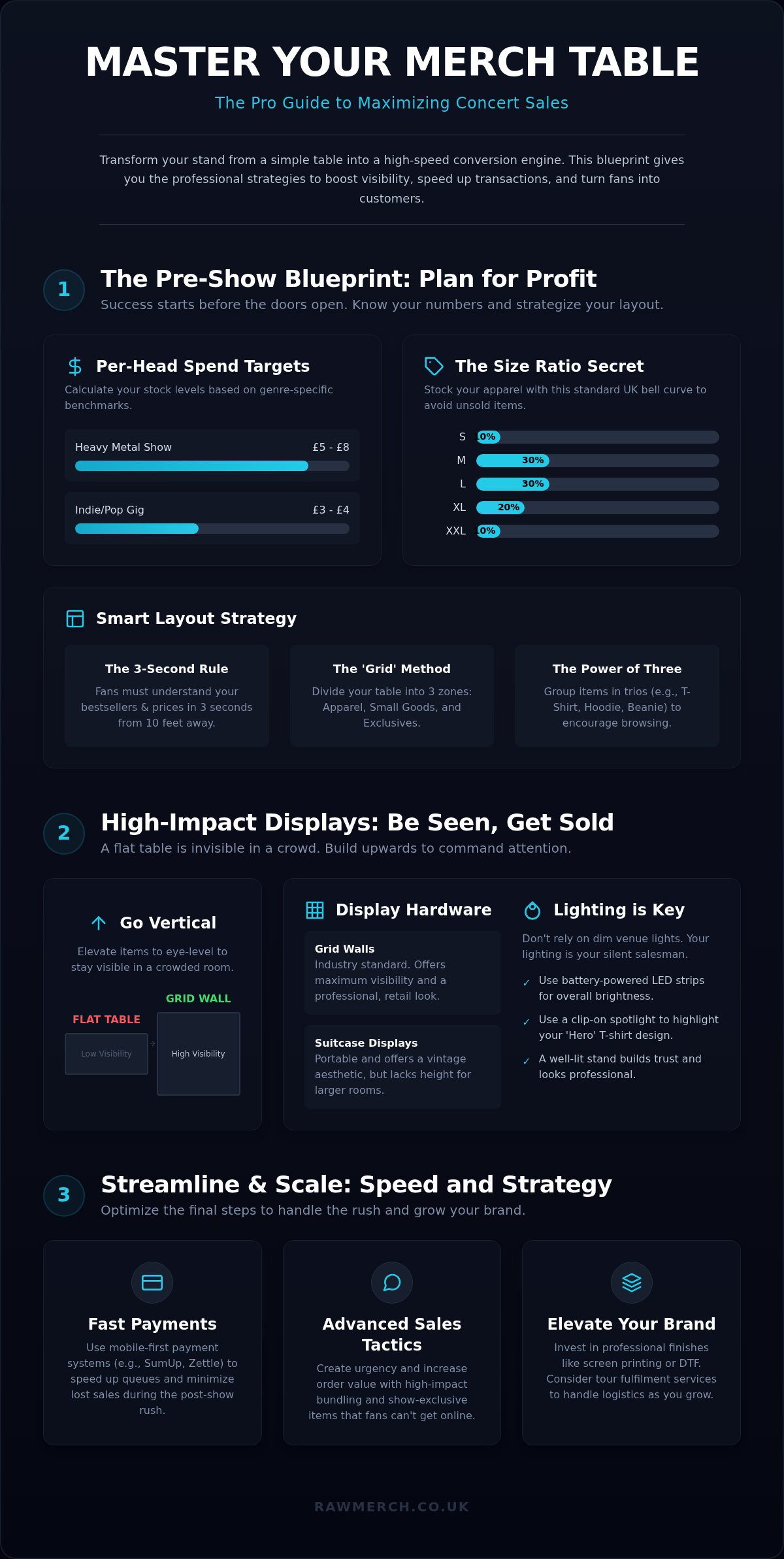
Success on the road starts long before the doors open. If you don't know your numbers, you're just guessing. Understanding the history of concert merchandise shows that apparel has always been the anchor of tour revenue. To master how to set up a merch table for a concert, you must first calculate your per-head target. This is your total projected sales divided by venue capacity. A heavy metal show might see £5 to £8 per head, while an indie gig might hover around £3 to £4. Use these benchmarks to set your stock levels and avoid hauling dead weight across the country.
Accountability is non-negotiable. Create a Master Inventory Sheet that tracks every item from the van to the table. Count in every box. Record every comp given to venue staff or the support band. Disorganised stock leads to lost revenue and phantom inventory. Your layout must also pass the Three-Second Rule. A fan should identify your bestsellers and prices instantly from ten feet away. If they have to squint or ask for a price, you've already lost the sale. Efficiency is the key to high-volume nights.
The Size Ratio Secret: What to Order
Most bands over-order smalls and under-order XLs. For a standard UK audience, follow a bell curve: Small (10%), Medium (30%), Large (30%), XL (20%), and XXL (10%). Metal fans often skew larger; indie and pop crowds might lean towards slimmer fits. Don't fear the Sold Out sign. Placing a Sold Out sticker over a size Large on your display board creates immediate urgency. It tells fans your gear is in high demand and they need to buy now or miss out. It’s a psychological trigger that drives faster decisions.
The 'Grid' Layout Method
Verticality and Visibility: Creating High-Impact Displays
A flat table is a graveyard for potential sales. Once the room fills up, your merchandise disappears behind a wall of backs and shoulders. To keep your revenue climbing, you must build upwards. Mastering how to set up a merch table for a concert means understanding that the space above the table is your most valuable real estate. If a fan at the back of the room can't see your designs, they won't even bother joining the queue. Pull your bestsellers into the line of sight using vertical displays that command attention.
Effective visibility starts with a clear signage hierarchy. Your prices shouldn't be a mystery. Use bold, high-contrast fonts that are readable from ten feet away. Professional artists often use these essential merch table tips to ensure their branding remains consistent across every venue. When you've invested in top-tier clothing printing, the last thing you want is for the artwork to be obscured by a poorly positioned price tag or a crowd of people. Clear communication reduces friction and speeds up the buying process.
Grid Walls vs. Suitcase Displays
Your choice of display hardware depends on your tour vehicle and your brand. Grid walls are the industry standard for a reason. They offer maximum visibility and allow you to hang multiple designs at different heights. While they take up more space in the van, the trade-off is a professional, retail-ready look. Suitcase displays offer a portable, vintage aesthetic that suits smaller indie acts, but they often lack the height needed for larger rooms. Choose grid walls if you have the transport capacity; the increased sales usually justify the extra gear.
Lighting Your Merch for the 'Dark Room' Effect
Venues are notoriously dim. Relying on house lights is a mistake that costs you money. Battery-powered LED strips and clip-on spotlights are essential tools for any touring professional. Use a dedicated spotlight to highlight your 'Hero' T-shirt design, making it the focal point of the stand. When you are learning how to set up a merch table for a concert, remember that lighting is your silent salesman. A well-lit point of sale area doesn't just help fans see the products; it creates a psychological sense of trust. When your table looks like a high-end shop rather than a cluttered stall, fans are more comfortable spending their hard-earned cash.
The Engine Room: Streamlining Payments and Inventory
Payment Tech: Beyond the Cash Box
Digital payments are non-negotiable for 2026 concert-goers. Most fans don't carry physical wallets, let alone cash. You need a mobile-first strategy using reliable hardware like Square or Zettle. These systems do more than just take money; they provide real-time data on what's selling. Prepare for "Dead Zones" in basement venues or remote festivals. Ensure your POS terminal supports offline mode so you can process transactions without a Wi-Fi signal. Syncing your tour POS with your online store prevents overselling and keeps your inventory levels accurate across all platforms.
Inventory Management on the Road
Accuracy at the end of the night is essential for your profit margins. Venue commissions, or "merch cuts," are a reality of touring. In the UK, venues often take between 15% and 25% of gross sales. An incorrect count-out means you're paying commission on items you didn't actually sell. Use barcodes or QR codes to scan items instantly. This removes human error and drastically speeds up the checkout process.
The "End of Night" count-out is your most important ritual. Compare your physical stock against your POS report every single night. This prevents the "phantom stock" nightmare where your records show a box of hoodies that doesn't exist. If you want to focus on the music while the logistics are handled, consider a professional fulfilment partner. High-quality clothing printing and reliable distribution ensure your fans get the gear they want without the touring headaches. Even in a digital world, keep a small cash float. A £50 mix of fivers and coins is usually enough to satisfy the few fans who still prefer paper. Knowing how to set up a merch table for a concert requires mastering these small, logistical details that keep the operation running smoothly.
Advanced Sales Tactics: Bundling and the Human Element
Mastering how to set up a merch table for a concert is only half the battle. Once the gear is visible and the payment systems are live, you need a strategy to drive the transaction. Selling merch isn't a passive activity. It requires active engagement and a deep understanding of fan psychology. You want to move from being a shopkeeper to an experience provider. This is where your profit margins truly expand. Every interaction at the table is an opportunity to turn a casual listener into a lifelong customer.
Bundling is your most powerful tool for increasing revenue. A fan might hesitate at a single T-shirt, but they'll often jump at a 'Tour Pack' that includes a shirt, a vinyl record, and a sticker. This increases your average transaction value instantly. It feels like a deal for the fan while you clear multiple inventory lines in one go. If you need more inspiration on product types, check our Band Merchandise: A Complete Guide to Creating & Selling Merch. Successful artists also use upselling at the point of sale. A simple question like "Would you like a sticker for a pound?" can significantly boost your end-of-night totals.
Drive urgency with show exclusives. Create a design that is only available on this specific tour or at this specific venue. FOMO is a massive motivator in the music industry. If a fan knows they can't buy that shirt online tomorrow, they'll buy it at the table tonight. Your merch person must reinforce this. They aren't just a cashier; they are a brand ambassador. They should be standing, making eye contact, and engaging with fans about the setlist. An approachable person behind the table makes the brand feel human and accessible.
The Art of the Bundle
Price your bundles so the savings are obvious. If the items cost £45 separately, offer the bundle for £40. You can also use 'Mystery Bags' to move older stock or slower-selling designs. Fans love the surprise, and it helps you maintain a fresh inventory. Don't forget the power of the stage. A quick shout-out from the lead singer about the new tour hoodie can double your traffic during the post-show rush. It is a critical step in how to set up a merch table for a concert that actually sells out.
Engagement Tactics for the Table
Keep your body language open. Avoid sitting down or looking at your phone; it creates a barrier between you and the fan. Use the 'Open Table' concept by keeping the area clean and inviting. This is also a prime time for data collection. Place a QR code on your price list that links to your mailing list sign-up. You can offer a small discount or a free digital track in exchange for their email address. This turns a one-time sale into a long-term marketing asset. For high-quality results, contact us for custom clothing printing that your fans will be proud to wear.
Scaling Up: Professional Production and Fulfilment
You can master every display trick in the book, but if your product quality is low, your sales will hit a ceiling. Professional production is the foundation of any successful tour. Fans pay a premium for concert gear. They expect retail-grade quality that survives the wash and the rigours of the road. When you are learning how to set up a merch table for a concert, you must consider the physical footprint and quality of your stock. High-quality hoodies and headwear take up more space than T-shirts, but they offer significantly higher margins and better brand perception.
Partnering with a seasoned UK expert like RAW Merch ensures logistical punctuality. With over 25 years of industry experience, we understand that your merch needs to be at the venue before the doors open, not the day after. We specialise in clothing printing that stands out in a crowded room. Whether you need custom T-shirts, hoodies, or bespoke promotional items, our focus is on providing a reliable service that empowers your creative vision.
Choosing the Right Print Method for the Road
Screen printing remains the industry standard for high-volume tour shirts. It offers unmatched durability and a professional finish that fans recognise. For more complex, multi-colour designs or smaller runs, DTF (Direct to Film) is an excellent choice. It allows for vibrant details and intricate artwork with smaller minimum order quantities. To get the best results from any print method, your artwork must be perfect. Check our guide on What is a Vector Image? A Simple Guide for Merch Printing to ensure your designs are production-ready.
Outsourcing the Logistics: Fulfilment & Distribution
Lugging fifty boxes of hoodies in a splitter van is a logistical nightmare. The tour fulfilment model changes the game. By letting experts handle the storage and distribution, you free up van space and mental energy. You can manage your online sales and tour stock from a single UK-based hub, ensuring consistency across all channels. This level of organisation is a vital part of how to set up a merch table for a concert at a professional level. It allows you to focus on the performance while the logistics are handled by specialists. Get a custom quote for your next tour's merch from RAW Merch and let us handle the heavy lifting for your next run of shows.
Drive Your Tour Revenue Forward
Mastering layout and inventory management is the first step toward a profitable tour. You've learned that verticality and lighting are essential for visibility in dark venues. Streamlining your payments and using bundling tactics will keep your queues moving and your per-head spending high. Implementing these strategies for how to set up a merch table for a concert ensures your brand looks as professional as your music sounds. It’s about creating a high-speed conversion engine that works even when you're on stage.
With over 25 years of industry experience, RAW Merch is your seasoned partner for high-durability screen printing and DTF finishes. We provide specialised UK-wide fulfilment and distribution services, allowing you to focus on the performance while we handle the heavy lifting. Don't let poor logistics or low-quality prints hold your tour back. Ready to level up your tour merch? Get an instant quote from the UK's custom printing experts at RAW Merch. Your fans are waiting for gear they'll be proud to wear. Make sure you're ready to deliver.
Frequently Asked Questions
How much merchandise should a band bring to a show?
Bring stock based on a per-head calculation of venue capacity. For a 200-capacity room, aim for 40 to 50 T-shirts across a standard size ratio. It's better to have a small surplus than to lose sales during the post-show rush. Always factor in your genre's typical spending habits. Metal fans often buy more apparel, while indie crowds might lean toward smaller promotional items. Knowing how to set up a merch table for a concert involves precise inventory planning.
Should I accept cash or card at my merch table in 2026?
You must prioritise card and contactless payments to survive in 2026. Most fans no longer carry physical cash, so relying solely on a cash box will cost you significant revenue. Use mobile POS systems like Zettle or Square to process transactions quickly. While card is king, keep a small £50 float for the occasional fan who prefers cash. Fast, digital transactions reduce queue times and ensure you don't miss out on impulsive purchases.
What is a 'venue cut' and how does it affect my pricing?
A venue cut is a percentage of your gross sales taken by the venue for the right to sell merchandise. In the UK, this typically ranges between 15% and 25%. You must account for this when setting your retail prices. If a venue takes a large cut, ensure your margins on custom T-shirts and hoodies are high enough to cover the fee. Always verify the specific percentage in your performance contract before you arrive at the venue.
How do I make my merch table visible in a dark venue?
Visibility in a dark room requires vertical displays and dedicated lighting. Use battery-powered LED strips to outline your price list and clip-on spotlights to highlight your hero designs. Elevating your gear on grid walls ensures it stays visible even when the room is packed with fans. If people can't see what you're selling from the back of the room, they won't join the queue. Effective lighting is a silent salesman for your brand.
What are the best-selling merch items for small bands?
T-shirts remain the best-selling items for bands of all sizes. They act as the anchor for your revenue, followed closely by hoodies for higher profit margins. For fans with less to spend, stock low-barrier promotional items like stickers, badges, and patches. These small goods encourage impulse buys at the end of a transaction. High-quality clothing printing ensures these items last, turning every fan into a walking billboard for your music and brand.
Who should run the merch table if we don't have a dedicated person?
Hire a trusted friend or a local street team member to handle sales if you don't have a touring merch manager. Some bands also use a merch swap with support acts to ensure the table is always manned. Avoid leaving the table unattended at any point during the night. A dedicated person allows band members to focus on the performance and fan engagement while ensuring every potential sale is captured during the busy peak periods.
How do I prevent merch theft during a busy concert?
Prevent theft by keeping your main inventory behind the table and out of reach. Use display-only items on the table surface and secure them with clips or tape. Never leave your cash float or card terminal unattended, especially during the post-show chaos. If the venue is particularly crowded, consider having a second person to help watch the stock. Learning how to set up a merch table for a concert safely protects your hard-earned tour profits.
Is it worth selling vinyl at the merch table anymore?
Vinyl is absolutely worth selling as it remains a premium collector's item for dedicated fans. While it is heavier to transport, the high perceived value and larger profit margins make it a staple for the merch table. Many fans buy vinyl at shows as a memento, even if they primarily stream your music online. Ensure you have sturdy mailers or bags available to protect the records during the rest of the gig.