

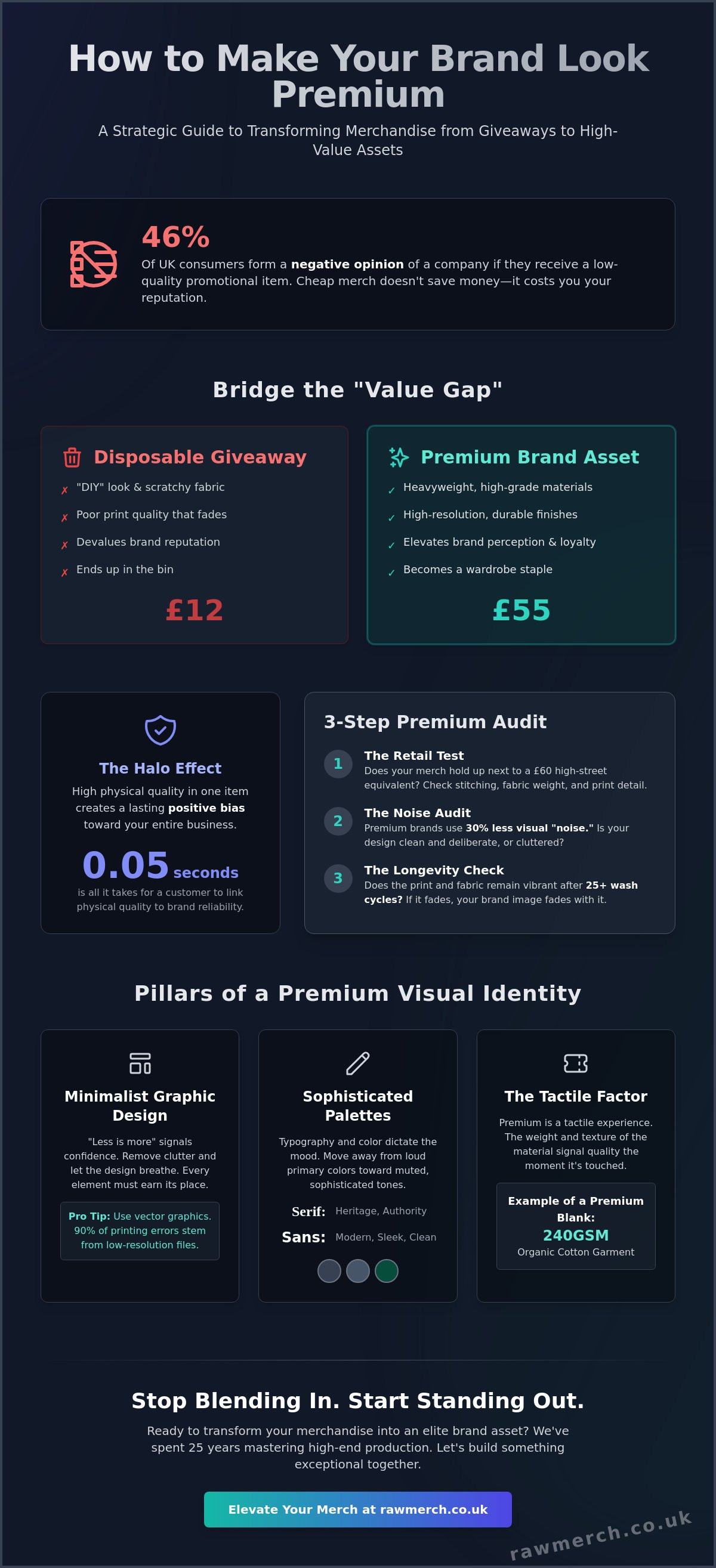
Most businesses treat merchandise like a cheap handout, but a 2023 industry report found that 46% of UK consumers form a negative opinion of a company if they receive a low-quality promotional item. You've likely felt that disappointment yourself when opening a delivery of "DIY" looking prints and scratchy fabric that belongs in the bin. It's frustrating to spend your budget on products that actually devalue your reputation. At RAW Merch, we've spent over 25 years proving that your gear should work as hard as you do.
This guide reveals exactly how to make your brand look premium by shifting from disposable giveaways to high-value assets. We're sharing the strategic design and production secrets we use to transform standard business apparel into elite merchandise. You'll get a clear roadmap to elevate your brand perception, including which specific printing methods look most high-end and how to choose materials that drive genuine customer loyalty. It's time to stop blending in and start standing out.
Key Takeaways
- Discover how to bridge the "Value Gap" and command higher prices by mastering the intersection of exclusivity and high-quality production.
- Learn the design secrets behind a sophisticated visual identity, including how to use negative space and typography to signal confidence.
- Understand how to make your brand look premium by selecting the specific fabric weights and high-end blends that signal quality the moment they are touched.
- Build a professional Merch Style Guide to maintain total brand consistency across your entire range, from custom stickers to luxury hoodies.
- Follow our expert UK sourcing guide to secure elite-level blanks and high-resolution finishes that guarantee a sharp, professional result every time.
What Does a Premium Brand Actually Look Like in 2026?
In 2026, premium isn't about being flashy. It's the precise intersection of exclusivity, high-grade materials, and restrained design. You see it in the heavy weight of a hoodie and the subtle, deliberate placement of a logo. Many businesses fail because they don't bridge the "Value Gap". This gap explains why a customer happily pays £55 for a custom heavyweight sweatshirt while a basic £12 promotional version stays on the shelf. It isn't just the fabric; it's the psychological trigger of status and perceived longevity.
Developing a deep understanding of brand identity fundamentals helps you bridge this gap. You aren't just selling a product. You're selling a promise of quality that lasts. Premium represents accessible excellence. It's the best possible version of a functional item. Luxury, by contrast, relies on exclusive scarcity and high price floors to keep people out. If you want to know how to make your brand look premium, focus on delivering a retail-quality experience that feels earned rather than just bought.
The Psychology of High-End Perception
Customers link physical quality to brand reliability within 0.05 seconds of contact. Handing out a thin, poorly printed shirt tells the world your business is disposable. Cheap merch doesn't save money; it costs you your reputation. Learning how to make your brand look premium involves moving beyond basic logos and focusing on the tactile experience. The Halo Effect in custom merchandise is the psychological process where the high physical quality of a single branded item creates a lasting positive bias toward every other aspect of your business.
Premium vs. Professional: Knowing the Difference
Professional is your baseline. It means you showed up and followed the rules. Premium is the aspirational goal. It's the difference between a standard t-shirt and a 240GSM organic cotton garment with a bespoke hem tag. One is a uniform; the other is a wardrobe staple.
Audit your brand perception in three steps:
- The Retail Test: Place your merch next to a £60 high-street equivalent. Does the stitching and print quality hold up?
- The Noise Audit: Review your designs. Premium brands often use 30% less visual "noise" than budget alternatives to create a cleaner look.
- The Longevity Check: Ensure the print and fabric remain vibrant after 25 wash cycles. If it fades, your brand image fades with it.
Strategic Visual Identity: Design Principles for High-End Perception
High-end perception relies on the "less is more" philosophy. When you use negative space effectively, you signal that your brand is confident enough to let the design breathe. This isn't about being empty; it's about being deliberate. Following established visual principles for a premium brand helps you understand that every element must earn its place on the canvas. If you want to know how to make your brand look premium, start by removing the clutter.
Typography dictates the mood of your entire identity. Serif fonts often feel like they have heritage and authority, making them perfect for brands that want to feel established. Minimalist sans-serif fonts feel modern, sleek, and efficient. Understanding how to make your brand look premium involves moving away from loud, primary colours toward muted, sophisticated tones. A 2023 industry report on luxury aesthetics found that palettes featuring charcoal, slate, and sage are perceived as more expensive than high-saturation palettes. Consistency is the final piece of the puzzle. Your physical merch must match your digital assets perfectly to create a unified brand system that builds trust.
Mastering Minimalist Graphic Design
Simplify your logo until only the core identity remains. If your design relies on complex gradients or drop shadows, it will likely look dated and low-budget when printed. These effects often fail to translate well to physical products. For professional results, always use vector graphics. Vectors ensure your lines stay crisp and sharp at any scale, whether you are printing a small neck label or a massive banner. We've seen that 90% of printing errors stem from low-resolution files, so keep your source files clean.
The Role of Texture and Finish
Premium merch is a tactile experience. It's not just about the 2D design; it's about how that design sits on the material. Tonal printing, such as black-on-black or navy-on-navy, is a classic move that adds a subtle, high-end feel to apparel. It shows you don't need to shout to be noticed. For non-apparel items like metal water bottles or wooden tech accessories, specialty finishes like laser engraving offer a level of permanence and quality that standard ink cannot match. These details turn a simple product into a keepsake. If you're ready to elevate your physical products, explore our custom merchandise range to find the perfect finish for your project.
The Tactile Factor: Choosing Materials That Feel Expensive
Your customers feel your brand before they even read your logo. If you want to know how to make your brand look premium, start with the fabric weight. Grams per Square Metre (GSM) is the industry standard for quality. A cheap promotional t-shirt usually sits around 135 to 145 GSM. It feels thin, looks translucent under bright lights, and loses its shape after one wash. Premium garments jump to 180 or 220 GSM. This weight provides a structured drape that communicates value instantly.
Material choice is your next big decision. Standard carded cotton is often scratchy because it contains short, uneven fibres. We recommend organic or ringspun cotton for a superior finish. These materials undergo a refining process that softens the yarn and increases durability. For a true luxury feel, heavyweight blends or French Terry fabrics are the way to go. These materials hold their shape and provide a smooth, high-end canvas for your designs.
Retail-ready features separate professional merchandise from amateur giveaways. Ditch the boxy, "one-size-fits-none" cuts that look like 1990s gym gear. Modern consumers expect a tailored fit with side-seamed construction. Small details make a massive impact. Use tear-away labels and replace them with custom neck printing. This shows you've invested in your own private label rather than just printing on a blank someone else made. We know what you want, and it starts with these small, professional touches.
Embroidery vs. Screen Printing: The Premium Debate
Embroidery is the gold standard for corporate and high-end workwear. It adds a physical 3D texture and a sense of permanence that ink cannot match. It's incredibly durable and stays looking sharp for years. For a modern streetwear vibe, high-quality screen printing or DTF (Direct to Film) is often better. These methods allow for intricate detail and a "soft-hand" feel where the ink blends into the fabric. We ensure your designs don't have that heavy, plastic texture found on cheap alternatives.
Premium Headwear and Accessories
Don't let your brand down with flimsy accessories. Headwear is a key part of your identity, but it must be functional. Choose caps with structured crowns and high-quality stitching that maintains its shape. You can even create custom bobble hats that fans actually want to wear during a cold British winter. Apply this logic to everything you produce. A 10oz heavy-duty tote bag is a premium accessory people will use daily, while a thin promotional version usually ends up in the bin. Quality materials build trust.
Consistency is Key: Maintaining Your Identity Across All Merch
You can't call yourself a high-end brand if your hoodie is luxury but your stickers look like they came from a home printer. Consistency is the foundation of trust. If you want to know how to make your brand look premium, start by treating every single product with the same level of respect. A fan or customer who buys a £2 badge should feel the same brand DNA as someone buying a £50 jacket. When quality fluctuates, your brand authority dissolves.
Create a Merch Style Guide to stay on track. This document should specify your exact Pantone colours and logo placements. Remember that colours react differently to different materials. A logo printed on a 100% cotton tee might look different than the same design on a polyester blend or a vinyl sticker. Professional printers use DTF or screen printing techniques to ensure a match across your entire range. If your reds don't match, your brand looks amateur.
The unboxing experience completes the journey. Research indicates that 61% of high-end consumers are more likely to repeat a purchase if the packaging feels premium. Don't just throw a shirt in a grey plastic mailer. Use branded tissue paper, custom hang tags, or heavy-duty cardboard boxes. It's the difference between a simple transaction and a memorable event.
Building a Unified Merch Collection
Start with a hero item. This is usually a high-ticket product like a heavyweight hoodie or a custom denim jacket. Once you have your anchor, build out supporting products like tote bags, beanies, or pins. Every item must feel like it belongs in the same family. Use consistent logo placements; don't just slap a design in the middle of every shirt. For those in the music industry, building a cohesive range is vital for long-term fan loyalty. Read our band merchandise guide to see how to structure a professional collection.
Limited-edition drops are a powerful tool. By releasing small batches of 50 or 100 units, you create a sense of urgency. Scarcity increases the perceived value of your brand instantly.
Quality Control and Sourcing in the UK
Cheap overseas bulk orders are a massive risk for premium brands. You might save a few pence per unit, but you lose control over the final product. UK-based production offers 10 to 14-day lead times and rigorous quality checks that overseas factories simply can't match. You need to know that the stitching is straight and the print won't crack after two washes. At RAW Merch, we've spent 25 years perfecting this process. We know what you want; we deliver on time everytime. Reliable service is a non-negotiable part of being a premium partner.
Ready to elevate your brand identity with high-end apparel? Contact us today for a no-obligation quote and let's get your project started.
Executing Your Vision: How to Source Premium Custom Merch in the UK
Turning a creative concept into a physical product requires precision. High-end merchandise isn't an accident; it's the result of a strict technical process. If you want to know how to make your brand look premium, you must focus on the execution phase with the same intensity you brought to the design. Follow these five steps to ensure your final product meets retail standards.
- Step 1: Start with high-resolution vector files. Low-quality JPEGs lead to blurry edges and pixelation. Always provide your artwork in .AI, .EPS, or high-res PDF formats. This ensures every line remains sharp, regardless of the print size.
- Step 2: Choose a "premium" blank garment. The fabric is the foundation of your brand. Opt for industry leaders like Stanley/Stella for organic, sustainable options or the high-end Gildan Hammer series for a heavy, durable feel.
- Step 3: Opt for embroidery or premium DTF. Embroidery adds a tactile, three-dimensional element that screams luxury. For complex, multi-colour designs, premium Direct to Film (DTF) provides a soft-hand finish that doesn't crack or peel.
- Step 4: Audit a sample. Never move to full production without seeing a physical proof. Check the thread tension for loops, verify that the ink opacity is solid, and ensure the placement is exactly where you specified.
- Step 5: Partner with an experienced UK printer like RAW Merch. Local expertise means faster turnaround times and a partner who understands the UK market's quality expectations.
Why 25 Years of Experience Matters
Experience is the difference between a "good" shirt and an "elite" garment. At RAW Merch, we've spent over 25 years perfecting our craft. We use a combination of DTF, traditional screen printing, and sublimation to achieve the best possible results for your specific design. We don't guess; we know what works.
Planning your transition to high-end products shouldn't be stressful. We offer No Obligation Quotes to help you map out your costs from the start. Beyond printing, our fulfillment and distribution services protect your brand reputation. We handle the logistics so your customers receive their premium gear in perfect condition, every single time.
Ready to Elevate Your Brand?
Stop settling for merchandise that's just "good enough." Your brand deserves better. Whether you're launching a new streetwear line or upgrading your corporate apparel, our team is here to provide expert advice on how to make your brand look premium. We've built our reputation on being the trusted partner for creators who demand excellence.
YOU WANT IT, WE CREATE IT! This is our philosophy for every custom project we take on. Contact the RAW Merch team today to discuss your vision and get your project started. We know what you want - we deliver on time everytime!
Take Control of Your Brand’s High-End Future
Building a high-end identity isn't just about a logo. It's about the weight of the fabric and the precision of the stitch. You've seen that high-end perception relies on strategic design principles and choosing materials that feel expensive to the touch. Consistency across every piece of custom clothing ensures your message stays sharp. Learning how to make your brand look premium is the first step; executing that vision requires a partner who understands the high stakes of the UK market.
At RAW Merch, we bring over 25 years of UK printing expertise to every project. We're specialists in high-end embroidery and DTF printing, ensuring your designs look professional and feel substantial. For growing brands, we provide reliable fulfilment and distribution so you can focus on your vision while we handle the heavy lifting. We know what you want and we deliver on time everytime. Don't settle for average when you can have elite quality.
Get a no-obligation quote for your premium brand merch today!
Let's turn your creative vision into a tangible reality.
Frequently Asked Questions
How do I make my logo look more expensive for printing?
You make your logo look expensive by using high-resolution vector files and simplifying the design elements. Professional printers require AI, EPS, or SVG files to ensure every line stays crisp at any size. If you use a low-quality JPEG, your logo will look pixelated and cheap. Focus on a clean layout with balanced white space, as 75% of luxury logos use minimalist typography to project authority and elegance.
Is embroidery always better than screen printing for a premium look?
Embroidery isn't always the superior choice. It offers a tactile texture that suggests a higher price point, making it perfect for small chest logos or headwear. For large, intricate designs, high-end screen printing or DTF is often better to avoid the garment puckering. A 2023 industry report found that 68% of consumers perceive embroidered outerwear as more professional than printed alternatives, but the choice depends on the garment.
What is the best fabric weight for a high-end t-shirt?
The best fabric weight for a high-end t-shirt is typically between 180 and 240 grams per square metre (gsm). Standard promotional shirts often sit around 140gsm, which feels thin and loses shape quickly. Choosing a heavier weight is a key step in how to make your brand look premium, as it provides a structured fit. A 200gsm combed cotton tee ensures the garment drapes well and survives repeat washing.
Can I make a brand look premium on a limited budget?
You can make your brand look premium on a tight budget by focusing on "less is more" and choosing high-quality placements. Small, refined logos on a superior blank garment often outperform large, complex designs on cheap fabric. Understanding how to make your brand look premium involves investing in the details that matter, such as custom neck labels. These small additions provide a luxury feel without the massive price tag of custom-cut garments.
Why does my current merchandise look cheap when printed?
Your merchandise looks cheap because of low-quality base garments or thin ink deposits. If your printer uses a low-mesh count or skips a white underbase on dark fabrics, the final result will look dull and unprofessional. We've seen over 25 years that 90% of poor results come from using "promotional" grade shirts that weigh less than 150gsm. High-end merch requires a stable, high-density surface to hold the ink properly.
What are the best colours to use for a luxury or premium brand?
Luxury brands typically rely on a palette of black, white, navy, and earth tones to convey sophistication. Muted colours like charcoal or forest green suggest a timeless quality that bright neons lack. Research from the Pantone Color Institute indicates that neutral tones evoke a higher perceived value in 74% of luxury fashion cases. Stick to a maximum of two or three colours to keep your branding focused and high-end.
How does packaging affect the perceived value of my brand?
Packaging serves as the first physical impression and significantly boosts the perceived value of your products. Swapping a standard clear poly bag for custom tissue paper or a branded cardboard box makes the unboxing experience feel like a gift. A 2022 Dotcom Distribution study revealed that 40% of consumers are more likely to buy again from brands that use premium packaging. It's an easy win for building brand loyalty and trust.
Should I use a UK-based printer for premium merchandise?
Choosing a UK-based printer is essential for maintaining high standards and ensuring reliable delivery schedules. You get direct communication and can request physical samples to verify quality before production. This local approach eliminates the 30-day shipping delays common with overseas suppliers. At RAW Merch, we know what you want and we deliver on time everytime. Using a UK printer also ensures compliance with UK REACH chemical standards for garment inks.