
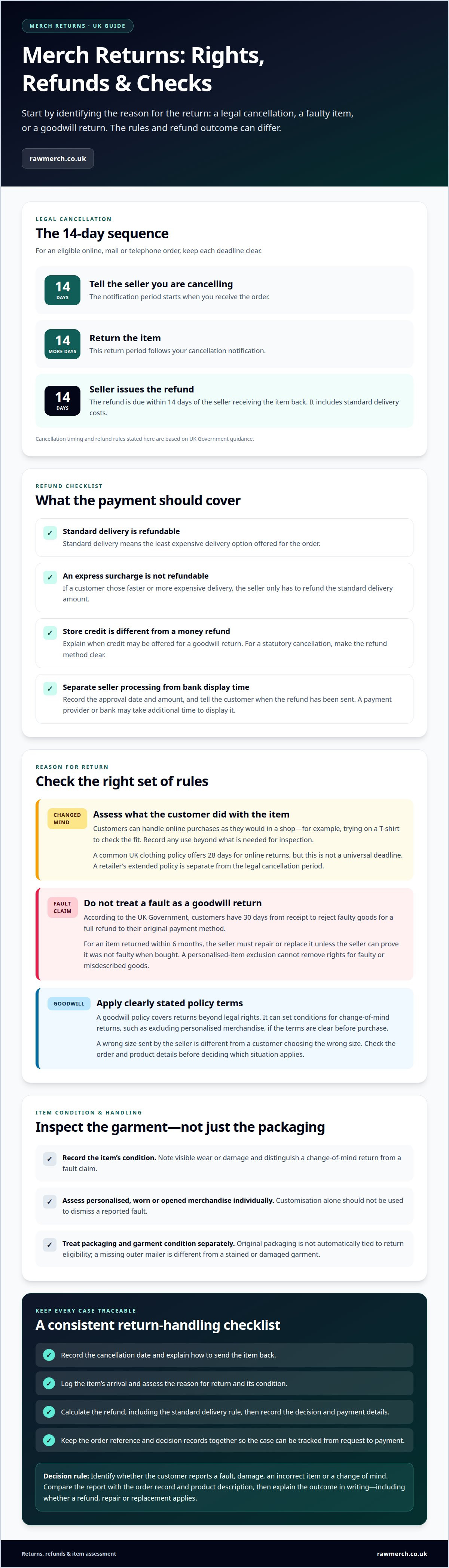
The return journey doesn’t end when the parcel goes back. To cancel an eligible online order, tell the seller within 14 days of receiving it, then return the item within the following 14 days. According to the UK Government, the seller must refund you within 14 days of receiving the item back, including standard delivery costs.
It’s reasonable to want clear answers before returning clothing: what refund to expect, who pays for postage and whether the item’s condition matters. The rules depend on why you’re returning it, so understanding the process can help avoid confusion.
This guide explains how to handle merch returns, from notifying the seller and sending back your order to understanding refunds, postage costs and possible exclusions. It also covers how a returned garment may be assessed, including its condition and any cleaning, sanitising or repair it may need.
Key Takeaways
- Work out whether your return is a legal cancellation, a faulty-item claim or a goodwill return, as the reason affects your refund rights.
- Understand how standard delivery costs affect the refund, and what happens if you paid for a faster delivery option.
- Check the item’s condition and the seller’s policy before sending clothing back, especially where an item may fall under an exclusion.
- Learn how returned garments can be assessed for cleaning, sanitising or repair before they are handled again.
Refund amount and original shipping costs
A refund is money returned after an eligible order is cancelled or an item is found faulty. For an online, mail or telephone order, the customer must tell the seller within 14 days of receiving it to cancel, then has another 14 days to return it. According to the UK Government, the seller must refund a cancelled distance-sale order within 14 days of receiving the item back.
Standard delivery is the least expensive delivery option offered for an order. If a customer cancels an online order, the seller must refund the standard delivery cost. If the customer chose a faster or more expensive option, the seller only has to refund the standard delivery amount. For example, the express surcharge is not refundable when a customer chooses express delivery.
Set up a clear process for merchandise returns: record the cancellation date, explain how to send the item back, log its arrival, assess the reason for return, then calculate and issue the refund. State the delivery-cost rule and refund method in your returns policy. Keep the order reference and decision records together so staff can track each case from request to payment.
Merchandise credit is a store balance offered instead of, or alongside, a refund. Explain when customers can choose credit for a goodwill return, and make clear that it is not the same as money refunded. For a statutory cancellation, explain the refund method clearly so customers know whether they are being offered store credit or a payment refund.
Refund processing time is the interval between approving a refund and the payment appearing in the customer’s account. Record the approval date and amount, then tell the customer when the refund has been sent. The payment provider or bank may take additional time to display it, so distinguish that stage from the seller’s processing. For faulty goods, the UK Government says customers have 30 days from receipt to reject them for a full refund to their original payment method.
Which products cannot be returned?
Return eligibility is whether an item qualifies for a refund under law or the seller’s policy. Yes, UK customers can generally cancel online purchases because they’ve changed their mind. The UK Government’s distance-selling rules give customers 14 days to notify the seller, followed by another 14 days to return the item.
Condition means the state of the item when it reaches the seller. For online purchases, customers can handle goods as they would in a shop, for example, trying on a T-shirt to check the fit. Assess whether the item shows use beyond what is needed for inspection, record the findings, and distinguish a change-of-mind return from a fault claim.
A returns policy sets the seller’s process and any extra goodwill terms. A common UK clothing policy gives customers 28 days to return an online purchase, but this is not a universal deadline. The legal cancellation period and a retailer’s extended returns offer are separate, so the policy should state which applies and explain how customers start a return.
Packaging is the wrapping or box supplied with an order. Keeping it can protect clothing in transit, but original packaging and return eligibility are not automatically linked. Explain whether you request the original packaging, then assess the item itself. A missing outer mailer, for example, is different from a stained or damaged garment.
Personalised, worn or opened merchandise needs a clear, item-specific assessment. Businesses should identify whether the return is for a change of mind or a fault, note any customisation, and document visible wear or damage. A policy can explain how personalised goods are treated for goodwill returns, but it should not use that label alone to dismiss a fault claim. For custom T-shirts and hoodies, clear product details help set expectations before purchase; custom T-shirts and hoodies are one example of merchandise customers may order with specific designs.
Items excluded from the goodwill returns policy
A goodwill returns policy allows returns beyond a customer’s legal rights. A business can set conditions for change-of-mind returns, such as excluding personalised merchandise, provided the terms are clear before purchase. An exclusion from goodwill returns does not remove a customer’s rights when goods are faulty or misdescribed.
A faulty item is one that fails to meet the standards customers can expect under the Consumer Rights Act 2015. According to the UK Government, customers have 30 days from receipt to reject faulty goods and receive a full refund to their original payment method. A “no returns on personalised items” term cannot cancel that right if, for example, the print is defective.
A damaged item has physical harm, while an incorrect item differs from what the customer ordered. Record the reported issue, order details and item condition, then assess the claim against the product description and purchase record. A wrong size sent by the seller differs from a customer choosing the wrong size: the reason determines whether the issue is a seller error or a goodwill return.
A replacement is a new item supplied instead of the original. The UK Government says a seller must repair or replace an item returned within 6 months unless the seller can prove it was not faulty when bought. For example, if a garment’s print peels during ordinary use, assess the fault before applying a change-of-mind exclusion.
Use a consistent process for each return. First, identify whether the customer reports a fault, damage, an incorrect item or a change of mind. Next, compare the complaint with the order record and product description. Then explain the outcome in writing, including whether the item qualifies for a refund, repair or replacement. Any goodwill exclusion should be specific, visible before purchase and applied consistently. Never use it to dismiss a faulty-goods claim without assessing the reported problem.
Cleaning, sanitising and repairing returned clothes
Cleaning removes visible dirt, while sanitising is intended to reduce contamination. Repairing restores a damaged garment to usable condition. These steps come after the return arrives and its condition has been recorded. First, note stains, odours, loose seams, print damage and signs of wear. A clear record helps distinguish a fault present at purchase from damage that happened later.
Sort each garment by condition and reason for return. A clean item that has been tried on briefly is different from clothing showing repeated wear, a strong odour or a mark. Check the care label before choosing a cleaning method. Heat, bleach or vigorous washing can shrink fabric, fade colour or affect a printed design. If the garment can no longer be resold as new, record the decision and keep it separate from sale-ready stock.
Sanitising should not replace a proper condition assessment. Treat it as a separate handling step, and keep returned garments apart from clean stock until inspection and any necessary treatment are complete. For example, assess a T-shirt with visible dirt before cleaning it, so its original condition is documented. Staff should follow the business’s established handling procedure and use a method suited to the fabric and print.
A repair fixes a fault or damage, such as a loose seam or detached trim. Before deciding what happens next, identify whether the issue appears to be a product fault or customer-caused damage. Document a reported fault before washing away any evidence. If a customer reports peeling print, photograph the affected area and record the complaint before cleaning or repair. This supports a fair decision and keeps the return history clear.
Use a consistent sequence: log the return, inspect and record its condition, assess the reported reason, then decide whether cleaning, sanitising, repair or separation from stock is appropriate. Keep the purchase record alongside the inspection notes. If you’re planning custom garments, explore custom clothing printing for your next order.
RAW Merch
RAW Merch is a natural next step when you’re planning branded clothing or merchandise, rather than managing a customer’s return. Choose Custom T-Shirts & Hoodies for wearable designs, Promotional Items for branded giveaways, Headwear for caps and other pieces, or Laser Engraving for personalised merchandise.
Before ordering, consider who will use the items, how they’ll be worn and what needs customising. These decisions give your merchandise project a practical starting point, whether you’re preparing clothing for a team or items for an event.
Ready to plan custom merchandise? Contact RAW Merch to discuss your project.
Plan merchandise that fits your next project
Clear return handling is one part of a strong merchandise experience. The next is choosing items that suit their purpose, audience and use. Before ordering branded clothing or event merchandise, decide what needs customising and how each item will be used. This gives your team a practical starting point for future purchases.
RAW Merch offers Custom T-Shirts & Hoodies, Promotional Items and Headwear for projects ranging from team clothing to branded event items. Understanding how to handle merch returns also helps businesses set expectations and create a straightforward process for the products they distribute.
Whether you’re shaping a new merchandise idea or refining an existing order, take the next step at your own pace. Start a conversation with RAW Merch about the items you have in mind. A clear brief can help turn your plans into merchandise that works for your organisation.
Frequently Asked Questions
How do I return my online order?
Start by telling the seller you want to cancel, then follow its return instructions. For an online order, notify the seller within 14 days of receiving it and send the item back within the next 14 days. Include the order details inside the parcel so the seller can identify it. Keep a copy of your cancellation message and any tracking information until the matter is resolved.
How do I return items by post?
Contact the seller using the returns method in its policy, and ask for any required returns reference or label. Pack the item securely, include the order details and use a postal service that provides proof of postage. Keep the receipt and tracking record. If the item is faulty or incorrect, describe the issue in your message and keep photographs of its condition before dispatch.
How long will it take to receive a refund?
For a cancelled distance-sale order, the seller must refund you within 14 days of receiving the returned item, according to the UK Government. The payment may take additional time to appear in your account after the seller issues it. Check the payment method used for the purchase and keep the seller’s refund confirmation, so you can distinguish processing by the seller from processing by your bank.
Who pays for my return?
Responsibility for return postage depends on why you’re returning the item and the seller’s stated policy. Check the terms before posting, because the cost of returning an item is separate from the refund of the original delivery charge. For a cancelled online order, the seller must refund standard delivery, according to the UK Government. Keep your postage receipt, especially if the item arrived damaged or differs from your order.
What are UK customers' legal rights when returning faulty or misdescribed merchandise?
The Consumer Rights Act 2015 gives customers a right to reject faulty goods within 30 days of receipt and receive a full refund to their original payment method, according to the UK Government. After that initial period, repair or replacement may apply. If merchandise differs from its description, explain the mismatch clearly, such as a print colour or item specification that does not match what was agreed.
How long do customers have to return merchandise bought online in the UK?
For most online purchases, customers have 14 days from receiving the item to tell the seller they’re cancelling, then another 14 days to return it, according to the UK Government. A retailer may offer a longer goodwill period, but that is separate from the cancellation process. Keep the date of delivery and the cancellation message, as both help establish whether the return was started on time.