

What if that single custom hoodie on your desk isn't just a finished product, but a technical blueprint that could save you thousands of pounds? You want your brand to look its best, but we know the fear of opening a bulk shipment only to find the colours are off or the ink is cracking. It's a common worry. With the global commercial printing market projected to reach £413 billion in 2026, the competition for quality is higher than ever. You need to know exactly how to check print quality on a sample before you commit your hard-earned budget to a massive production run.
We've spent over 25 years perfecting the art of merchandise, and we're handing you our internal audit process. You'll learn the exact technical checks and stress tests professionals use to guarantee bulk production success. We'll break down the latest 2026 ISO standards and show you why fabric behaves differently than a computer screen. This guide provides a clear checklist to inspect your samples with total confidence. You want it, we create it; but first, we'll make sure it's perfect.
Key Takeaways
- Stop relying on digital mockups and discover why a physical sample is the only way to guarantee your bulk merchandise meets professional standards.
- Learn exactly how to check print quality on a sample using our 10-point checklist for resolution, sharpness, and precise colour accuracy.
- Put your custom clothing through 'Real World' stress tests to ensure the print remains durable without cracking or fading after a standard wash cycle.
- Spot common technical errors like fibrillation and scorch marks early to avoid wasting your budget on poor-quality bulk orders.
- Master the art of technical feedback to ensure your final products arrive exactly as you envisioned, on time, every time.
Why Ordering a Sample is the Secret to Pro-Level Custom Merchandise
Skipping the sample stage is the single biggest mistake you can make when ordering bulk merchandise. Many businesses treat a digital mockup as a final guarantee, but a render on a screen is just a digital guess. A physical pre-production sample is your only real insurance policy against a £5,000 mistake. It allows you to verify the garment fit, the actual fabric weight (GSM), and the physical texture of the print before the machines start running for your full order. It's the difference between a professional launch and a warehouse full of unsellable stock.
Think of the approved sample as a technical contract. If your bulk shipment arrives and doesn't match the quality of that specific piece, you have the professional leverage to demand a reprint or a refund. Without it, you're essentially guessing. Learning how to check print quality on a sample gives you the upper hand in every negotiation with your supplier. When you master how to check print quality on a sample, you transition from a hopeful customer to a seasoned merchandise expert who knows exactly what to look for. We've seen it happen for over 25 years; brands that skip this step often end up with "hairy" prints or colours that don't match their brand identity.
Digital Mockups vs. Physical Reality
Your computer screen uses RGB light to show colours, while printers use physical ink. This gap often leads to disappointment when a vibrant red on screen looks dull on a heavy cotton hoodie. Beyond colour, mockups can't tell you anything about the "hand feel" of the design. Different techniques like DTF or the traditional Screen printing process create entirely different textures on the fabric. A sample lets you feel if the ink is too thick, too plastic-like, or if it breathes well with the garment. Verifying the base garment quality alongside the print is the only way to ensure the final product feels premium.
When Should You Request a Physical Sample?
You don't always need a physical sample for a 10-unit top-up. However, for high-volume orders or complex multi-colour designs, it's non-negotiable. With the global commercial printing market projected to reach £413 billion in 2026, the industry is moving fast. New standards like ISO 12647-3:2026 highlight the need for strict process control and colour consistency. You should always request a pre-production sample if you're using a new fabric type or a complex gradient design. At RAW Merch, our 25 years of industry experience has proven that spending a small amount on a sample today saves thousands in the long run. We know what you want, and we deliver on time every time, but we always start with technical precision.
The 10-Point Technical Checklist for Inspecting Print Quality
You have the physical product in your hands. Don't just give it a quick glance. You need to interrogate it. A surface-level check won't reveal the structural flaws that ruin a 500-unit order. Learning how to check print quality on a sample requires a technical eye, a bit of patience, and a precise vocabulary to articulate your findings—much like the level of detail found in the Vitruvian Advance Vocabulary book. At RAW Merch, we've spent over 25 years refining this audit because we know one tiny alignment error can destroy your brand's reputation. We've seen it all, from bleeding inks to misaligned logos.
Inspecting the Fine Details
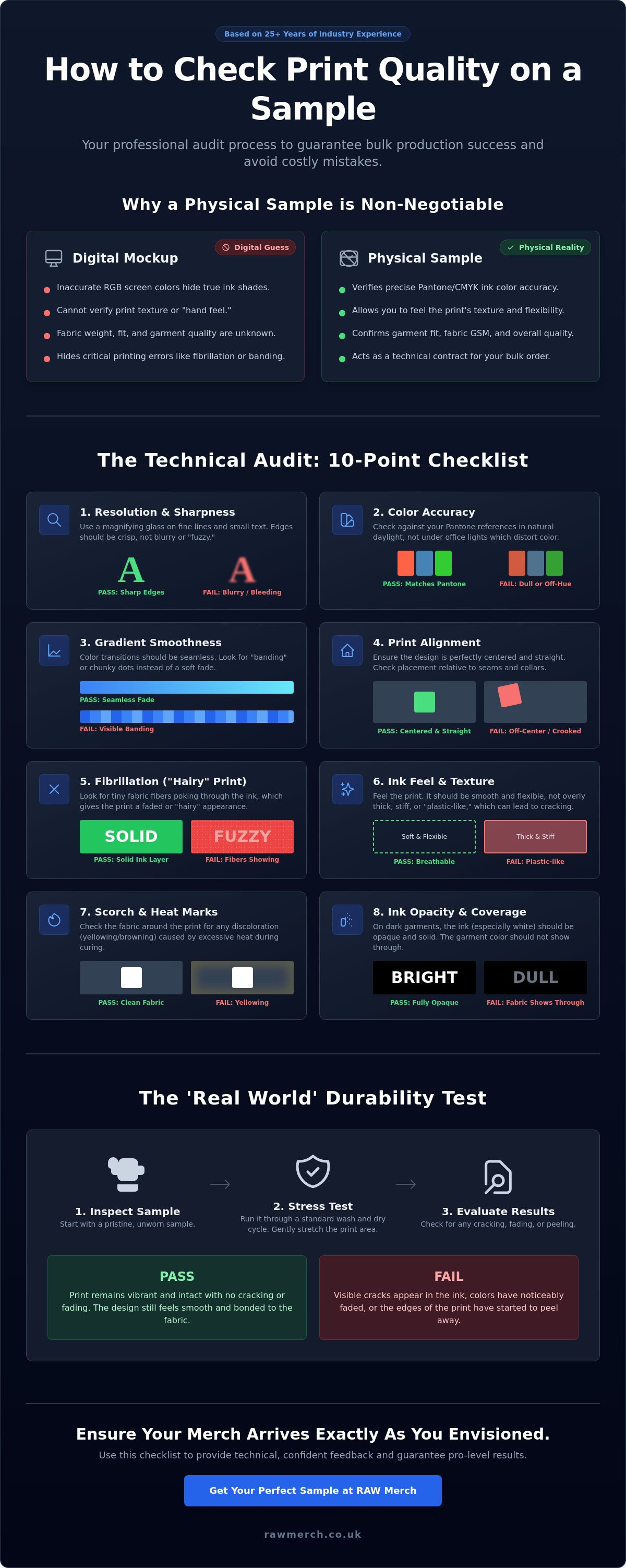
Grab a magnifying glass and look at the smallest lines in your logo. They must be sharp and distinct. If they look "fuzzy" or blurred, the resolution is too low or the ink is bleeding into the fabric. This is usually where vector graphics make the difference. If your original file wasn't a proper vector, the printing software will struggle to interpret the edges. Check your gradients too. Transitions should look seamless. If you see distinct, chunky dots where there should be a soft fade, the screen mesh or digital settings are incorrect.
Colour Consistency and Saturation
Step away from the office fluorescent bulbs. They distort hues and hide flaws. Take your sample to a window and check it under natural daylight. This is the only way to verify if your brand's Pantone references are actually accurate. Look for "banding," which appears as visible streaks in solid blocks of colour. This often indicates the print heads were clogged or the squeegee pressure was uneven during production. Organizations like the Printing Industries of America emphasize that visual consistency starts with these baseline density checks.
Opacity is another dealbreaker. If you've ordered white ink on a navy or black garment, it must be a "true white." If the fabric colour is peeking through, making the print look greyish or translucent, the ink deposit is too thin. Finally, check the registration. In multi-colour designs, every layer must align perfectly. If you see tiny gaps of fabric between two colours, the registration is out. If you're worried about your current designs, let our experts take a look. We know what you want, and we deliver on time every time.
The 'Real World' Stress Test: How to Evaluate Durability
A print that looks sharp on day one might vanish by day ten. Visual beauty is only half the battle. If your merchandise falls apart after the first wash, your brand's reputation goes with it. You need to be aggressive. Professionals don't just look at a product; they try to break it. Understanding how to check print quality on a sample means putting that garment through a gauntlet of stress tests designed to simulate months of heavy wear.
Start with a simple adhesion check. Use your fingernail to gently scratch the edge of the print. If the ink flakes off or feels brittle, it hasn't been cured properly in the dryer. This is a massive red flag. High-quality band merchandise needs to survive mosh pits and countless laundry cycles. If the ink doesn't bond with the fibres now, it never will. Fans pay good money for your gear. Don't let them down with a "one-wash wonder."
The Wash and Dry Performance
Turn the garment inside out and throw it in a standard wash at 30 degrees. This is the ultimate truth-teller. After the cycle, check if the ink has migrated or bled into the surrounding fabric. Look for "pilling," those tiny bobbles of fabric that make a new shirt look old. You should also inspect high-tension areas like the chest and shoulder seams. If you see tiny cracks forming in the design after just one wash, the ink layer is either too thick or lacks the necessary elasticity for the fabric type. Knowing how to check print quality on a sample involves identifying these structural failures before you approve a production run of 500 units.
The Texture and Elasticity Test
Perform the "Snap-back" test. Gently pull the fabric where the design is printed, then let it go. Does the print crack? Does it return to its original shape, or does it stay distorted? A quality print should breathe and move with the garment, not feel like a stiff sheet of plastic glued to the chest. For embroidered items, don't just look at the front. Flip it over. Check the "backing" material. If it's scratchy or excessively bulky, it will be uncomfortable against the skin, and your customers won't wear it. We've spent 25 years ensuring our custom products pass these tests because we know what you want. We deliver on time everytime, and we deliver quality that lasts.
Spotting Common Printing Errors Before Bulk Production
Small errors on a single sample become expensive disasters when multiplied by five hundred. You must look for technical defects that the untrained eye misses. As industry leaders prepare for the FESPA Global Print Expo in Barcelona from May 19-22, 2026, the focus is squarely on technical precision. Learning how to check print quality on a sample involves spotting errors like fibrillation. This happens when tiny fabric fibres poke through the ink, making the print look "hairy" and dull. It usually means the ink deposit wasn't thick enough or the garment wasn't properly pre-treated before the ink was applied.
Check for scorch marks too. These are yellowish halos around the design. They occur when the garment spends too much time under the heat press or in the curing oven. If you see this on your sample, it's a sign of poor temperature control. Another major issue is dye migration, especially on polyester blends. Dye migration is the chemical process where fabric dye moves into the printed ink layer. This turns your bright white logo into a murky pink or grey over time. If you want to avoid these technical headaches, talk to our clothing printing specialists today.
Placement and Alignment Accuracy
Lay the garment flat on a table. Don't just eyeball it. Use a ruler to measure the distance from the side seams to the edge of the print. It must be perfectly centred. Check the vertical placement too. A standard rule is "three fingers" down from the collar, but this varies by design. Ensure the print is parallel to the hem. A crooked logo looks amateur and ruins the whole look. Finally, check the scaling. A design that looks great on a Small might look tiny on an XXL. The scale should be adjusted or at least verified across the size range to ensure the brand impact remains consistent.
Ink Curing and Surface Defects
Hold the print up to the light. Check for "pinholes." These are tiny unprinted spots usually caused by dust particles or air bubbles that got trapped during the production process. They might seem small now, but they can lead to premature peeling. Look for "ghosting" as well. This is a faint, blurry second image or shadow around your main design. It happens when the garment shifts slightly during the printing process. Understanding how to check print quality on a sample means rejecting these flaws immediately. We've spent 25 years catching these errors so our clients don't have to. You want it, we create it; and we make sure it's flawless.
From Sample Approval to Bulk Delivery: The RAW Merch Standard
You have finished your audit. You know exactly how to check print quality on a sample. Now comes the most important part: the feedback loop. Don't settle for "it looks okay." At RAW Merch, we want your feedback to be as technical as our printing process. If the colour isn't matching your brand guidelines, don't just say it's "too bright." Give us the specific Pantone reference, like Pantone 185C. This level of detail is how we ensure that your creative vision translates perfectly from a single sample to a bulk run of thousands. We've seen the global commercial printing market grow toward its £413 billion projection for 2026, and we know that precision is the only way to stand out.
We've spent over 25 years perfecting this transition. We know what you want - we deliver on time everytime! Whether your project requires the durability of screen printing, the detail of DTF, or the vibrancy of sublimation, we choose the technique that fits your specific garment and design. We don't believe in a one-size-fits-all approach. Every project is an opportunity to prove why we are the UK's trusted partner for custom merchandise. Once you approve that sample, it becomes the golden standard for every single item that leaves our facility.
Providing Actionable Feedback to Your Printer
Communication is the final step in creating professional custom bobble hats or premium hoodies. If you find an issue, take high-resolution photos in natural light. Place a physical ruler next to the design in your photos. This shows us the exact scale or placement error in millimetres. It removes all guesswork. Clear, data-driven feedback allows us to calibrate our machines perfectly before the bulk production starts. It's the difference between a "good enough" product and a retail-ready masterpiece that your customers will love.
Why RAW Merch is the UK’s Trusted Partner
Our no-nonsense approach to quality control is built on decades of hard-won experience. We handle everything from the initial design consultation to final fulfillment and distribution across the UK. You aren't just buying a print; you're buying a partnership with seasoned experts who value your budget as much as you do. We stay ahead of the curve by investing in the latest AI-driven workflows and sustainable ink technologies. We're the specialists who get the job done right and on schedule. Ready to scale your brand? Get a no-obligation quote for your bulk order today!
Take Control of Your Bulk Production Success
You now have the technical blueprint to ensure every piece of merchandise meets your standards. A physical sample isn't just a preview; it's your insurance policy against expensive mistakes. By mastering how to check print quality on a sample, you can confidently verify everything from colour accuracy to wash-test durability. You've learned how to spot technical flaws like fibrillation and scorch marks before they impact your full order. This level of scrutiny is what separates professional brands from the rest.
At RAW Merch, we bring over 25 years of industry experience to every project. We are specialists in DTF, screen printing, and sublimation, trusted by bands and businesses across the UK to deliver perfection. We know what you want and we deliver on time everytime. Don't leave your quality to chance when you can work with seasoned experts who value precision as much as you do.
YOU WANT IT, WE CREATE IT! Get a No-Obligation Quote for Your Custom Merch! Let's get your next project moving with total confidence.
Frequently Asked Questions
Is it worth paying for a physical sample before a bulk order?
Yes, paying for a sample is the smartest investment you can make for your brand. It prevents the risk of wasting thousands of pounds on unsellable stock that doesn't meet your standards. A physical proof allows you to verify the GSM and ink density before bulk production begins. Industry data suggests that 85% of bulk order disputes could be avoided with a pre-production sample. It is your ultimate insurance policy for quality.
What is the most common print error to look for on a t-shirt sample?
Registration errors are the most frequent issue we see in the industry. This happens when multi-colour designs don't align perfectly, leaving tiny gaps of fabric or overlapping ink layers. It makes your merchandise look amateur and rushed. Check the edges of your logo carefully under a bright light. If the colours don't meet exactly where they should, the printer's alignment is off and must be corrected before the bulk run.
How do I check if the colours on my sample are accurate?
Use a physical Pantone bridge and inspect the garment in natural daylight. Office lighting often distorts hues, making a navy look black or a vibrant red look orange. Compare the sample directly to your brand's specific Pantone values to ensure total consistency. This is a vital part of how to check print quality on a sample. If the shade is off, provide the specific code for the correction rather than using vague descriptions.
Can I wash my sample to test its quality before approving the batch?
You absolutely should wash your sample before giving the final approval. Put it through a standard 30-degree cycle inside out to test for ink migration or cracking. This stress test is the only way to ensure the print won't vanish after one laundry day. If the ink flakes or the garment shrinks excessively, you need to address the curing process or the base garment quality with your supplier immediately.
What should I do if my sample arrives with a crooked print?
Measure the distance from the side seams and the collar with a ruler to confirm the misalignment. If the print is off-centre or tilted, take high-resolution photos with the ruler clearly visible in the frame. Send these directly to your supplier with the specific measurements of the error. A crooked print is usually a sign of poor jig setup. At RAW Merch, we ensure every design is parallel to the hem because we know what you want.
Does the type of printing (DTF vs. Screen Print) affect how I should check the sample?
How long does it usually take to receive a custom merch sample in the UK?
Custom merch samples in the UK typically take 5 to 10 working days for delivery. This timeline includes the digital proofing stage and the physical production of the single unit. While it adds a week to your schedule, it saves you from the disaster of a failed bulk shipment later. We always aim for maximum efficiency because we deliver on time everytime, ensuring your project stays on track for your launch date.
What is 'hand feel' and why does it matter for print quality?
Hand feel refers to the physical texture of the print on the fabric. A "heavy" hand feel means the ink is thick and plastic-like, which can be uncomfortable and prone to cracking over time. A "soft" hand feel is usually preferred for premium retail brands as it breathes with the garment. It matters because it determines the perceived value of your products and the comfort level for your customers. High-quality prints should feel like part of the shirt.