

A well-planned bundle gives customers a clear reason to buy several items together. Bundling merch for more sales means offering multiple products as one package, often for less than the cost of buying each separately. It can simplify the purchase and encourage customers to add more to their order.
But not every combination works. Items should make sense together, and the bundle price should offer a clear saving without eating into your margin. A T-shirt and cap may suit one audience or campaign, while a hoodie with accessories may work better for another.
This guide explains pure, mixed and price bundling, and how to choose an approach for your merchandise. You’ll learn how to compare bundle and individual prices, calculate a transparent discount and present the offer so customers can see exactly what they’re getting.
Key Takeaways
- Build merchandise combinations around what customers are likely to use together, and decide how much choice to offer.
- Choose a bundle format that fits your sales goal, whether that means offering a package alone or alongside individual items.
- Set a price by weighing the combined item value against your costs, then make the saving easy to understand.
- Present the products and discount clearly so customers can quickly see what the bundle includes.
What is merchandise bundling?
Merchandise bundling brings complementary products together in one offer. It can make buying more convenient while giving customers a clear reason to choose the package.
Pair Merchandise Products
Start by pairing items customers can use for the same activity, event or outfit. A T-shirt, bucket hat and hoodie could form a custom merchandise bundle for a group or campaign. A combination works best when it feels useful, rather than like a way to shift extra stock. In apparel design, brands like Martindale similarly emphasize how quality core pieces are created to complement one another in an outfit.
Review customer purchase patterns before settling on a pairing. If shoppers often buy a particular accessory with a garment, test that combination first. Avoid items that meet different needs or make the bundle harder to understand. The goal is a relevant offer, not simply a bigger basket.
Customise Bundles for Customers
Offer a few clear choices, such as selecting a garment size or choosing between complementary items. Customisable bundles let customers shape a package around their needs. Keep the options focused, so choosing a bundle is easier than building an order from scratch.
Use customer feedback to improve the offer. Review comments, returns and questions about unwanted or missing items, then adjust the combinations or choices. If customers repeatedly ask to swap an item in a T-shirt and hat package, for example, test that option and track its effect on bundle purchases.
- Build one relevant example. Combine a T-shirt, bucket hat and hoodie for a campaign or event. Explain what each item contributes, then compare interest in the package with purchases of the separate products.
- Use buying behaviour to improve the mix. Look for products customers commonly purchase together and feedback about preferred combinations. Test one change at a time, such as allowing a choice of item, so you can see which adjustment makes the package more useful.
- Check stock and fulfilment before selling. A bundle draws on inventory for every included item, so a shortage of one product can hold up the whole order. Packing items together may reduce separate parcels, while parcel size and weight can affect shipping costs. Avoid tying up popular stock with slower-moving items if the combined offer risks reducing margins or leaving unsold stock.
Pure, mixed, and price bundling
- Choose pure bundling when the offer only works as one package. Customers buy the products together, not separately. A limited event pack containing a poster and programme, for example, can give the set a clear identity. Use this approach when the items belong together and selling them individually would weaken the offer. Make the contents and purpose clear, since customers have less choice.
- Use mixed bundling to give customers a choice. Offer the package alongside its individual products. For example, a customer could buy one shirt alone or choose a package combining shirts with a complementary accessory. This serves shoppers who want the complete set and those who only need one item. Compare both buying routes to see whether the bundle adds convenience without simply replacing individual purchases.
- Apply price bundling when the combined offer has a clear price advantage. Group products in a single package and set its price below the total for buying each item separately. Calculate the combined costs first, then decide what discount still leaves room for profit. Avoid a saving so small that customers overlook it, or so large that each sale undermines revenue. This is a practical approach to bundling merch for more sales while protecting your margin.
- Match the format to your selling goal. Choose pure bundling for a cohesive, exclusive set; mixed bundling when flexibility matters; and price bundling when a visible saving should encourage a larger purchase. These approaches can overlap: a mixed bundle may also use a discounted package price. Treat bundling merch for more sales as a test, tracking which format customers choose and adjusting the offer accordingly. For an apparel-led package, plan your merchandise bundle around products customers want to wear together.
Bundle prices versus individual prices
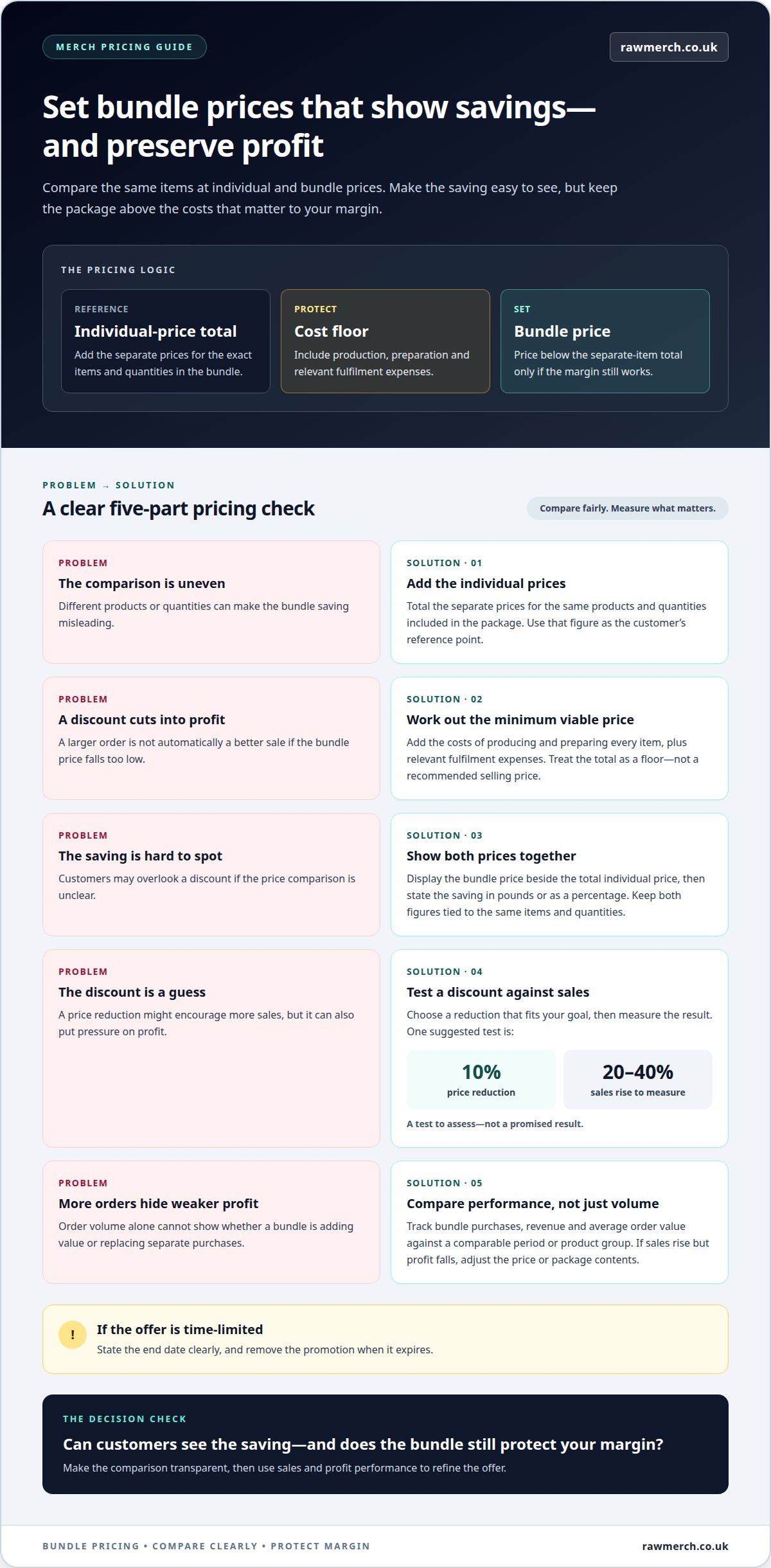
Price the bundle below the combined individual prices only if the margin still works. There’s no universal discount: account for product costs and fulfilment expenses, and protect the profit your pricing strategy requires.
- Calculate the individual total. Add the prices of every item customers could buy separately. Use the same products and quantities shown in the package, so the comparison is fair. This total gives shoppers a reference point and gives you a starting figure for setting the bundle price.
- Work out your minimum viable price. Add the costs of producing and preparing each item, then include relevant fulfilment expenses. Treat that total as a floor, not a recommended selling price. A discount that takes the package below this level can turn a larger purchase into a less profitable sale.
- Choose a discount that fits your goal. A modest saving may help customers see the convenience of buying together, while a deeper reduction can put more pressure on profit. One suggested test is a 10% price reduction, then measuring whether sales rise by 20-40%. Treat those figures as a test, not a promised result.
- Compare performance with individual sales. Track bundle purchases, revenue and average order value against a comparable period or product group. Check whether the bundle attracts additional purchases or simply replaces separate orders. If sales rise but profit falls, adjust the price or package contents rather than judging success by order volume alone.
- Keep the comparison clear. Show the bundle price beside the total individual price, then state the saving in pounds or as a percentage. Make sure both figures refer to the same items and quantities. If a discount applies only for a limited period, state its end date clearly and remove the promotion when it expires.
Displaying bundle discounts
For UK-facing promotions, show the total price payable, exactly what the package includes and the basis for any claimed saving. State the conditions clearly, and avoid comparisons that could mislead customers.
- Lead with the bundle contents. Name each item and show them together in the product image or display. For example, if an offer includes a shirt and cap, label both clearly. Customers should understand what they’re buying before they compare the discount or add the package to their basket.
- Make the saving easy to verify. Display the bundle price beside the combined price of the same individual products. State the saving in pounds or as a percentage, and ensure the comparison uses the same items and quantities. Don’t imply a discount against a price that customers can’t genuinely pay.
- Put important conditions beside the offer. If the discount applies only to selected sizes, colours or stock, state that near the price. For a time-limited promotion, make the end date visible. Avoid placing essential terms only in distant product information, where shoppers may miss them before buying.
- Promote the package where customers decide. Online, show the offer on relevant product pages, in category listings and in the basket. In-store, place the items together with one clear price card. Use matching wording across both channels so customers see the same contents, discount and conditions.
- Review the display against inventory. A promotion can raise demand for one item faster than its matching products. Track which individual products are bought together, then update the display or pause the offering if stock levels make the advertised package difficult to fulfil. Clear product photos and concise labels help shoppers choose without extra steps.
For custom merchandise promotions, plan a clear bundle offer around the items and discount you want customers to see.
RAW Merch: Custom T-Shirts & Hoodies
RAW Merch can produce custom-printed merchandise for your event, team or campaign. Build your package around Custom T-Shirts & Hoodies, then consider whether Custom Headwear or Custom Promotional Merchandise adds value for your audience.
Focus on products customers will use together. A hoodie and headwear could suit an event pack, while Custom Promotional Merchandise can complement a campaign bundle. Custom Laser Engraving is another option when an engraved finish suits the package. Choose products to fit your purpose, then set the contents and price around your costs and sales goals.
Contact RAW Merch to create custom merchandise for your bundle, or visit rawmerch.co.uk.
Make your next bundle a learning opportunity
Turn your next merchandise idea into a focused test. Choose a clear audience and purpose, then decide what the bundle should achieve, such as introducing a new design or making event merchandise easier to buy. Effective bundling merch for more sales starts with a useful offer and improves through learning from customer responses.
After launch, note which items attract interest, what customers ask about and where they hesitate. Use those signals to refine the product mix, presentation or price for your next campaign. Small, deliberate adjustments can strengthen the offer without relying on guesswork.
RAW Merch can support your merchandise plans with custom clothing and promotional products. Contact RAW Merch about merch bundles to discuss your idea and take the next step with confidence.
Frequently Asked Questions
Why is price bundling important?
Price bundling gives customers a reason to choose a set instead of buying each item separately. It also lets a business present a coordinated offer for a campaign, event or product launch. For example, a band could group merchandise around a new release, making related items easier for fans to find in one purchase. Keep the offer relevant and protect your margins.
What Is Fashion Product Bundling?
Fashion product bundling groups clothing or accessories into a coordinated offer, such as a sweatshirt with a matching beanie. The aim is to make it easier to put together an outfit or choose several useful pieces at once—an approach seen in childrenswear brands like Maison Q that curate complementary pieces for quick styling. For a seasonal range, build the set around a shared colour palette or purpose, and show how the items work together.
What is an example of bundling?
A band could bundle a tour shirt with a branded sticker. The pairing connects wearable merchandise with a small keepsake from the same tour. Show the items together and explain their connection so customers understand why they belong in one offer. Use customer responses to decide whether to offer the pairing again.
What is bundle pricing?
Bundle pricing is the price for a group of products sold as one offer. It may be lower than the combined individual prices or reflect the convenience and coordinated contents of the package. Before publishing the price, add up the costs of every item and other order-related expenses. This helps protect profitability while keeping the offer clear to customers.
Why is cross-sell bundling successful?
Cross-sell bundling presents a relevant companion item while someone is considering a purchase. A customer choosing a tour shirt, for example, might also want a sticker from the same event. Make the connection useful and obvious. An unrelated extra can distract from the main purchase rather than help the customer decide.
What is product bundling and how does it increase merchandise sales?
Product bundling brings related merchandise together in one offer, giving customers a simpler way to buy a coordinated selection. It can increase sales when shoppers choose additional items they might not have bought individually. For example, an organisation could pair event clothing with a small branded keepsake. Track which combinations customers choose, then refine the offer around the pairings that work.