
A merch launch doesn’t need a huge catalogue to make an impact. Creating hype for your new merch starts with a focused, limited or timed drop, teased 7-10 days before launch; reveal the products and launch date 3-5 days beforehand, introducing one product each day. The release becomes an event, not just another post.
You already know anticipation matters. But a countdown alone won’t carry a launch if the products feel disconnected from your identity, the audience has no reason to join in, or the buying experience falters when interest peaks.
This guide shows where merch strategies go wrong and how to plan a more considered release. You’ll learn how genuine scarcity can build interest without requiring you to reduce overall stock, how to plan teasers and timed drops, and what to keep doing after launch day. The aim is simple: make the release relevant to your audience, give people something worth sharing, and create a clear path from excitement to purchase.
Key Takeaways
- Keep merch true to your identity, and share design or production progress to give followers something genuine to engage with.
- Use a limited or timed drop to make a release feel like an event without relying on permanently reduced stock.
- Build interest with a clear launch plan, and make the product pages and checkout ready for the traffic a successful release can bring.
- Keep the conversation going after launch by sharing customer reactions and spotlighting products that are selling quickly.
1. Where do artists typically go wrong with their merchandising strategies?
Artists often treat merch as a sales announcement instead of part of their identity. A design that follows a passing trend can feel disconnected from the music, performances or community that fans value. Start with a recognisable aesthetic and ask whether the product feels authentic to your audience. Harry Styles used two bunnies to represent his 2021-2022 tour, showing how a clear visual idea can give fans something memorable to share.
Another mistake is waiting until launch day to post. Build anticipation on social media with practical behind-the-scenes details: a close-up of a print test, a packaging preview or a short clip showing the design taking shape. Each post gives followers a reason to return and respond. Invite them to choose between colourways or vote on which detail you reveal next. That turns a teaser into a moment of participation, not just another sales message.
For UK giveaways, publish clear entry instructions, eligibility, the closing date and how a winner will be selected. Make the promotion’s terms easy to find. If an influencer receives payment or a free product, disclose that clearly in the promotional post so the audience can recognise the commercial relationship. Agree on the content and expectations with creators before sending merchandise, rather than mailing products at random and hoping for coverage.
How much should you budget for promoting a new merch drop? Set a campaign limit based on the costs you choose to take on, such as paid social reach, creator fees, giveaway products and content production. Track each spend against your goals, then invest more in the channels bringing meaningful interest. For UK promotion, Instagram and TikTok suit visual teasers, while YouTube can carry longer behind-the-scenes content. Direct shoppers to a clear online store to complete a purchase.
Measure the launch with a short scorecard: product-page visits, sales, email sign-ups, comments, shares and creator referral activity. Compare the results with your campaign aim, since reach alone doesn’t show whether the audience acted. Organic sharing can extend the effect when customers post photos or discuss a product they genuinely like. Give fans a distinctive design or story worth sharing, then use their responses to shape the next release.
2. Building hype with limited and timed merchandise releases
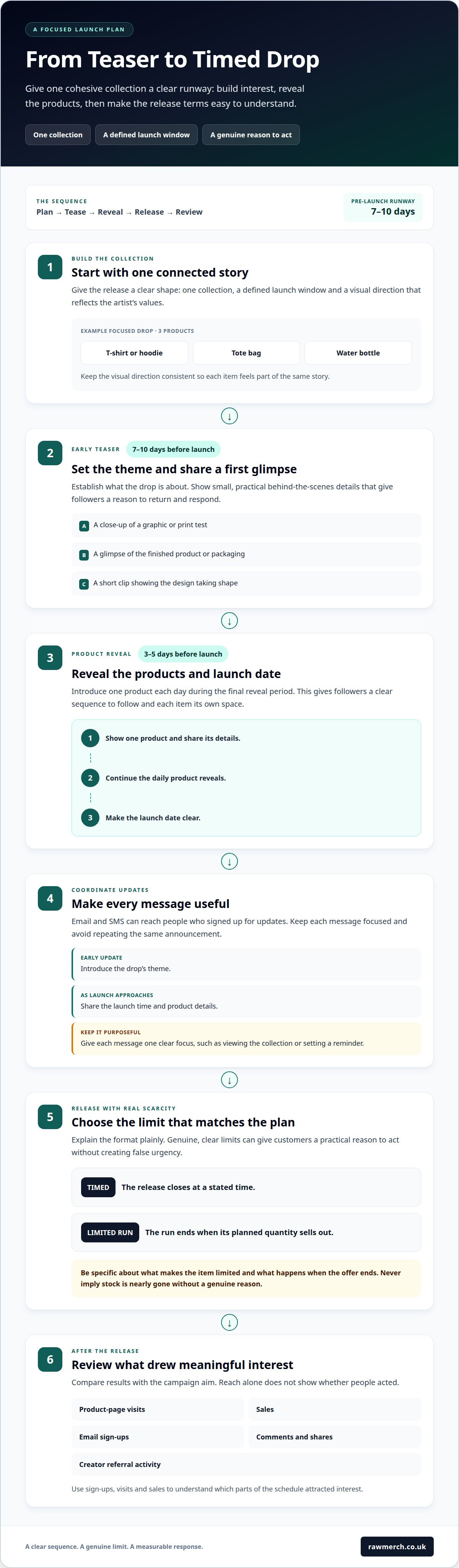
A limited release gives a campaign a clear shape: one collection, a defined launch window and a reason to act. Brands can generate engagement by presenting an exclusive design as a moment, rather than keeping every item available indefinitely. For example, a focused three-product drop could pair a T-shirt or hoodie with a tote bag and water bottle. Keep the visual direction connected across the collection, so each item feels part of the same story and reflects the artist’s values.
Start promoting the release 7-10 days before launch. Use those early days to establish the theme and show small details, such as a close-up of a graphic or a glimpse of the finished product. Then, 3-5 days before launch, reveal the products and share the launch date. Introduce one product per day during that final reveal period. This gives followers a clear sequence to follow and gives each item its own space in the campaign.
Email and SMS can take the plan directly to people who have signed up for updates. Send an early announcement introducing the drop’s theme, then share the launch time and product details as the date approaches. Keep each message focused on one action, such as viewing the collection or setting a reminder. Avoid repeating the same message; useful details make each update feel purposeful.
Scarcity works best when the limit is real and easy to understand. A timed release can close at a stated time, while a limited run can end when its planned quantity sells out. Choose the format that matches your production plan, explain it plainly and avoid implying that stock is almost gone without a genuine reason. After the release, review sign-ups, visits and sales to see which parts of the schedule drew interest. A clear merchandise drop plan can help turn a visual idea into a coordinated launch.
3. Limited-time offers and scarcity
Scarcity can make a release feel distinctive, but the limit must be genuine. Set a clear end time for a timed offer, or explain that a run ends when its planned stock sells out. This gives customers a practical reason to act without creating false urgency. Keep the offer true to your identity, too. A fashion-inspired design should still feel like your brand, not a trend borrowed for a quick sales lift.
Use a limited run to test whether a new idea has an audience before expanding it. For example, a clothing label exploring a partnership could create a capsule collection and reveal it at a pop-up event. Customers can see the product, discuss its function and respond to the collaboration in person. That feedback helps show whether the partnership feels natural enough to develop into a wider release.
How do limited editions and pre-orders affect demand for merch? A limited edition gives buyers a defined window or quantity, which can focus interest on a particular release. Pre-orders let customers register demand before production, helping you understand which designs attract attention. Set out clear terms for orders and fulfilment so buyers know what to expect.
Make the offer easy to understand across every channel. State what makes the item limited, when the offer closes and what happens when it ends. If an influencer helps promote the launch, share the same details and a consistent explanation of the product’s story. Don’t suggest that stock is nearly gone unless that’s accurate. Clear information protects trust while giving the audience a reason to engage.
After the event or release, review the response before planning another exclusive. Compare customer questions, pre-order interest and sales across the collection. Strong interest in one design may guide a follow-up; weak engagement can signal that the offer, product or timing needs a rethink. Treat each limited release as a learning opportunity, not a promise that every future drop will sell out. That discipline keeps scarcity credible and supports a stronger campaign.
4. How do you build anticipation for a new merch drop?
Give fans a reason to participate before launch, not just a product to view. Ask them to vote on a detail, share a memory connected to the artist, or submit a question for a launch-day reveal. Their responses help shape the campaign and give the audience a visible role. A strong plan for creating hype for your new merch makes that involvement part of the release, rather than an unrelated contest.
Choose channels based on where your community already responds. Esports organisation 100 Thieves uses Twitter as its primary channel for communicating with fans and posts merchandise announcements there first. That approach gives followers a familiar place to look for news. Keep the announcement consistent across other channels, and make the route from post to product page easy to follow.
A partnership can introduce a drop to a relevant new audience. Choose a complementary brand or influencer whose style and values fit the release, then agree on the story and promotional roles before launch. A virtual giveaway or digital pop-up can give people another reason to engage. Make the participation rules and dates clear, and connect the activity to the merchandise rather than offering an unrelated prize.
Prepare the online store before directing followers there. Review product pages, images and checkout steps, then run load tests if a timed release could bring a traffic increase. A campaign for creating hype for your new merch also needs a smooth destination for interested fans. Clear product details help visitors understand what they’re viewing and how to buy.
After launch, use customer feedback to decide what to share next. Schedule 3-4 follow-up promotions within 2-3 weeks, featuring customer reactions or the fastest-selling item. Then use engagement and sales patterns to plan future releases. Plan your merch launch with a clear story and a store ready to receive interested fans.
RAW Merch: Custom T-Shirts & Hoodies
RAW Merch helps artists and brands turn a release idea into physical merchandise, including Custom T-Shirts & Hoodies, Promotional Items, Headwear and Laser Engraving. Turn to RAW Merch when your launch plan is ready to move from audience interest to a coordinated product range.
Choose items that support the story of your drop. A printed hoodie can carry a central design, while Promotional Items offer another format for extending the release. Headwear can add variety, and Laser Engraving can give suitable merchandise a distinctive finish. Keeping the selection connected makes the launch feel considered, not like a collection of unrelated products.
Share your campaign idea and the merchandise you want to produce with RAW Merch. Contact RAW Merch to discuss your next merch release.
Turn your launch idea into something tangible
Decide what you want people to remember after the drop. The right merchandise gives your audience a way to carry that connection beyond the launch. Keep the product aligned with your creative identity and make sure it suits the people you want to reach. That’s the foundation for creating hype for your new merch that lasts beyond a single announcement.
RAW Merch offers Custom T-Shirts & Hoodies, Promotional Items and Headwear to help bring a merchandise concept to life. Share your direction and the products you have in mind, then build a release that fits your audience and brand. A clear brief gives your launch a practical starting point.
Contact RAW Merch to plan your launch, and take the next step towards merchandise that feels unmistakably yours.
Frequently Asked Questions
Okay Great, Thanks for the Info… Now What?
Turn your ideas into a short launch brief before creating content. Note your audience, product concept, campaign goal, launch date and who will handle each task. For example, an artist releasing tour merchandise could assign one person to approve product details and another to schedule posts. A shared reference helps collaborators make decisions and keep the launch moving.
Where do artists typically go wrong with their merchandising strategies?
Artists can misjudge what fans want by choosing merchandise based on personal taste alone. Before committing to a concept, look for recurring themes in audience comments, song requests or event conversations. If fans repeatedly mention a particular lyric or visual, explore whether it could work as a wearable design. A product should feel like a natural extension of the artist, not an unrelated item carrying a logo.
What are the best social media tactics to promote a merch launch?
Give each platform a specific job instead of copying the same post everywhere. Pin a post so the key launch details are easy to find, answer product questions in the comments and direct followers to the right product page. A short vertical clip can show how a design looks in motion, while a customer photo after launch can offer a fresh perspective on the finished item.
What teaser content works best for a merch launch?
Teasers work best when they reveal enough to spark curiosity without confusing the audience. Share a cropped section of the artwork, a close-up of a label, or a detail linked to a song or performance. Keep the colours and visual style consistent across each asset. Make the final reveal useful: show the complete product clearly, with its name and launch information.
What are common merch launch mistakes and how can you avoid them?
Unclear product information can leave interested customers unsure what they’re buying. Use consistent product names and explain the available options, fit and care details on the product page. Keep launch information consistent across posts, emails and the store. After launch, review customer questions and feedback alongside sales activity. These details can show what to improve before the next release.