

Your brand is only as good as the fabric it's printed on. In 2026, thin cotton is a fast track to the bargain bin. If you want to command retail prices and build brand loyalty, you need a product that feels substantial. Opting for heavyweight t-shirt printing uk is the most direct way to elevate your merchandise from a basic giveaway to a premium retail garment. You probably worry that "cheap-feeling" shirts reflect poorly on your business. It's a valid concern. Many brands struggle to distinguish between simple GSM numbers and actual fabric quality; they often fear their designs will crack or peel on thicker materials.
We've spent over 25 years perfecting the art of bulk merchandise. This guide will help you master the technical specifications and printing performance of heavyweight garments. You'll learn how to create durable, retail-ready merchandise that survives the wash and justifies a premium price tag. We'll break down the best printing methods for thick cotton and review the top heavyweight models currently available in the UK. Expect a clear, no-nonsense look at how to build a high-end product line that stands out in a crowded market.
Key Takeaways
- Understand why GSM measures fabric density and how to choose weights between 180gsm and 240gsm for a premium feel.
- Discover why combed ringspun cotton and high stitch density are essential for high-definition prints that don't crack.
- Master the best customisation methods for heavyweight t-shirt printing uk, including why screen printing offers superior ink hold-out.
- Use our decision matrix to select the right fit, whether it's a modern classic cut or a trendy, oversized silhouette.
- Learn how to manage bulk logistics for retail-ready merchandise that justifies a higher price point and builds brand loyalty.
What is Heavyweight T-Shirt Printing? (Beyond the GSM)
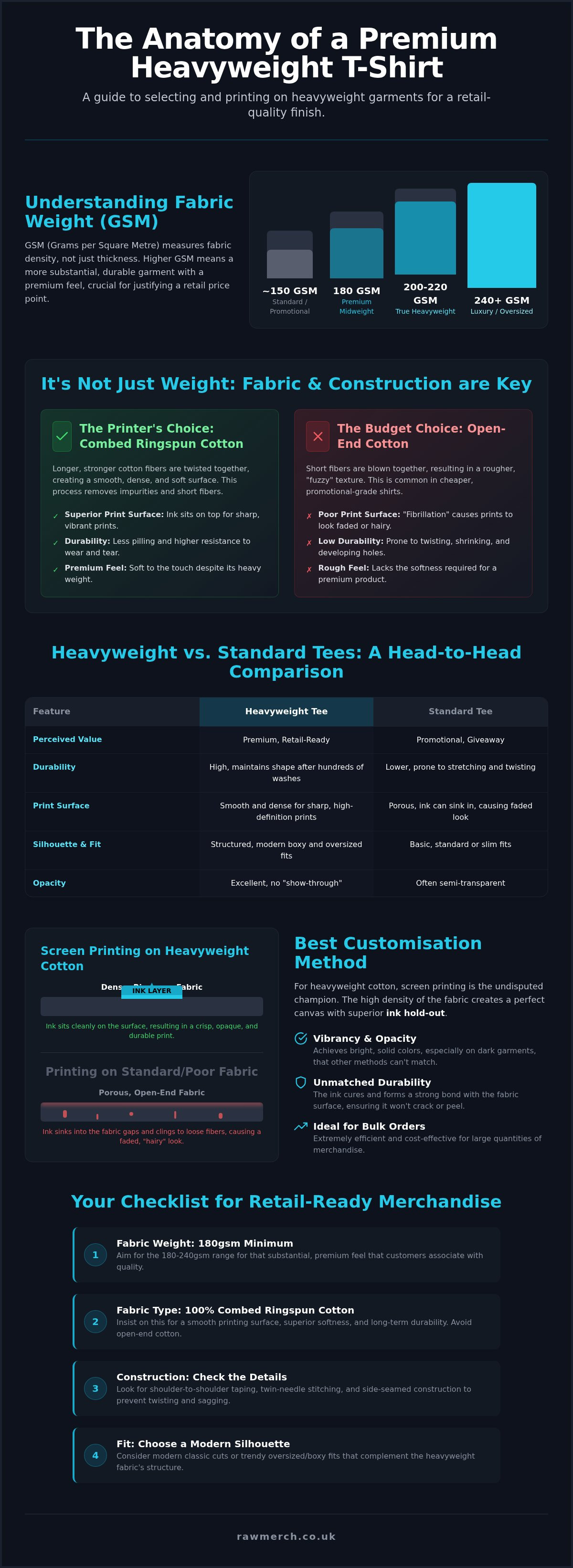
Heavyweight t-shirts are defined by their substance. While a standard promotional tee might sit at 150gsm, a true heavyweight garment ranges from 180gsm to 240gsm and beyond. GSM stands for Grams per Square Metre. It's a technical measure of fabric density, not just thickness. You can have a thick, airy fabric that feels light, but heavyweight tees use a dense weave to create a garment with real physical presence. Choosing the right partner for heavyweight t-shirt printing uk means looking past the label and understanding how that density affects the final print quality.
The UK market has seen a massive shift toward "oversized" and "boxy" fits. Streetwear brands and independent labels are moving away from the slim-fit trends of the last decade. They want garments that drop off the shoulder and hold their form. This is exactly why these shirts are the preferred choice for premium band merchandise. Fans want a shirt that feels like a piece of equipment, not a disposable souvenir.
The Anatomy of a Heavyweight Tee
Quality starts with the yarn. We always recommend 100% combed ringspun cotton. This process removes short fibres and leaves a smooth, consistent surface. It's the only way to ensure a high-definition finish. This density creates a superior canvas for screen printing, as the ink sits on the surface rather than disappearing into the fibres. Thick fabric also prevents "show-through", meaning your customers don't have to worry about what they're wearing underneath. A true heavyweight tee provides a structured silhouette that standard 150gsm shirts simply cannot match. It maintains its shape through hundreds of wears and washes.
Why Weight Matters for UK Brands
Weight is a vanity metric if the construction is poor. A 220gsm shirt made with low-grade yarn will still look like a rag after two washes. For professional heavyweight t-shirt printing uk, the focus must be on the knit. A higher stitch density means the fibres are packed tighter together. This creates a flat, stable surface that holds ink exactly where it's placed. It prevents the design from "sinking" into the gaps of the fabric. When the surface is smooth, the print stays sharp.
Look for shoulder-to-shoulder taping and twin-needle stitching on the sleeves and hem. These aren't just decorative details. They provide the structural integrity needed to support the extra weight of the fabric. Without them, the neck will sag and the seams will pull under the garment's own mass. For dark garments, insist on reactive dyes. These chemical bonds ensure the colour stays deep and rich even after multiple high-temperature washes. If you want your merch to last, these specs are non-negotiable.
Ringspun vs. Open-End: The Printer’s Choice
Open-end cotton is cheap and rough. It's made by blowing fibres together, which results in a "fuzzy" surface. In the industry, we call this fibrillation. These tiny loose fibres can poke through your ink, making a solid print look faded or "hairy." Combed ringspun cotton is the only serious choice for high-end t-shirt printing. It uses longer, stronger fibres that are twisted together for a smooth finish. This results in fewer holes, less pilling, and a garment that feels soft against the skin despite its heavy weight. It is the foundation of any premium heavyweight t-shirt printing uk project.
Shrinkage and Shape Retention
Heavy cotton is prone to shrinkage. You should expect a standard 5% reduction after the first wash. To combat this, premium manufacturers use "quarter-turning" during production. This process rotates the fabric roll before cutting to eliminate the centre crease. Even more important is side-seamed construction. Most cheap tees are tubular, which leads to "torquing"-that annoying twist where the side seams end up on your stomach. Side-seams ensure the shirt stays square and the print stays centred. If you're planning a complex project, it's worth speaking to a specialist about garment selection to avoid these common pitfalls.
Heavyweight vs. Standard Tees: Which is Right for Your Project?
Choosing the right garment is a strategic decision. It isn't just about the price tag; it's about how your brand is perceived in the hands of your customer. Standard tees, typically 150gsm to 165gsm, offer a "Modern Classic" fit. They are slimmer, lighter, and follow the body's contours. These are excellent for mass-market giveaways or high-volume promotional events where the unit cost is the primary driver. However, if you are targeting the streetwear market or producing high-end band merch, the "Boxy" or "Oversized" fit of a heavyweight tee is the industry benchmark. Benchmark models like the Gildan Hammer and AS Colour Heavy have defined this category for 2026. They provide a drop-shoulder silhouette that looks intentional and expensive.
A common objection we hear is that heavy tees are "too stiff." This is a misconception. High-quality heavyweight t-shirt printing uk relies on the density of the knit, not the rigidity of the fibre. While a 240gsm shirt feels more substantial, a premium combed cotton remains soft against the skin. It simply doesn't cling like a lighter shirt. Use this decision matrix to guide your next order:
- Target Audience: Fashion-forward brands and touring bands should almost always opt for heavyweight. General corporate events often find better value in standard weights.
- Retail Price Point: If you plan to sell your shirts for £30 or more, a heavyweight garment is mandatory to justify the markup.
- Longevity: Heavyweight cotton handles the rigours of daily wear and industrial washing better than its lightweight counterparts.
The "Hand Feel" and Drape
The drape of a garment changes the entire aesthetic of your design. Lightweight shirts have a soft, flowing drape that moves with the wearer. This is great for gym wear or summer basics. Heavyweight cotton offers a rigid, structured drape. It holds its own shape, which is why it is the "gold standard" for the current UK streetwear trend of boxy, oversized fits. To see how this weight translates to other streetwear essentials like high-density crewnecks, visit Blankstyle. Don't believe the myth that these shirts are too hot for the UK. A high-quality, dense knit allows for better air circulation than a poorly made, thin synthetic blend. It's about the quality of the cotton, not just the weight.
Your investment needs to scale. For small runs of 50 units, the price difference between standard and heavy might seem significant. However, as you move toward 250 or 1000+ units, the gap narrows. The long-term brand loyalty gained from a shirt that lasts five years instead of five months is worth the initial spend. Stick with standard weights for one-day events or "throwaway" promo items. For everything else, the retail-ready appeal of heavyweight cotton is the smarter play for your reputation.
Best Customisation Methods for Heavyweight Cotton
Heavy cotton isn't just about the feel. It fundamentally changes how ink and thread behave during the production process. For professional heavyweight t-shirt printing uk, screen printing remains the undisputed champion. The dense weave of a 200gsm+ shirt provides superior ink hold-out. This means the pigment stays on the surface rather than soaking into the core of the garment. The result is a vibrant, opaque finish that looks identical on the first shirt and the five-hundredth. It's the standard for retail-ready merch.
To get the most out of this premium surface, you must start with a vector based image. Thick weaves can be unforgiving with low-resolution files. A vector ensures your lines stay crisp against the textured grain of heavy cotton. This is especially vital when you're moving away from simple text to complex, multi-colour streetwear designs that require precise registration.
Screen Printing: The Bulk Merch King
Heavy garments are built to handle high ink loads. You can print large, solid blocks of colour without the fabric warping or "bleeding" through the fibres. On a standard 150gsm tee, a massive back print can feel like a heavy plastic shield that pulls the garment out of shape. On a heavyweight shirt, the fabric has enough structural integrity to carry the weight of the ink comfortably. We often recommend a "soft hand" finish for bulk orders. This ensures the design feels like part of the fabric rather than a heavy layer stuck on top. If you're printing large back graphics, the extra weight of the shirt prevents the "parachute" effect where the garment bunches up around the print.
Embroidery and DTF on Heavy Fabric
Embroidery is where heavyweight fabric truly shines. On thin shirts, a high thread count logo often causes puckering, which is that ugly wrinkling around the design. A 220gsm or 240gsm shirt is thick enough to support dense embroidery without distorting. It's the only serious choice for high-end branding. For complex, photographic designs, Direct to Film (DTF) is the modern solution. The dense fibres of heavy cotton provide an incredible bonding surface for DTF transfers. This creates a durable finish that won't peel or crack, even after heavy industrial washing. The stability of the heavy surface makes it much easier to maintain fine-line detail during the heat-press stage.
Ready to elevate your brand with premium garments? Get a custom quote for your heavyweight order today.
Why RAW Merch is the UK’s First Choice for Heavyweight Bulk Orders
Experience isn't just a number. It's a guarantee of reliability. With over 25 years in the industry, we've refined our process to meet the highest retail standards. We don't just print on fabric; we build products that represent your brand's integrity. Choosing RAW Merch for heavyweight t-shirt printing uk means partnering with a team that understands the technical demands of thick cotton and high-density ink. We operate from a dedicated UK-based production and distribution centre. This ensures every bulk order is handled with precision and delivered on time across the country.
We've spent decades as a trusted partner for brands that cannot afford mistakes. Our team understands that merchandise is often the primary revenue driver for our clients. We don't take that responsibility lightly. We provide a no-nonsense, expert service that prioritises execution and scheduling above all else. When you work with us, you're getting a seasoned specialist who knows exactly how to handle premium garments for maximum impact.
Specialists in Band and Tour Merchandise
Touring is a logistical puzzle. You need a partner who can keep up with your schedule. We specialise in band merchandise and tour logistics, helping artists maximise their retail profit margins. Fans expect a high-end product at the merch desk. By choosing heavyweight garments, you offer a "Retail-Standard" item that justifies a premium price point. We manage everything from bulk production to end-to-end fulfilment. Whether you're playing a club tour or a stadium run, our team ensures your merch is where it needs to be, exactly when it needs to be there. We handle the heavy lifting so you can focus on the performance.
Quality Control and UK Production
Consistency is the hallmark of a professional print shop. We use a multi-point inspection process for every order we produce. This isn't a "set and forget" operation. We monitor ink viscosity, dryer temperatures, and colour consistency across every batch. If you order 500 shirts, the first one will look identical to the last. This is especially critical for heavyweight t-shirt printing uk, where the fabric density requires specific curing times to prevent cracking. We verify stock availability for industry benchmarks like the AS Colour Heavy and Gildan Hammer to ensure your project never hits a bottleneck. Our commitment to logistical punctuality means we don't miss deadlines.
Your brand deserves a partner that treats your vision with respect. We provide the expertise, the equipment, and the reliability to bring your premium project to life. Don't settle for "good enough" when you can have retail-ready quality. Get a quote for heavyweight t-shirt printing today!
Elevate Your Brand With Retail-Ready Merchandise
Premium merchandise is an investment in your brand's reputation. By choosing high-density fabrics and professional construction, you move beyond disposable promo items and into the world of high-end retail. Master the technical side by prioritising fabric density over simple thickness. Whether you're opting for the boxy silhouette of an oversized streetwear tee or the durable finish of heavy embroidery, the quality of the base garment dictates the success of the final product. Choosing heavyweight t-shirt printing uk ensures your merch survives the wash and maintains its value over time.
At RAW Merch, we bring 25+ years of industry expertise to every project. Our UK-based production and distribution centre is specifically designed to handle the logistical demands of touring bands and growing brands. We ensure your designs are executed with technical precision and delivered exactly when you need them. Don't settle for merch that feels cheap or wears out fast. Build something that lasts and represents your creative vision with pride. We're ready to help you create merchandise that your audience will actually want to wear for years to come.
Start your premium heavyweight t-shirt order now!
Frequently Asked Questions
What is considered a heavyweight t-shirt in the UK?
In the UK market, a heavyweight t-shirt is typically defined as any garment with a fabric weight ranging from 180gsm to 240gsm and above. While standard promotional shirts usually sit around 150gsm, these denser options provide a more structured fit and greater durability. This increased density is a key factor for anyone looking into heavyweight t-shirt printing uk to achieve a high-end, retail-ready finish that justifies a higher price point.
Are heavyweight t-shirts better for screen printing or DTF?
Heavyweight t-shirts are exceptionally well-suited for both methods, though screen printing is often considered the gold standard for bulk orders. The dense knit of a 200gsm+ shirt provides superior ink hold-out, preventing the design from sinking into the fibres. DTF is also an excellent choice for complex, multi-colour logos on these stable surfaces. The thickness of the cotton ensures the print remains durable and vibrant without the fabric warping under the heat press.
Do heavyweight t-shirts shrink more than standard ones?
You should expect a standard shrinkage rate of approximately 5% after the first wash, which is common for 100% cotton garments. However, premium heavyweight models often undergo "quarter-turning" during the manufacturing process to eliminate centre creases and reduce distortion. Because the fabric is denser and more structurally sound than lightweight alternatives, it tends to hold its overall shape and silhouette much better over long-term use, provided you follow the correct care instructions.
What is the best GSM for a premium streetwear brand?
For a premium streetwear brand, a GSM between 220 and 240 is currently the industry benchmark. This weight provides the "boxy" and "oversized" silhouette that defines modern streetwear aesthetics. It offers a substantial hand-feel that customers immediately associate with high-end quality. Choosing a weight in this range ensures your heavyweight t-shirt printing uk project stands out against cheaper, thinner competitors and allows you to command a premium retail markup that reflects your brand's value.
Is Gildan Ultra Cotton considered a heavyweight t-shirt?
Yes, the Gildan Ultra Cotton is a classic entry-level heavyweight option, typically weighing in at approximately 200gsm. It features a thicker, rougher open-end cotton texture compared to more premium ringspun alternatives like the Gildan Hammer or AS Colour Heavy. While it's a reliable choice for budget-conscious bulk orders, we often recommend stepping up to a combed ringspun fabric if you want a smoother finish for high-detail printing projects that require a softer, more refined feel.
Can I get heavyweight t-shirts with embroidery?
Heavyweight t-shirts are actually the best choice for embroidery. The thickness of a 200gsm+ fabric provides the necessary structural integrity to support high thread counts without the puckering or wrinkling often seen on thinner garments. This stability allows for dense, complex logos that stay flat and look professional. It's the ideal customisation method for corporate workwear or premium brand logos that need to survive frequent industrial washing cycles while maintaining their original shape.
Are heavyweight t-shirts too hot for summer wear?
Not necessarily. While the fabric is thicker, a high-quality 100% cotton knit remains naturally breathable. Heavyweight tees are often preferred in the UK climate because they offer better moisture absorption and don't cling to the body in the heat. The structured fit allows for better air circulation between the skin and the garment. Many people find the substantial feel of a heavy shirt more comfortable for all-day wear than a thin, synthetic-heavy alternative that traps heat.
How should I wash printed heavyweight t-shirts to make them last?
To maximise the lifespan of your printed merch, always wash garments inside out at 30 degrees. Avoid using harsh detergents or bleach, as these can break down the ink bonds and damage the cotton fibres over time. Never tumble dry your printed heavyweight tees; air drying is essential to prevent the print from cracking and the fabric from excessive shrinking. Following these simple steps will ensure your high-end merchandise maintains its retail-ready appearance for years rather than months.