
The cheapest shirt in your order might be the one your fans wear most. That sounds wrong, but here's the thing: the Gildan Softstyle range has quietly become the go-to blank for bands and brands across the UK, not because it cuts corners, but because it doesn't feel like it does. Pick one up and you'll understand immediately. It's soft. Properly soft. The kind of soft that makes people check the label.
You already know the frustration. You've seen merch come back from print looking great, only for the customer to tell you it feels like sandpaper after two washes. You've stared at GSM numbers wondering what they actually mean in the real world. And you've questioned whether a budget-friendly blank can genuinely hold a screen print or DTF transfer without the design cracking, fading, or bleeding at the edges.
Those are fair concerns, and this guide answers all of them directly. With 25+ years of UK printing experience behind us, we know exactly how these garments behave under a heat press and on a screen bed. By the end, you'll know whether Gildan Softstyle is the right blank for your next run, which printing method suits it best, and why it consistently punches well above its price point.
Key Takeaways
- The Gildan Softstyle (64000) is a ring-spun cotton blank with a modern semi-fitted silhouette — a significant upgrade from traditional boxy cuts that makes it far more wearable as retail-quality merch.
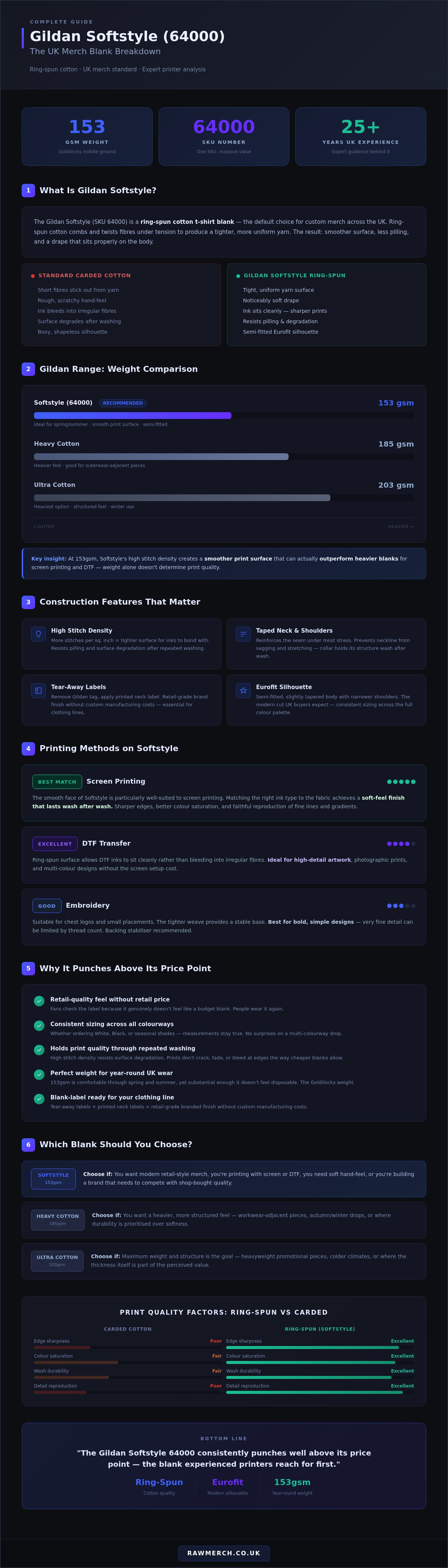
- At 153gsm, Gildan Softstyle sits lighter than Heavy Cotton and Ultra Cotton, but its high stitch density creates a smoother print surface that can actually outperform heavier blanks for screen printing and DTF results.
- Choosing between Softstyle, Heavy Cotton, and Ultra Cotton isn't just about weight — understanding the price-point crossover helps you make smarter decisions for bulk orders without overspending.
- The smooth face of Gildan Softstyle is particularly well-suited to screen printing, and matching the right ink type to the fabric is the key to achieving a soft-feel finish that lasts wash after wash.
- With 25+ years of UK printing experience, RAW Merch knows exactly how Gildan Softstyle performs under a heat press and on a screen bed — so you get expert guidance before a single shirt is printed.
What is Gildan Softstyle? The Modern Merch Standard
The Gildan Softstyle (SKU 64000) is a ring-spun cotton t-shirt blank that's become the default choice for custom merch across the UK. It's not new. But the way it's positioned in 2026, against a market where buyers are more quality-conscious than ever, makes it more relevant now than it's ever been. One garment. One SKU. A huge amount of practical value.
Understanding what separates it from standard blanks starts with the fabric itself. Traditional carded cotton is spun quickly, leaving short fibres sticking out from the yarn. That's what creates that rough, slightly scratchy hand-feel you've probably noticed on older promotional tees. Gildan Softstyle uses a ring-spun process instead, which combs and twists the cotton fibres under tension to produce a tighter, more uniform yarn. The result is a smoother surface, less pilling, and a drape that sits properly on the body rather than hanging like a bin bag.
The Science of Ring-Spun Cotton
Ring-spun cotton produces a denser, more consistent yarn surface that allows screen printing and DTF inks to sit cleanly on the fabric rather than bleeding into irregular fibres. In practical terms, that means sharper edges on your design, better colour saturation, and a finish that holds up through repeated washing. For high-detail artwork, particularly fine lines or gradients, this matters enormously. The smoother the substrate, the more faithfully your print reproduces the original artwork.
The skin-feel benefit is equally significant. Compared to cheaper carded alternatives, ring-spun cotton has a noticeably softer drape. People wear it differently. They reach for it again. That's not a small thing when you're producing merch that needs to stay in rotation.
European vs. American Fit Styles
The Softstyle range uses what's commonly referred to as a Eurofit cut: a semi-fitted silhouette with a slightly tapered body and narrower shoulders than the classic boxy American style. For UK clothing brands and startups, this is the right call. British buyers expect a more contemporary shape, and the Softstyle delivers it without veering into the overly slim territory that alienates part of your audience.
Sizing consistency across the 2026 colour palette is solid. Whether you're ordering White, Black, or any of the extended seasonal shades, the measurements stay true to size. That matters when you're running a multi-colourway drop and can't afford inconsistencies across the range.
At 153gsm, the Softstyle sits in a genuinely useful middle ground. Light enough to wear comfortably through spring and summer. Substantial enough that it doesn't feel disposable. That's the Goldilocks weight for modern merch, and it's a big part of why gildan softstyle has become the blank that experienced printers reach for first.
Technical Performance: Durability and Wearability
A blank that looks good on day one but falls apart by wash ten isn't merch. It's a liability. The gildan softstyle earns its reputation not just from how it feels in your hands, but from how it holds up over months of real-world use. That's where the construction details stop being spec-sheet numbers and start mattering to your customers.
High stitch density is the foundation. More stitches per square inch means the fabric surface is tighter and more uniform, which does two things simultaneously: it gives screen printing and DTF inks a stable base to bond with, and it resists the surface degradation that makes cheaper blanks go bobbly and rough after repeated washing. You're not just buying softness. You're buying a surface that stays printable-looking long after the first wear.
The taped neck and shoulders are worth understanding properly, not just listing as a feature. Shoulder taping reinforces the seam that takes the most stress during wearing and washing. Without it, the neckline stretches progressively outward, creating that sagging, shapeless look that signals a cheap garment immediately. With it, the collar holds its structure wash after wash. For branded merch, this is the difference between a shirt someone wears once and one they reach for repeatedly.
Tear-away labels are equally significant for anyone building their own clothing line. Printed neck labels, applied directly to the inside of the garment after the Gildan tag is removed, give your brand a retail-grade finish without custom manufacturing costs. It's a clean, professional solution that experienced printers have used for years.
Shrinkage and Shape Retention
Cotton shrinks. That's not a flaw; it's physics. With the Softstyle, expect some shrinkage in the first wash, particularly in length. The quarter-turned body construction eliminates the centre-front crease that plagues standard tubular-knit tees, which means the shirt retains a cleaner drape even after multiple washes. Advise your customers to wash at 30 degrees and avoid tumble drying on high heat. That single habit extends the retail feel significantly.
Colour Fastness and the 2026 Palette
Black, Navy, and Sport Grey remain the strongest sellers in the UK market. Black deserves specific attention: it's the most demanding colour to maintain, because any fading is immediately visible. Washing inside-out at low temperatures is the single most effective way to preserve print vibrancy and base colour depth over time. The heather variants in the range use a polyester blend to achieve their marled appearance, which slightly alters the hand-feel compared to the solid colours. Worth flagging to customers who are sensitive to fabric texture.
If you're unsure which colourway or print method will give you the best long-term result for your specific design, the team at RAW Merch custom clothing printing can advise before a single shirt goes to press.
Gildan Softstyle vs. Heavy Cotton vs. Ultra Cotton
Three blanks. Three weight classes. One decision that shapes your entire production run. Gildan's core t-shirt lineup covers 153gsm (Softstyle 64000), 180gsm (Heavy Cotton 5000), and 203gsm (Ultra Cotton 2000), and the differences go well beyond what the scales say. Fit, print performance, wash durability, and cost-per-unit all shift meaningfully between them. Here's how to read those differences and make the right call for your specific job.
The weight debate is real, but it's not the whole story. Heavier fabric gives a more substantial hand-feel, which some buyers associate directly with quality. Lighter fabric drapes better, breathes more easily, and tends to suit the semi-fitted silhouette that modern retail merch demands. The gildan softstyle sits at 153gsm precisely because it's optimised for wearability and print clarity, not raw thickness. For a lot of UK merch runs, that's exactly the right priority.
Fit is where the three diverge most visibly. The Softstyle uses a tapered, semi-fitted cut. Heavy Cotton and Ultra Cotton both use a classic boxy fit with broader shoulders and a straighter body. Neither is wrong. They're just built for different audiences and different use cases.
When to Choose Gildan Heavy Cotton (5000)
The 5000 is the workhorse. Its boxy cut makes it the natural choice for workwear uniforms, where a relaxed fit over clothing layers is practical rather than a compromise. It's also the blank that's quietly driving a lot of oversized streetwear drops, where that traditional boxy silhouette is the intended aesthetic rather than a limitation. For large-scale event giveaways where you're printing thousands of units and cost-per-shirt matters enormously, Heavy Cotton's pricing at volume makes it genuinely hard to beat. It also handles high-heat industrial washing better than lighter blanks, which matters for hospitality and trade uniforms that go through commercial laundry cycles repeatedly.
When to Choose Gildan Ultra Cotton (2000)
The Ultra Cotton is for buyers who want weight they can feel. At 203gsm, it has the dense, substantial hand-feel that a specific segment of customers equates with premium quality. That thickness makes it particularly well-suited to heavy embroidery and complex woven patches, where lighter fabrics can pucker or distort under the needle. It's also remained a staple for band merchandise, where the heavier feel reinforces the perceived value of a tour tee sold at the merch desk.
The practical breakdown looks like this:
- Retail merch and clothing brands: Softstyle. Every time. The fit and print surface are built for it.
- Workwear and large-volume giveaways: Heavy Cotton. Cost-efficient, durable, and built for hard use.
- Premium band tees and embroidery-heavy designs: Ultra Cotton. The weight justifies the price point at the merch desk.
One thing experienced printers know: upgrading to a heavier blank doesn't automatically improve your print result. On some designs, the smoother surface of the gildan softstyle produces sharper, cleaner output than either of its heavier siblings. The right blank is the one that matches your print method, your customer, and your use case. Not just the one with the highest GSM.
Printing on Softstyle: DTF, Screen Print, or Embroidery?
The blank you choose determines what printing methods are available to you. Choose wrong and you're fighting the fabric at every stage. The gildan softstyle 64000 is one of those rare substrates that genuinely works well across multiple methods, but each one has rules. Get those rules right and the results are exceptional. Ignore them and you'll be reprinting.
The smooth, tight surface created by ring-spun cotton is the defining factor here. It's why printers talk about the Softstyle as close to a Holy Grail substrate for print work. Less fibre interference means inks sit on top of the fabric rather than disappearing into it, which translates directly to sharper edges, truer colours, and prints that hold their integrity through repeated washing.
Screen Printing for Bulk Band Merch
Screen printing on the 64000 is where this blank really earns its reputation. The tightly woven surface gives plastisol inks a stable, consistent base to bond with, producing the kind of clean, saturated results that cheaper carded cotton simply can't match. Water-based inks behave differently; they absorb slightly into the fabric rather than sitting on top, which creates a softer hand-feel finish that's become increasingly popular for retail-quality merch. Both work well on Softstyle. Your choice depends on the finish your customer wants.
Artwork preparation matters as much as ink selection. Vector images optimised for the Softstyle weave ensure your separations are clean and your halftone dots reproduce accurately. On a smooth ring-spun surface, fine halftone work and detailed gradients are achievable in ways that heavier, coarser fabrics don't allow. That's a genuine advantage for bands running complex artwork on tour tees.
DTF and the Retail-Look Startup
Direct to Film transfers have become the dominant method for small-run and startup clothing brands, and the Softstyle is the blank that suits them best. DTF transfers bond exceptionally well to ring-spun cotton, delivering vibrant, stretch-resistant prints with a retail-quality finish that rivals screen printing on lower quantities. No minimum run. No screens. Clean results from unit one.
One thing to watch: heat press marks. Ring-spun cotton is more delicate than heavier fabrics, and excessive pressure or temperature can leave visible impressions around the transfer edge. Using a silicone sheet and dialling back dwell time prevents this. It's a simple adjustment, but it's one that separates experienced printers from those learning on your stock.
Embroidery is where caution applies. At 153gsm, the Softstyle doesn't have the structural density to support heavy embroidery without puckering or distorting around the needle path. Small chest logos work. Large, densely stitched designs don't. For embroidery-heavy applications, the Ultra Cotton 2000 is the correct blank.
Not sure which method suits your design and quantity? Talk to the RAW Merch team before you commit to a production run.
Ordering Custom Gildan Softstyle with RAW Merch
Twenty-five years is a long time to spend perfecting one thing. At RAW Merch, that one thing is getting custom printed garments from blank to finished product without the drama. We've run Gildan Softstyle through screen beds and heat presses more times than we can count, which means when you come to us with a project, you're not our test case. You're the beneficiary of everything we've already figured out.
The process is straightforward by design. No jargon. No upselling you into blanks you don't need. You tell us what you're making, who it's for, and what quantity you're working with, and we tell you exactly what will produce the best result. If the gildan softstyle 64000 is the right blank for your project, we'll say so. If it isn't, we'll say that too.
The RAW Merch Advantage
We work with bands, businesses, and influencers across the UK, and the brief is different every time. A 500-piece tour run has completely different priorities to a 50-piece startup clothing drop. We treat them differently. Personalised service isn't a marketing phrase here; it's how the operation actually runs. UK-based production means quality control happens on our end, not thousands of miles away where a problem only surfaces when the box arrives at your door.
We recommend Softstyle for the vast majority of retail-focused projects because the fit, print surface, and price point align with what UK buyers actually expect in 2026. That recommendation comes from experience, not commission.
Next Steps: Design to Delivery
File preparation is where projects either run smoothly or hit delays. For screen printing on Softstyle, supply vector artwork at the correct spot colours. For DTF, high-resolution files at 300dpi minimum with a transparent background. Get those basics right and production moves fast.
Lead times vary by method and quantity, but our UK-wide distribution means finished orders reach you without the extended waits that overseas fulfilment introduces. For bands and tour logistics specifically, that reliability matters. Your merch needs to be at the venue, not stuck in a warehouse.
- Screen printing runs: Supply separated vector files, confirm Pantone references where colour accuracy is critical
- DTF transfers: 300dpi PNG with transparent background, confirm garment colourway before production
- Bulk orders: Discuss sizing breakdowns and delivery schedule upfront to avoid fulfilment delays
Ready to get started? Contact the RAW Merch team with your brief and we'll turn a quick quote around fast. No lengthy back-and-forth. Just straight answers and a production plan that works for your timeline.
The Right Blank Makes Everything Easier
The gildan softstyle earns its place at the top of the UK merch blank shortlist for three straightforward reasons: the ring-spun surface delivers cleaner prints, the semi-fitted cut meets modern retail expectations, and the price point works at scale without compromising the result. Those aren't small wins. They're the difference between merch people wear and merch that sits in a drawer.
Choosing the right blank is only half the job. Getting it printed correctly, on time, and to a standard your customers notice, is where experience counts. RAW Merch brings 25+ years of UK printing expertise to every order, trusted by touring bands and national brands alike. Whether you're planning a high-volume screen print run or a tight startup DTF drop, we know exactly how to get it right.
Don't leave your next run to guesswork. Get a quote for custom Gildan Softstyle merch and let's build something worth wearing.
Frequently Asked Questions About Gildan Softstyle
Is Gildan Softstyle 100% cotton?
Most Gildan Softstyle colourways are 100% ring-spun cotton. The exception is the heather variants, which use a cotton-polyester blend to achieve their marled appearance. If fabric composition matters for your project, check the specific colourway before ordering. Solid colours like Black, White, and Navy are pure cotton. The heather shades have a slightly different hand-feel as a result of that polyester content.
Does Gildan Softstyle shrink in the wash?
Yes, some shrinkage is normal, particularly after the first wash. Cotton behaves this way regardless of brand. The Softstyle tends to lose a small amount in length rather than width. To minimise this, wash at 30 degrees and avoid tumble drying on high heat. Advising your customers to follow those two steps consistently will preserve both the fit and the print quality over time.
What is the difference between Gildan Softstyle and Gildan Heavy Cotton?
The key differences are weight, fit, and fabric construction. Gildan Softstyle is 153gsm with a semi-fitted, tapered cut and ring-spun cotton for a smoother surface. Heavy Cotton is 180gsm with a boxy, relaxed fit and a coarser carded cotton construction. Softstyle suits retail merch and clothing brands where fit and print clarity matter. Heavy Cotton suits workwear, uniforms, and high-volume giveaways where durability and cost-per-unit take priority.
Is Gildan Softstyle good for tie-dyeing?
Yes, the 100% ring-spun cotton construction absorbs dye well, making it a solid choice for tie-dye projects. The tight fibre structure means colour penetrates evenly rather than pooling unevenly across the surface. Pre-washing the garment before dyeing helps the fabric absorb colour more consistently. Stick to the solid colourways rather than heather variants, since the polyester content in heathers resists dye uptake and produces uneven results.
Can you embroider on a Gildan Softstyle t-shirt?
Small embroidery designs, like a chest logo or sleeve hit, work fine on Gildan Softstyle. At 153gsm, the fabric handles modest stitch counts without issue. Large, densely stitched designs are a different matter. That level of needle work can cause puckering and distortion on a lighter fabric. For embroidery-heavy applications, the Gildan Ultra Cotton 2000 at 203gsm provides the structural density needed to support it cleanly.
What is the GSM of a Gildan Softstyle t-shirt?
The Gildan Softstyle 64000 is 153gsm. That places it in the lighter end of the standard blank range, sitting below both the Heavy Cotton at 180gsm and the Ultra Cotton at 203gsm. It's worth understanding that GSM isn't a direct measure of quality. The ring-spun construction of the Softstyle produces a tighter, more uniform surface than heavier carded alternatives, which is why it consistently delivers strong screen print and DTF results despite its lower weight.
Is the Gildan Softstyle fit true to size for UK customers?
Generally, yes. The semi-fitted Eurofit cut runs true to size across the range, and sizing stays consistent across colourways. UK buyers tend to find the silhouette sits well without being overly slim. If your customers are between sizes or prefer a looser fit, sizing up is a reasonable call. For clothing brands running multi-colourway drops, the consistency across the 2026 palette means you won't encounter the sizing variation that can create fulfilment headaches.
Why do bands prefer Gildan Softstyle over other brands?
The Gildan Softstyle hits the right combination of wearability, print performance, and price point for tour merch. Fans actually wear it, which matters more than it sounds. The ring-spun surface holds screen print inks cleanly through repeated washing, so the design stays sharp long after the tour ends. For bands running large runs where cost-per-unit is a real consideration, it delivers a retail-quality result without the premium blank price tag that eats into margin at the merch desk.