
The secret to a retail-ready black hoodie isn't the top layer of ink. It's the white underbase you never see. Achieving professional full colour printing on dark garments is a science of layering, not just splashing ink on fabric. Most people expect vivid results but end up with dull, muddy colours that look faded before they're even worn. You've likely felt the frustration of receiving custom t-shirts with prints that feel like a thick, uncomfortable plastic sheet. It's a common industry hurdle, but it's one we know how to clear.
We're going to show you how to master the technical secrets behind high-vibrancy prints that maintain a soft-hand feel. This guide provides the clarity you need to choose between DTF, DTG, and screen printing based on your specific budget and quantity requirements. We'll explore how to ensure your clothing printing results are vibrant, durable, and ready for the retail shelf. From artwork specs to production methods, here is everything you need to know about creating premium dark apparel.
Key Takeaways
- Learn why a white underbase is the critical foundation for achieving maximum vibrancy on black and navy apparel.
- Master the choice between DTF and screen printing to get the best full colour printing on dark garments for your specific order size.
- Secure retail-quality results by following 300 DPI artwork standards that prevent blurry edges and white outlines.
- Identify the best fabric compositions to stop dye migration and keep your custom t-shirts and hoodies looking sharp.
- Benefit from 25 years of production expertise to ensure your promotional items and uniforms meet professional standards.
THE CHALLENGE: WHY DARK GARMENT PRINTING IS DIFFERENT
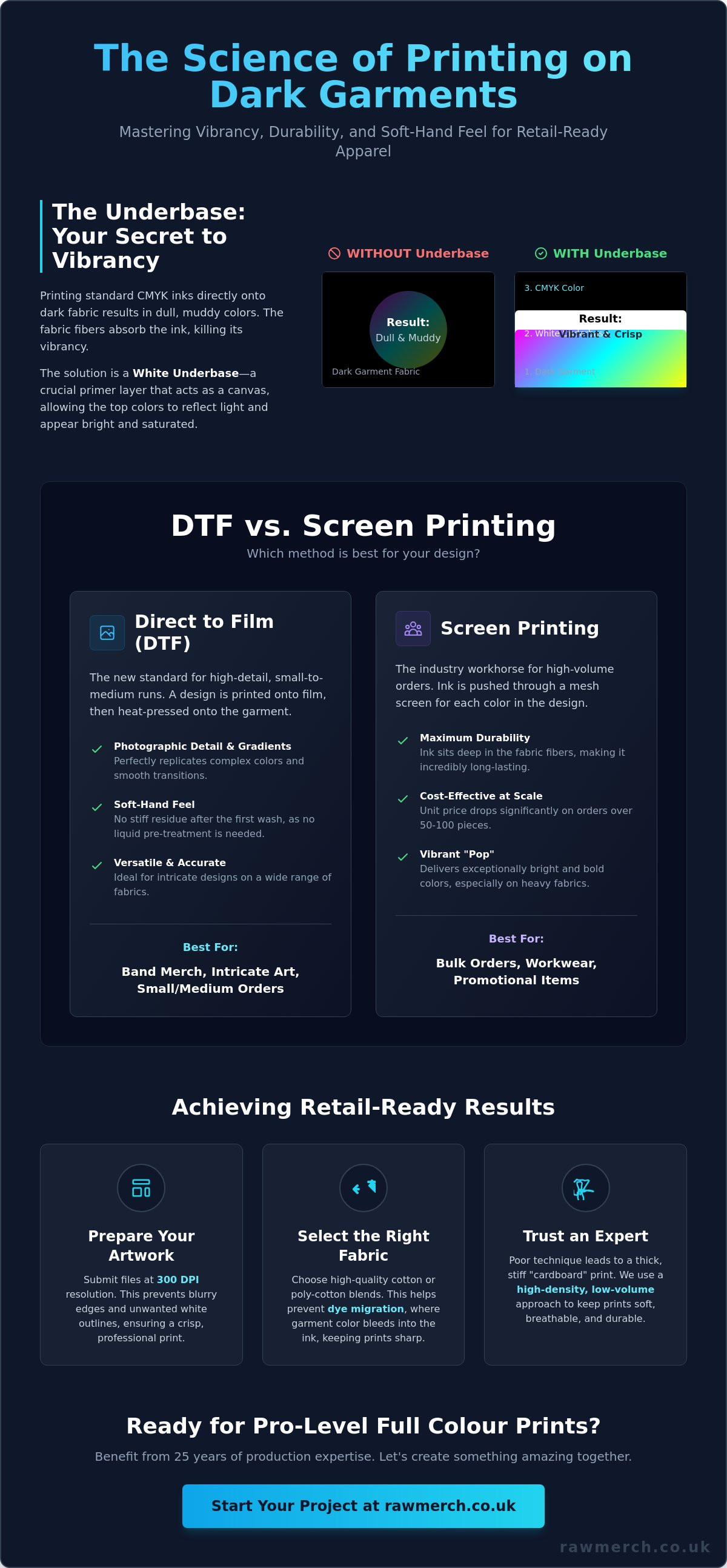
Dark fabric is a light sponge. It drinks up standard CMYK inks, making your vibrant design look like a ghost on a black shirt. This happens because dark fibres naturally absorb light rather than reflecting it. If you print directly onto a navy or black surface, the colours appear dull, muddy, or completely invisible. Professional full colour printing on dark garments solves this by treating the fabric as a canvas that needs preparation. Without a solid foundation, the ink has nothing to bounce off.
Full colour dark garment printing is the specific process of applying a white under-base before any CMYK layers are added. The white under-base is the essential primer for any dark textile project. Without this layer, your creative vision stays trapped in the fabric fibres. We use technical precision to ensure this foundation is solid enough for vibrancy but thin enough for comfort.
The Role of the White Under-Base
Think of painting a dark blue wall with bright yellow paint. If you don't use a white primer first, you get a muddy green mess. The same rule applies to clothing printing. Advanced digital RIP software acts as the brain of the operation. It calculates exactly where to lay down white ink with microscopic accuracy. It doesn't just flood the design; it puts white only where it's needed to make the top colours pop. Smart designers use transparent areas in their artwork to let the garment colour show through. This technique reduces ink usage and significantly improves the soft-hand feel of the finished product.
CMYK vs. RGB in a Dark Merch Context
Your computer monitor is a lie. It uses RGB light to create millions of bright colours that don't always translate to physical ink. Printers use CMYK, which behaves differently on dark substrates. Direct-to-garment printing relies heavily on that white under-base to bridge the gap between digital vibrance and physical reality. If you want a specific purple to look punchy on a navy hoodie, you need an expert who understands colour matching on dark textiles. Standard settings won't cut it. You need technical calibration to ensure the final result matches your expectations.
Poor technique often leads to the "cardboard effect." This happens when a printer lays down far too much white ink to compensate for a lack of equipment calibration. Your custom t-shirts end up feeling like they have a thick, uncomfortable plastic sheet glued to the chest. It's stiff. It doesn't breathe. It cracks after three washes. We focus on a high-density, low-volume approach. This keeps the full colour printing on dark garments retail-ready and soft to the touch while maintaining maximum visual impact.
DTF VS. SCREEN PRINTING: WHICH IS BEST FOR YOUR DESIGN?
Choosing the right production method is the difference between a bestseller and a box of unsold stock. You need to balance the complexity of your design against the size of your order. While there are many ways to handle full colour printing on dark garments, two methods dominate the industry: Direct to Film (DTF) and traditional Screen Printing. One offers surgical precision for complex graphics; the other provides unmatched efficiency for large-scale production. We choose the technique based on your artwork to ensure the best possible result.
Direct to Film (DTF): The New Standard for Detail
Direct to Film (DTF) has completely changed how we handle small-to-medium runs. This process prints your design onto a special film, which is then heat-pressed onto the garment. It allows for photographic detail and smooth gradients that traditional methods often struggle to replicate. Because it requires no liquid pre-treatment, you won't find any stiff residue on the fabric after the first wash. This makes it the ideal choice for band merchandise where intricate album art and high-contrast visuals are the priority. It's fast, accurate, and incredibly versatile for modern designs.
Screen Printing: The Bulk Specialist
Screen Printing remains the industry standard for high-impact, high-volume orders. This method involves burning a unique mesh screen for every individual colour in your design. For a full-colour look, we use a simulated process or four-colour process (CMYK) layering. It is the most cost-effective route once your order crosses the 50 to 100-unit threshold. The ink sits deep in the fibres, providing a level of durability and "pop" that is difficult to beat on heavy hoodies and industrial workwear. If you're looking for maximum longevity in a large batch, this is the king of the warehouse.
Deciding between these two comes down to your specific needs. DTF wins on colour accuracy and detail for smaller batches. Screen printing wins on speed and unit cost for bulk projects. Both methods provide excellent durability if cured correctly. The Science of Textile Printing Techniques shows that modern ink chemistry has closed the gap in "hand-feel," meaning both can produce soft, wearable results. We select the technique based on your artwork’s specific detail level to ensure you never pay for more than you need. If you're ready to start your next project, explore our range of clothing printing options to find the perfect fit for your brand.
PREPARING ARTWORK FOR FULL COLOUR VIBRANCY
Your print is only as good as your file. You can have the best machinery in the world, but a low-quality image will always result in a low-quality product. To achieve professional full colour printing on dark garments, your artwork must be technically sound before it ever hits the production floor. This starts with understanding how digital files interact with the physical layers of ink. If the foundation in your digital file is weak, the physical print will fail.
The "Halo Effect" is the most common mistake in dark garment printing. This happens when a file has a fuzzy edge or a semi-transparent border. The printer sees these pixels and tries to put a white under-base beneath them. The result is an ugly white outline around your design on a black t-shirt. Clean, sharp edges are vital. They ensure the under-base stays perfectly hidden beneath the CMYK layers. You must also provide files with a transparent background. Leaving a white box around your logo means we print a white box on your shirt. It is a simple rule that saves your merch from looking amateur.
Why Vector Images Win Every Time
Vectors are the gold standard for custom apparel. Unlike standard photos, vectors use mathematical paths rather than pixels. This allows for infinite scaling without any loss of crispness. If you want your logo to look as sharp on a massive hoodie back as it does on a small chest print, you need a vector file. It ensures the white under-base aligns perfectly with the top colours every single time. If you're unsure about the technical side, check our guide on what is a vector based image for a complete breakdown. For hand-drawn sketches, scan them at a high resolution and use professional software to trace the lines into a digital format. This extra step guarantees a professional finish.
The Importance of 300 DPI Resolution
If you can't provide a vector, your raster image must be high resolution. Saving an image from a website or Google Images won't work. These files are usually 72 DPI; they look fine on a screen but appear blurry and pixelated when printed on fabric. Low-resolution files force the printer to "guess" where to place the white ink foundation. This leads to muddy colours and lost detail. Professional Textile Printing methods require precision to maintain vibrancy. We require a minimum of 300 DPI at the actual print size to guarantee retail-quality results. If your design is 30cm wide on the shirt, it must be 30cm wide at 300 DPI in your file. Don't compromise on resolution if you want your merch to stand out.
- Always use CMYK colour mode for better accuracy.
- Check your edges at 400% zoom to ensure they are crisp.
- Double-check that all "hidden" layers are deleted before exporting.
SELECTING THE RIGHT GARMENT FOR FULL COLOUR SUCCESS
Don't build a masterpiece on a weak foundation. The garment you choose dictates the final vibrancy and longevity of your print. For full colour printing on dark garments, fabric composition isn't just a detail; it's the core of the entire chemical process. You can have the sharpest artwork in the world, but if the fabric doesn't cooperate, the result will be dull. We prioritize the right canvas to ensure your creative vision translates perfectly to the physical product.
Cotton vs. Polyester: The Technical Battle
100% cotton is the industry standard for a reason. It acts as the perfect canvas for water-based and DTF inks. The fibres are natural and porous, allowing the white under-base to bond deeply and stay put. Polyester is a different beast entirely. High-polyester counts often lead to a nightmare called "dye migration." This happens when the heat from the curing process turns the fabric dye into a gas. That gas then bleeds into your ink. If you print white on a red polyester shirt without the right technical barriers, your white ink will turn pink. This is a common failure in amateur production. Whether you are ordering custom hoodies or custom bobble hats, the fibre mix determines the printing method we use. Mixed-fibre items require specific temperature controls to prevent the dark base from ruining your colours.
Surface Smoothness and "Fibrillation"
Fibrillation is the enemy of a retail-ready finish. It occurs when tiny fabric fibres break through the ink layer, usually after the first wash. This makes your print look "hairy" or prematurely faded. Standard carded cotton has many loose ends that cause this issue. Ring-spun cotton is different. The fibres are twisted and thinned to create a much smoother, tighter surface. This smoothness allows the ink to lay flat and stay vibrant. Premium brands like Stanley/Stella and Continental Clothing are worth the extra cost for dark prints. Their high-quality weave ensures the ink sits on the surface rather than sinking into a fuzzy mess. The weight of the fabric also matters. A heavy 200gsm cotton provides a sturdy drape for large back prints, while a lighter 150gsm shirt offers a softer hand-feel.
We use professional pre-treatments to flatten the fabric surface before the ink ever hits. This extra step ensures your merch feels like a premium garment rather than a stiff plastic billboard. If you want results that last through dozens of washes, you need the right combination of fabric and ink. Start your next project with our professional clothing printing services to ensure your dark garments look and feel retail-ready.
GET PRO-LEVEL FULL COLOUR PRINTS WITH RAW MERCH
We've spent 25 years perfecting the art of full colour printing on dark garments. We don't just push buttons on a machine; we understand the chemistry of ink and the physics of fabric. Our team has handled everything from high-volume corporate uniform orders to complex, multi-coloured band merchandise. We've seen every shift in the industry and invested in the technology that actually delivers results. You get the benefit of a seasoned, no-nonsense expert who prioritises execution and reliability above all else.
UK-based production is the backbone of our service. It allows us to maintain strict quality control over every custom t-shirt and hoodie that leaves our warehouse. We don't outsource your reputation to third parties. Every order is checked by a human being who knows exactly what a retail-quality print should look like. This hands-on approach ensures that your promotional items and headwear meet the highest standards before they ever reach your customers or fans. We handle the technical complexity so you can focus on your creative vision without the stress of production errors.
Why Our 25 Years of Experience Matters
Experience is the difference between a print that lasts and one that fails after the first wash. We know how to avoid the common "peeling" and "fading" traps that plague low-quality shops. These issues often stem from incorrect curing temperatures or poor-quality adhesives. We use only the highest grade inks and films to ensure maximum wash-fastness and durability. Every piece of artwork is reviewed by our technical team before it hits the press. If your file isn't ready for full colour printing on dark garments, we'll tell you immediately. We provide honest, practical advice on which method fits your design, budget, and quantity. We're here to be your partner, not just a supplier.
Ready to Start Your Project?
Getting started is straightforward and efficient. To provide an accurate price, we need your artwork, your garment choice, and your required quantities. Remember the 300 DPI rule we discussed earlier; it makes a massive difference in the final output. We understand that timing is everything, especially for touring bands and major events. Our commitment to scheduling and logistical punctuality means your merch arrives when you need it, where you need it. No excuses. Whether you need uniforms for a new team or a fresh drop of hoodies for your brand, we've got the technical side covered. We take pride in delivering results that exceed expectations every single time.
GET A QUOTE FOR YOUR FULL COLOUR DARK GARMENT PRINTING TODAY!
UPGRADE YOUR MERCH WITH VIBRANT DARK PRINTS
You now have the technical blueprint for achieving professional, retail-ready results on every order. Success depends on a solid white foundation, the correct fabric choice, and high-resolution artwork. Whether you need the photographic detail of DTF or the bulk efficiency of screen printing, your choice defines your brand's reputation. Mastering full colour printing on dark garments is about removing the guesswork and focusing on proven, high-density production methods that stand the test of time.
We bring over 25 years of industry experience to every project we handle. As specialists in both DTF and screen printing, we ensure your designs pop against even the deepest black or navy fabrics. Our UK-based production and fulfillment centre is designed for speed and reliability, making us the trusted partner for touring bands, local businesses, and professional teams. Don't settle for dull or muddy prints when you can have vibrant, durable results that your customers will love to wear. Your creative vision deserves a specialist who prioritises execution and quality control.
START YOUR FULL COLOUR PRINT ORDER NOW
We're ready to help you turn your designs into high-impact merch that grabs attention. Let's get to work on your next project today.
Frequently Asked Questions
Do I need a white under-base for printing on black t-shirts?
Yes, a white under-base is mandatory for vibrant results on black fabric. Think of it as a primer that prevents the dark fibres from absorbing your colours. This foundation reflects light back through the ink, ensuring your design looks exactly as intended. Without it, your print will appear dull or invisible against the dark background.
Will full colour printing on dark garments peel off in the wash?
No, professional full colour printing on dark garments won't peel if it's cured at the correct temperature and pressure. We use industrial-grade adhesives and inks specifically designed for wash-fastness. Proper maintenance, like washing inside out, helps extend the life of the print. Cheap, amateur setups are usually where peeling issues begin.
What is the best file format for full colour printing on dark shirts?
Vector files are the gold standard for any clothing printing project. Formats like .AI, .EPS, or .PDF allow for perfect scaling and sharp edges. If you use raster images, they must be at least 300 DPI at the actual print size. This ensures the digital printer knows exactly where to place the white under-base for a crisp finish.
Can I print full colour on navy or charcoal garments as well as black?
Yes, you can achieve vibrant results on navy, charcoal, or any other dark substrate. The technical process remains the same as printing on black. We apply the white foundation layer first to block the garment's base colour. This allows the CMYK inks to stay bright and accurate, regardless of the fabric's original shade.
Does full colour printing feel thick or "plastic-y" on the shirt?
It doesn't have to feel like a plastic sheet. While some under-base is necessary, our technical process focuses on a high-density, low-volume ink application. This maintains a soft hand-feel while delivering maximum vibrancy. Modern DTF and refined screen printing techniques have significantly reduced the "stiff" sensation common in older dark garment prints.
What is the minimum order quantity for full colour printing on dark garments?
Minimum order quantities depend on the specific printing method chosen for your project. DTF is highly efficient for small-to-medium runs, often allowing for lower entry points. Screen printing is better suited for bulk orders of 50 units or more due to the setup involved. We review your requirements to suggest the most cost-effective route.
Is DTF better than screen printing for multi-coloured designs?
DTF is superior for photographic detail and complex gradients in smaller batches. It captures nuances that screen printing often misses. However, screen printing is the king of efficiency and durability for massive orders. We choose the method based on your design’s complexity to ensure full colour printing on dark garments meets retail standards.
How do I avoid a white "halo" around my design on dark fabric?
You avoid the white halo by providing artwork with perfectly clean edges and a transparent background. Fuzzy pixels or semi-transparent borders confuse the printer's RIP software. It tries to put white ink under those stray pixels, creating a visible outline. Using vector files is the most reliable way to prevent this common production error.