
The most expensive logo decoration isn't always the best one for your brand. Choosing the wrong method for your specific fabric can lead to puckered shirts or prints that peel off after just a few washes. You need a professional finish that stands the test of time. This guide settles the embroidery vs print for logos debate by giving you the technical facts you need to make a confident decision.
You probably worry about complex designs looking like unreadable blobs of thread or feel confused by digitisation fees. It's a common frustration. You want a uniform that reflects your expertise and custom t-shirts or headwear that people feel proud to wear. We understand that durability and professional aesthetics are your top priorities.
We'll break down exactly when to choose embroidery for its 300-wash durability and when printing is the superior choice for lightweight fabrics. You'll discover how to avoid fabric sagging on items under 140 GSM and how to ensure your promotional items look sharp. Get ready to build a merch line that lasts for years without the guesswork.
Key Takeaways
- Learn the technical differences between stitching and ink application to choose the right finish for your brand.
- Discover which decoration method withstands over 300 industrial washes for maximum long-term value.
- Settle the embroidery vs print for logos debate using a professional decision matrix based on your specific order size.
- Understand how setup fees like digitisation and screen costs change depending on your design's colour count.
- Find out why fabric weight is the most critical factor in preventing logo puckering and garment damage.
Logo Decoration 101: Embroidery vs Printing Explained
Your choice of decoration defines your brand's first impression. It's a technical decision that goes beyond simple aesthetics. Embroidery involves high-speed industrial needles driving thread directly through the fabric fibers to create a permanent, raised design. Printing methods like Screen, DTF, or Sublimation work differently by applying a layer of ink or a thin film onto the surface of the material. Both methods deliver professional results when executed by experts using the right machinery, but they interact with your clothing in fundamentally different ways.
The choice between embroidery vs print for logos fundamentally alters the weight and drape of your garments. A heavy embroidered crest on a thin, 120 GSM t-shirt will cause the fabric to sag and pucker. Conversely, a thick plasticol print on a breathable performance polo can block ventilation and feel uncomfortable. Before any production begins, your artwork must undergo logo digitisation, which is the bridge between a digital file and a physical stitch. Understanding the history and techniques of embroidery helps you appreciate why this method remains the gold standard for durability and texture in the modern merch industry.
When to Choose the "Stitched" Look
Embroidery is the superior choice for heavy-duty workwear and corporate apparel. It adds a physical 3D texture that signals "premium" quality and professional authority. If you are ordering hoodies, softshell jackets, or custom bobble hats, thread is the way to go. It handles the thickness of these materials without the risk of cracking over time. Stick to simple, bold logos for this method. Intricate gradients or tiny text can become "blobby" in thread, so keep your design clean to ensure a sharp, professional finish.
When to Choose the "Inked" Look
Choose printing when you need maximum flexibility and vibrant, complex detail. It is the ideal solution for lightweight t-shirts, promotional tote bags, and high-volume band merchandise. Modern printing allows for photographic details and massive back-prints that thread simply cannot replicate. Because the ink sits on or just within the fibers, the garment remains light and moves with the wearer. This is a critical factor when deciding on embroidery vs print for logos for summer events or athletic use where comfort and breathability are non-negotiable.
Custom Embroidery: The Premium, Long-Lasting Choice
Embroidery is the gold standard for longevity. If your team works in demanding environments, you need a logo that survives the grind. When comparing embroidery vs print for logos, the main advantage of thread is its sheer physical resilience. An embroidered design can withstand 200 to 300 industrial wash cycles. It often outlasts the actual garment itself. This makes it the standard choice for corporate uniforms—such as those provided by The Staff Uniform Company—hospitality staff, and premium streetwear brands that prioritise quality over cost. The raised texture creates a professional aesthetic that flat printing cannot replicate. It signals that your brand is established and serious about its image.
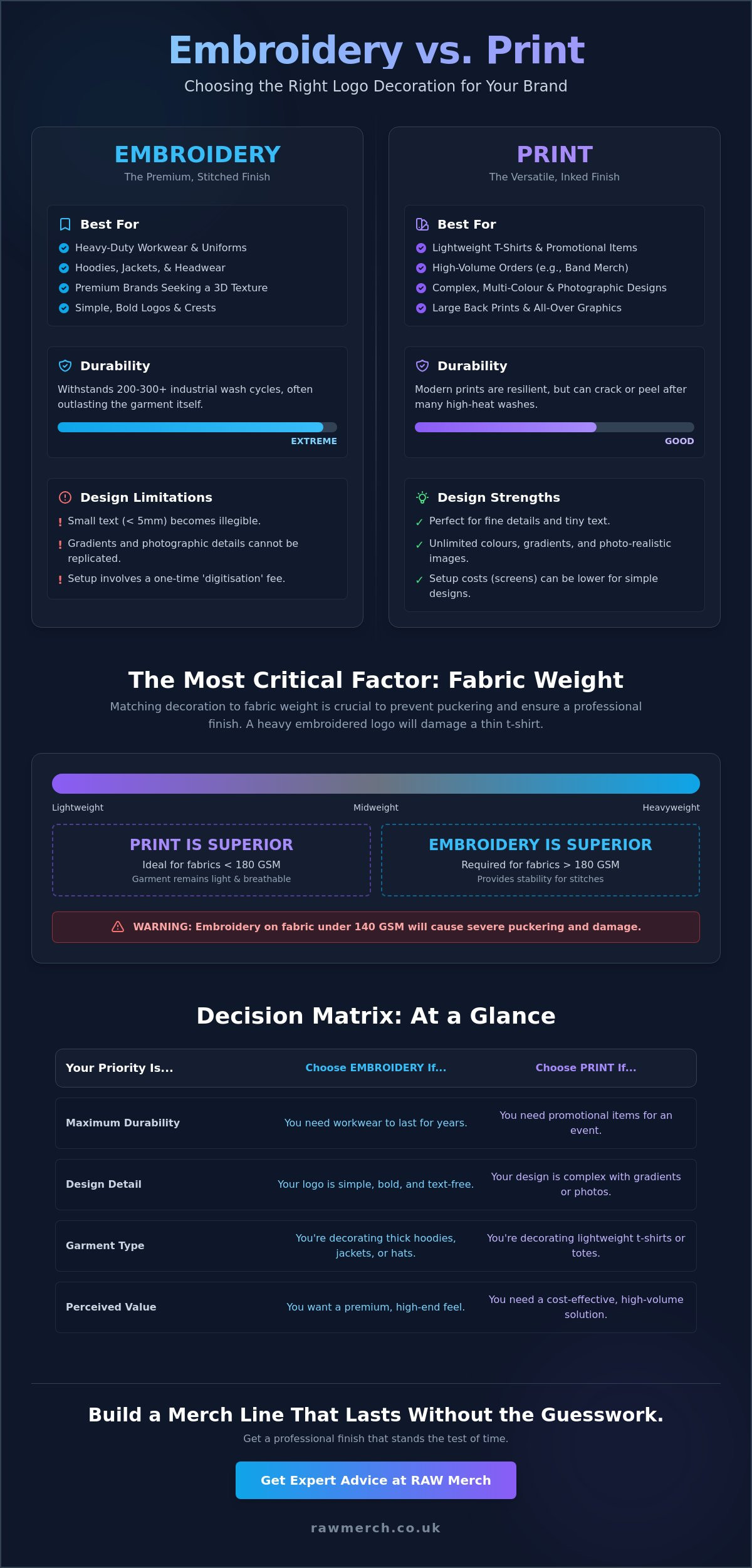
You must match the decoration to the fabric weight. We recommend using materials over 180gsm for all embroidery projects. Stitched logos on thin fabrics will cause puckering, which looks unprofessional and ruins the drape of the clothing. Heavyweight cotton and polyester blends provide the stability needed to hold thousands of stitches without pulling. While we have a massive range of thread colours available, you are limited to physical thread stocks. Most brands find a near-perfect match, but it's a point to consider if your brand relies on very specific, unconventional neon or pastel shades. We always advise on the best thread match to ensure your corporate identity remains consistent.
The Durability Factor for UK Workwear
UK weather and industrial laundry processes are tough on clothing. Embroidery excels here because the colour is locked into the thread itself. It won't peel off or crack like a surface-level print might after exposure to heavy rain or high-heat drying. For outdoor staff or manual labourers, this is a "one-time" investment. You pay for the quality once and reap the benefits for the entire lifespan of the uniform. If you want to see how this looks on professional gear, browse our range of custom hoodies and headwear to find the right fit for your team.
Logo Limitations in Thread
Thread has physical boundaries that ink does not. Small text under 5mm in height usually becomes illegible once stitched. The needles simply cannot move fast enough or tight enough to maintain clarity at that scale. You should also avoid complex gradients or photographic shading. Embroidery works best with solid blocks of colour and clean lines. To get the best results, start with a high-quality file. A vector image is the essential starting point for clean digitisation. It allows our experts to map out every stitch path with precision, ensuring your logo looks sharp rather than blobby.
Garment Printing: Versatility for Modern Brands
Printing offers a level of creative freedom that thread simply can't match. While embroidery provides that classic, premium texture, modern printing methods allow for intricate gradients, photographic details, and massive designs that stay lightweight. When evaluating embroidery vs print for logos, you must consider the complexity of your artwork and the weight of your garment. Large, solid prints on thin cotton remain breathable and move naturally with the wearer. This makes ink the go-to choice for summer-weight custom t-shirts and promotional items.
Screen printing remains the heavyweight champion for bulk orders of 50 units or more. It uses physical stencils to push ink into the fabric, resulting in incredibly vibrant colours and a durable finish. For brands with strict identity guidelines, screen printing allows for precise Pantone matching. This ensures your logos look identical across every hoodie and t-shirt in your merch line. It is a reliable, high-speed process that rewards volume with efficiency.
Screen Printing vs DTF: Which is Best for You?
Direct to Film (DTF) is revolutionising the industry by filling the gap where screen printing becomes too expensive. Traditional screen printing requires a separate setup for every colour in your logo. DTF skips this by printing your design onto a special film before heat-transferring it to the garment. It handles unlimited colours and razor-sharp fine lines without massive setup fees. Modern DTF produces a "soft-feel" finish that is a far cry from the stiff, plastic transfers of the past. It's the perfect solution for small runs of highly detailed logos.
Maximising the Impact of Printed Merch
The Decision Matrix: Quantity, Budget, and Detail
Your final decision on embroidery vs print for logos usually comes down to three factors: quantity, budget, and design detail. Many people assume embroidery is always the more expensive option, but that isn't true for every order. The "break-even" point depends heavily on your logo's colour count and the total number of items you need. While printing scales beautifully for massive runs, embroidery offers a unique cost advantage for complex, multi-coloured logos in smaller quantities. It's about matching the technical process to your specific project goals.
Design detail is the ultimate deal-breaker. If your logo features complex gradients, drop shadows, or photographic "glow" effects, printing is your only viable path. Thread cannot replicate a fade from one colour to another with the same precision as ink. However, if your brand uses solid, bold blocks of colour, embroidery provides a professional, high-relief look that stays consistent from the first garment to the last. Quantity changes the game. While screen printing becomes incredibly cheap as you move into the hundreds, embroidery costs remain relatively consistent per unit regardless of the volume.
Cost Comparison: The Setup Fee Reality
Understanding setup fees is critical for your budget. Screen printing requires a physical screen for every single colour in your design. A one-colour logo is cheap to set up, but a six-colour logo requires six separate screens, which can be a massive upfront investment. Embroidery works differently. You pay a one-off digitisation fee to convert your file into a stitch map. This fee is the same whether your logo has two colours or ten. For a small team order with a multi-coloured logo, embroidery is often the cheaper path. The "sweet spot" for small businesses is often DTF for high-detail designs or embroidery for long-term uniform durability.
Fabric Compatibility Check
The garment itself often dictates the method. Polos and fleeces are built for embroidery. Printing on textured pique or high-pile fleece can look messy and uneven as the ink struggles to settle on the bumpy surface. Conversely, t-shirts and tote bags are perfect for printing. Embroidery on a light t-shirt can feel heavy, "scratchy" against the skin, and may cause the fabric to pull. Always check the Grams per Square Metre (GSM) of your garment before choosing a method. If you aren't sure which path is right for your brand, request a quote for your custom hoodies and uniforms and our experts will guide you.
Expert Execution: Getting Your Merch Right with RAW Merch
Experience is the difference between a logo that fails and a brand that shines. With 25+ years in the UK merch industry, we don't just take orders; we provide expert advice. We've seen every possible mistake in the book. We know why a design might look great on a screen but fail on a polo shirt. Our team empowers your creative vision by using pro-level equipment and decades of technical knowledge. We ensure your custom t-shirts, hoodies, and promotional items meet the highest professional standards every time.
Deciding on embroidery vs print for logos shouldn't be a guessing game. Our in-house specialists review every single piece of artwork before production begins. If we think a logo is too detailed for thread, we'll tell you. If a print won't hold up on a specific fabric, we'll suggest a better alternative. We operate with fast-paced, efficient production schedules because we respect your deadlines. You get high-quality results without the unnecessary complications or delays often found with less experienced providers.
The RAW Merch Advantage
We provide direct, no-nonsense expert advice on whether your logo will "stitch well" or if it requires the precision of ink. One of our core strengths is handling mixed orders under one roof. Many brands require embroidered headwear for a premium feel but prefer clothing printing for their event t-shirts. We offer DTF, Screen Printing, and Embroidery in-house, ensuring your branding remains consistent across different products. As a UK-based business, we understand the local market and provide reliable logistics you can trust.
How to Start Your Order
Getting your merch right starts with high-quality files. Submit your artwork in a high-res or vector format to ensure a fast, accurate quote. When you contact us, tell us the "job" of the garment. A t-shirt for a one-day promotional giveaway requires a different approach than a heavy-duty uniform designed to last for four years. We match the decoration method to the intended use of the clothing to give you the best possible value for your budget. We are ready to help you build a professional merch line that stands out.
GET A QUICK QUOTE FOR YOUR CUSTOM LOGOS
Build Your Brand With Professional Merch
You now have the technical knowledge to choose the right decoration method for your team. Fabric weight is the most critical factor; keep embroidery for heavy materials and use printing for your lightweight t-shirts. The embroidery vs print for logos decision is much simpler when you factor in your design's colour count and the total quantity you need. We've spent over 25 years perfecting these methods to ensure your results are sharp and durable.
Our in-house UK production team handles everything from bulk screen printing to detailed embroidery with total precision. We're trusted by bands and businesses nationwide to deliver professional gear on time. Don't leave your brand's reputation to chance. Let our experts review your artwork and recommend the best path forward for your specific project. Your creative vision deserves the highest quality execution.
GET A CUSTOM QUOTE FROM THE UK MERCH EXPERTS
Frequently Asked Questions
Is embroidery more expensive than printing for small orders?
Embroidery is often more cost-effective for small runs of 1 to 24 items. Screen printing requires expensive physical screens for every colour in your design, which drives up the unit price for low volumes. A one-time digitisation fee makes embroidery a smarter choice for small teams. It allows for high-quality results without the heavy setup burden associated with traditional printing methods.
Will my printed logo peel off in the wash?
Modern printing methods are extremely durable when applied correctly using industrial equipment. Our screen printing and DTF processes are designed to last for the life of the garment. While some low-end transfers might peel, our professional prints withstand 80 to 150 commercial washes. We use professional-grade inks and heat-press technology to ensure your branding remains sharp through every laundry cycle.
Can any logo be embroidered?
Most logos work well, but thread has physical limits that ink does not. Very small text under 5mm or complex colour gradients are difficult to replicate with needles and thread. We analyze the embroidery vs print for logos technical requirements for every order. If your design is too intricate for stitching, we will recommend a high-detail print method like DTF to keep your branding clear.
What is digitisation in embroidery?
Digitisation is the technical bridge between your digital file and the physical embroidery machine. It is not just a file conversion; it involves a specialist mapping out every stitch direction, length, and density. This ensures the machine knows exactly how to recreate your logo in thread. This one-off process is essential for achieving a clean, professional finish on your hoodies, headwear, or uniforms.
Which is better for high-visibility (Hi-Vis) workwear?
Embroidery is the standard choice for Hi-Vis workwear and outdoor gear. Stitched logos handle the rough texture and waterproof coatings of safety vests and jackets better than surface-level ink. Thread won't crack or peel when exposed to harsh weather conditions or industrial cleaning. It ensures your team stays visible and professional while maintaining the integrity of the garment's safety features over long-term use.
Can I have both embroidery and printing on the same garment?
You can absolutely combine both methods on a single garment for a high-impact look. This is a common strategy for premium merch lines and corporate uniforms. You might choose a high-relief embroidered logo on the chest and a vibrant screen print across the back. Mixing methods allows you to balance the premium feel of thread with the large-scale visibility of ink on the same piece of clothing.
What file format do I need for my logo?
Vector files such as .AI, .EPS, or high-resolution .PDFs are the best formats for professional results. These files allow us to scale your logo up or down without any loss of clarity or detail. When comparing embroidery vs print for logos, having a vector file is the essential starting point for both decoration paths. If you only have raster files like .JPG, we can often convert them, but vectors ensure total precision.
How long does custom embroidery or printing usually take?
Our production schedules are designed for speed and reliability. Most custom orders are completed and ready for dispatch within 7 to 10 working days from the moment you approve the final artwork. We provide clear timelines at the start of every project to ensure we meet your specific deadlines. Our efficient in-house UK production team prioritizes execution and scheduling to keep your brand moving forward.