
What if the traditional "gold standard" of screen printing is actually costing your UK business more than it's worth in 2026? Choosing between dtf vs screen printing uk isn't just about ink on fabric. It's a critical decision for your bottom line. You want custom apparel that stays vibrant through 50+ washes. You don't want the headache of hidden setup fees or complex vector file requirements. Whether you're launching a streetwear line or ordering staff uniforms, the right choice depends on your volume and your need for speed.
We know the frustration of prints that crack and the confusion over setup costs for small runs. This guide provides the definitive comparison between Direct to Film and Screen Printing. You'll learn the exact break-even point where one method outshines the other. We'll show you how to secure a fast turnaround from a UK-based facility. Discover how to get durable merch that fans or staff will actually wear. We're here to help you choose the perfect method for your next project with total confidence.
Key Takeaways
- Master the technical differences between traditional mesh stencils and digital film transfers to choose the right tech for your custom apparel.
- Calculate your true ROI by comparing screen printing setup fees against the flexibility of DTF for short-run orders and samples.
- Evaluate dtf vs screen printing uk to ensure your complex, high-detail designs maintain professional quality through dozens of industrial washes.
- Match your specific merchandise needs, from durable band hoodies to professional corporate uniforms, with the most efficient production method available.
- Get the facts on UK-based production timelines to guarantee your custom clothing is ready for your next event or product launch.
What Are DTF and Screen Printing? The Basics Explained
The UK custom apparel market has hit a turning point. You need to understand the mechanics before you commit your budget. Screen printing is the heavyweight champion of high-volume production. DTF is the agile challenger redefining what's possible for small batches. In 2026, the most successful brands use a hybrid strategy. They combine both methods to maximize efficiency and profit. This isn't just about picking a printer. It's about choosing the right tool for your specific project goals.
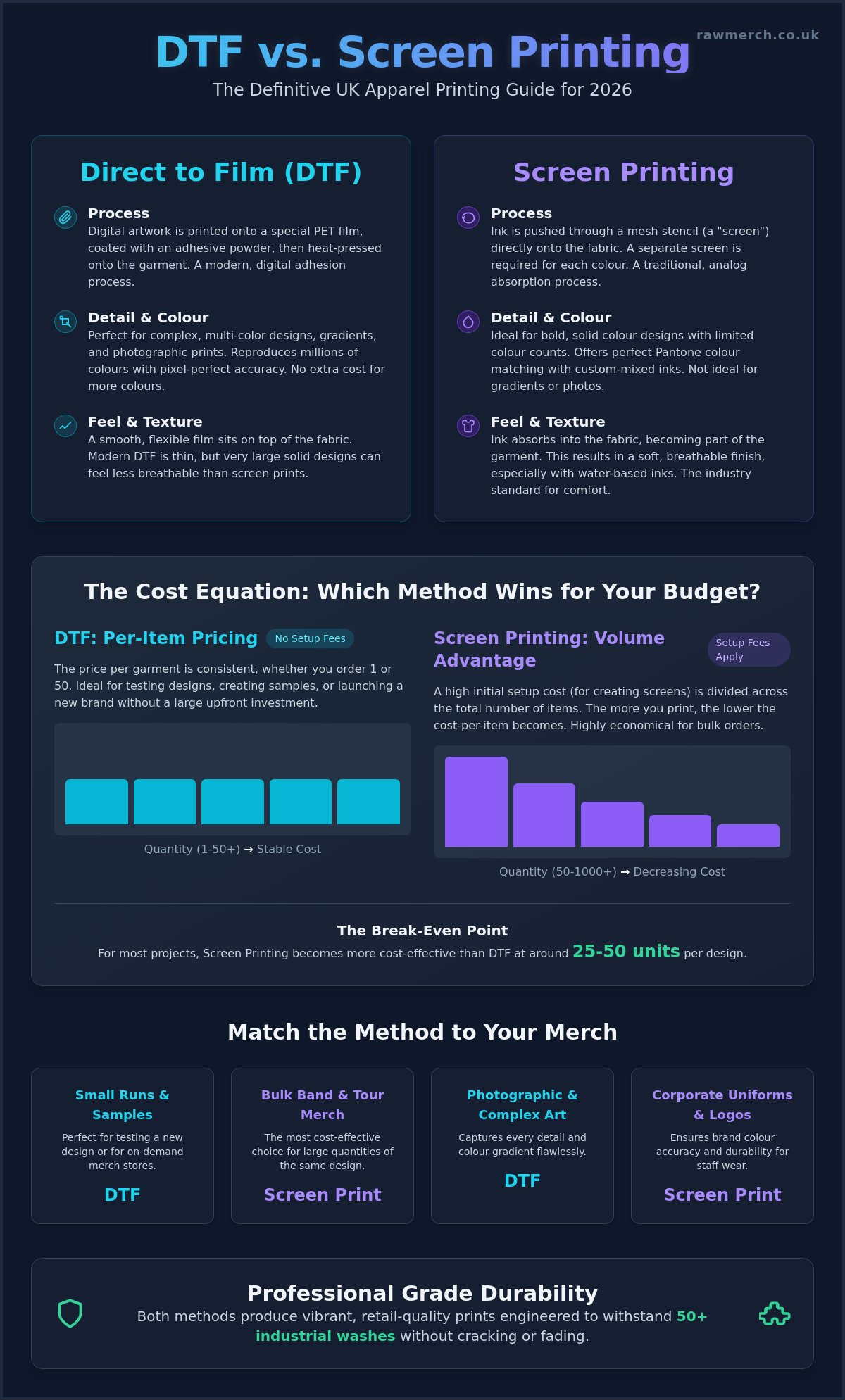
The core difference lies in how the design meets the garment. Screen printing is an analog process. It relies on ink absorption into the fabric fibers. This creates a deep, integrated bond. DTF is a digital process. It uses a specialized film and adhesive powder to create a bond on the surface. Understanding dtf vs screen printing uk means knowing when to choose physical ink penetration over digital film adhesion. Both methods result in professional, retail-quality clothing printing, but the path to get there is very different.
The Screen Printing Process: Tradition Meets Scale
We've used screen printing for over 25 years because it delivers consistent results. The process starts by "burning" a design into a fine mesh screen. If your design has four colours, we create four separate screens. Ink is then pushed through the mesh directly onto the fabric. We use plastisol inks for vibrant, thick coverage or water-based inks for a softer, breathable feel. It remains the industry gold standard for large orders of custom t-shirts and hoodies. The setup takes time and precision, but the speed of the actual print run is unmatched once the screens are on the press.
The DTF Revolution: Digital Precision
Direct to Film has evolved rapidly. By 2026, the technology has moved past the "thick" feel of early transfers. The Direct-to-Film (DTF) printing process involves printing your artwork onto a PET film using specialized inkjet printers. A hot-melt adhesive powder is applied to the wet ink and cured. This creates a transfer that is ready to be heat-pressed onto almost any material, including headwear and promotional items.
This digital method handles millions of colours effortlessly. You don't need extra screens for gradients, photographic detail, or complex shadows. The biggest win for your business? No minimum order quantities. You can print a single, highly detailed garment without the massive setup costs associated with traditional methods. This efficiency allows brands to pivot quickly, and you can discover more about Timed Preorder Streetwear Drops to see how this technology supports limited-edition business models. Modern DTF adhesives are thinner and more flexible than ever. They provide a smooth "hand-feel" that rivals high-end screen prints while maintaining incredible durability through 50+ washes.
Detail, Colour, and Feel: The Visual Head-to-Head
Visuals sell merch. It's that simple. When you weigh up dtf vs screen printing uk for your next collection, you must consider how the design actually interacts with the fabric. One method captures every pixel of a digital file; the other creates a classic, integrated texture that fans have loved for decades. Your choice dictates whether your merch feels like a premium retail item or a budget giveaway.
Vibrancy and Complex Designs
DTF is the clear winner for complex artwork. It handles fine lines, tiny text, and intricate shadows that often "choke" or bleed during the screen printing process. Because it's a digital method, it reproduces gradients with perfect clarity. If your brand relies on a specific Pantone colour, screen printing offers unmatched accuracy through custom ink mixing. However, most modern brands find that the high-resolution CMYK output of DTF is more than sufficient for vibrant, eye-catching results. Photographic prints always favour the DTF method because they don't require the expensive and time-consuming multi-screen separations needed for analog printing.
Texture and Wearability
The "hand-feel" is where these two methods diverge most sharply. Screen printing inks, especially water-based varieties, sink into the fabric fibers. This creates a soft, breathable finish that becomes part of the garment itself. Professional facilities adhere to screen printing safety standards to ensure that every chemical and ink used is handled with care for both the producer and the wearer. This integrated feel is why screen printing remains the preferred choice for massive back-prints on hoodies or heavy cotton tees.
DTF creates a smooth, thin film that sits on top of the fabric. While 2026 technology has made these transfers incredibly flexible, a very large solid design can still create a "sweat patch" effect because the film isn't porous. For smaller chest logos or sleeve prints, this isn't an issue. If you're looking for the best results on tricky fabrics, keep these points in mind:
- 100% Cotton: Screen printing is the king of comfort and breathability here.
- Polyester and Blends: DTF offers superior adhesion and won't suffer from dye migration.
- Durability: Both methods easily withstand 50+ washes when cured correctly.
- Fine Detail: DTF maintains the integrity of logos with complex edges and floating elements.
Choosing the right finish ensures your fans or staff actually want to wear the gear you produce. If you want to see these finishes in person, reach out to us at RAW Merch for expert advice on which method suits your specific artwork and fabric choice.
The Cost Equation: Which Method Wins in the UK?
Your choice between dtf vs screen printing uk often comes down to the balance sheet. Merch managers and brand owners must understand the "hidden math" of production. Screen printing carries upfront costs that can eat your margin on small orders. DTF eliminates those barriers but has higher per-unit costs at scale. Finding your break-even point is the key to a successful project.
In the current UK market, the break-even point typically falls between 24 and 48 pieces for simple designs. If you're ordering 10 units, DTF is the obvious winner. If you're ordering 500, screen printing is unbeatable. Local UK production also means you save on international shipping and customs. These hidden expenses often double the price of overseas merch and extend your lead times by weeks.
Screen Printing: The Bulk Discount King
Screen printing is built for volume. Every colour in your design requires a physical screen. These "screen charges" represent the labour and materials needed to set up the official screen printing process correctly. For a five-colour design on just ten shirts, these fees make the unit price astronomical. However, once you hit 50 or 100 units, those setup costs are spread thin. The per-shirt price drops significantly.
Simple one-colour designs are almost always better suited for screen printing. The setup is fast, and the ink costs are minimal. This method maximizes your profit margins for retail merch. When you're selling at festivals or online, every pound saved on production goes straight back into your business. It's the most reliable way to scale your brand once you've proven your designs with your audience.
DTF: Flexibility Without the Fees
DTF is the king of the short run. Because there are no screens to burn, there are no setup fees. This makes it perfect for testing new designs or creating one-off samples for a photoshoot. You get the same high-quality clothing printing whether you order one shirt or twenty. For multi-colour logos on small orders, DTF is significantly more cost-effective. You don't pay extra for every colour in the rainbow.
Both methods require high-quality artwork to get the best results. You need to understand what is a vector based image to ensure your prints are sharp and professional. Using low-resolution files will lead to blurry results regardless of the print method. DTF allows you to move from design to finished product in a fraction of the time. This speed is vital for UK businesses that need to react to trends or restock popular items quickly.
Which Method for Your Merch? Practical UK Applications
Theory is one thing; the reality of the UK merch market is another. Your decision on dtf vs screen printing uk should be driven by the end-use of the garment. A tour shirt destined for a mosh pit requires a different approach than a promotional tote bag for a corporate event. We look at the practicalities of every project to ensure you get the best ROI and a product that lasts.
Bands and Touring Merch
Screen printing remains the soul of band merchandise. It provides that classic, heavy-ink feel that fans associate with premium tour gear. It is incredibly durable. These shirts survive the rigours of the road and hundreds of wash cycles without losing their impact. However, the industry is changing. If your album art features complex gradients or photographic detail, DTF is a game-changer. It allows you to reproduce intricate artwork on a tour shirt without the massive setup costs of a ten-colour screen print. For UK bands managing online stores, DTF is perfect for small restocks between tour dates. You can keep your fans happy without holding thousands of pounds in unsold stock.
Uniforms and Promotional Wear
Durability for workwear is a top priority. Your staff uniforms need to survive frequent industrial washing while maintaining a professional look. For large branding on the back of hoodies, screen printing is often the most cost-effective and breathable choice. For small, precise logo placements on the left chest of a polo, DTF is the superior option. It handles small text and sharp brand colours with ease, even on tricky polyester blends or piqué fabrics. This ensures your brand looks consistent across your entire range, from headwear to custom t-shirts. DTF transfers are also perfect for branding promotional items that are difficult to fit on a traditional screen press.
High-volume events require a different strategy. If you need 2,000 shirts for a London tech conference, screen printing is the undisputed king of low-cost, high-speed production. Conversely, limited edition "drops" benefit from the flexibility of DTF. You can launch a new design on your website and print only what you sell. This "on-demand" approach is the smartest way to test the market in 2026. Ready to get your project moving? Speak with our UK-based printing team to find the most efficient path for your merchandise.
RAW Merch: 25 Years of UK Printing Excellence
Choosing between dtf vs screen printing uk shouldn't be a guessing game. At RAW Merch, we provide both technologies under one roof. This allows us to give unbiased, expert advice based on your specific order volume and design complexity. We don't push one method because it's easier for us. We recommend the one that is best for your bottom line. Our UK facility is built for efficiency. We ensure your creative vision translates perfectly onto the final product.
The UK printing industry is projected to hit £8.4 billion in revenue during the 2026-27 period. We are proud to be a part of this thriving sector. Our commitment to UK-based production means you avoid the logistical nightmares of overseas shipping. You get fast turnarounds. You get clear communication. Most importantly, you get durable merch that represents your brand with total authority. We handle everything from custom t-shirts and hoodies to promotional items and headwear.
Expertise You Can Trust
We have 25 years of experience in the garment decoration industry. We've seen every print trend come and go. This tenure is your guarantee of quality. Our no-nonsense approach means we tell you exactly what will work for your fabric and artwork. We understand the technical nuances of ink chemistry and film adhesion. Whether you need a small batch of 24 pieces or a massive run of 1,000+ units, our team applies the same level of precision to every print. Our facility is equipped to handle diverse requirements, including laser engraving and specialized clothing printing for uniforms.
Ready to Start Your Order?
Getting your design from a digital file to a finished garment is simple with our team. We guide you through the file requirements to ensure your artwork is print-ready. Our fulfillment services are a game-changer for UK brands. We can store, pack, and ship your orders directly to your customers. This frees you up to focus on growing your business while we handle the heavy lifting. We prioritise execution and scheduling to meet your deadlines every time.
Our turnaround times are some of the fastest in the country. Many DTF projects can be completed in 24-48 hours. Traditional screen printing orders typically move through our shop in 7-10 business days. We never sacrifice quality for speed. Every item undergoes a rigorous check before it leaves our facility. Stop wasting time with providers who don't understand your needs. Secure the professional results your project deserves.
GET A FAST QUOTE ON YOUR CUSTOM PRINTING TODAY!
SCALE YOUR BRAND WITH THE RIGHT PRINT TECH
Your merch strategy for 2026 depends on balancing order volume with design complexity. Screen printing remains the powerhouse for bulk orders and classic band gear. DTF has emerged as the flexible champion for small runs and photographic detail. Making the right choice for dtf vs screen printing uk ensures your project stays on budget and on schedule. You don't have to navigate these technical decisions alone. We've seen every trend and technology shift over the years, and we're here to guide you.
Our team brings 25+ years of industry experience to every project we handle. We operate from a dedicated UK-based production and fulfillment facility. This means you get expert advice and fast turnarounds without international shipping delays. We are specialists in both touring band gear and professional corporate uniforms. We prioritize your creative vision and your budget to deliver retail-quality results every time. Stop guessing and start creating with a partner you can trust. Let's get your designs onto the garments your fans and staff will love.
GET YOUR CUSTOM PRINT QUOTE NOW!
Frequently Asked Questions
Is DTF better than screen printing for t-shirts?
The best method depends entirely on your order volume and design complexity. DTF is the superior choice for small runs under 25 pieces or designs with complex gradients and photographic detail. Screen printing remains the heavyweight champion for bulk orders where the lowest per-unit cost is your priority. We recommend analyzing your specific quantity before deciding on dtf vs screen printing uk to ensure you get the best return on your investment.
Does DTF printing crack after washing?
Modern DTF prints do not crack or peel when they are cured properly by a professional facility. The 2026 adhesive technology creates a thin, flexible bond that moves with the fabric fibers. These prints are rated to withstand 50+ industrial washes without losing their colour vibrancy or integrity. Your custom merch will stay looking professional and retail-ready for the entire life of the garment.
What is the minimum order for screen printing at RAW Merch?
Our screen printing services typically start at a minimum of 24 to 48 pieces per design. This requirement covers the labour and material costs involved in burning individual mesh screens for each colour. If you only need a handful of shirts or a one-off sample for a photoshoot, our DTF service has no minimum order requirements. This flexibility allows you to test new designs without a large upfront financial commitment.
Can I use DTF for my band's complex album cover art?
DTF is the perfect solution for intricate album artwork that features millions of colours. It captures fine lines and subtle shadows that are often lost in traditional screen printing separations. Your band can offer high-detail merch that looks exactly like your digital cover art without paying for ten or more individual screens. It's a game-changer for touring acts who want premium visuals on a tight schedule.
Which printing method is more eco-friendly in the UK?
Both methods offer sustainable benefits depending on how they are used. Screen printing with water-based inks is a traditional eco-friendly choice that many UK brands prefer. DTF is also highly efficient because it produces almost zero ink waste and uses significantly less water during the setup phase compared to screen reclamation. We prioritize environmentally conscious practices across our facility to help your brand meet its sustainability goals.
How do I know if my design needs a vector file?
Your design needs a vector file if it contains sharp lines, text, or brand logos that must be scaled up. Vector files allow us to resize your artwork for anything from a small pocket print to a massive back-piece without any pixelation. While DTF can handle high-resolution raster images for photos, vectors ensure the cleanest possible finish for both print methods. We always check your files to guarantee a professional result.
Is screen printing cheaper for 100 t-shirts?
Screen printing is almost always the more cost-effective choice once you reach an order of 100 t-shirts. The initial setup fees are spread across a larger volume, which brings your per-shirt price down significantly. For simple designs with one or two colours at this quantity, you'll see a much better profit margin compared to digital transfer methods. It's the smartest financial move for established brands and annual events.
What is the turnaround time for DTF vs Screen Printing in the UK?
Turnaround times are driven by the setup requirements of each method. DTF orders are often completed in 24 to 48 hours because they skip the time-consuming screen-burning process. Screen printing typically takes 7 to 10 business days to ensure every screen is perfectly registered and the ink is fully cured. We manage our production schedule tightly to ensure your dtf vs screen printing uk choice arrives exactly when your project demands it.