
In 2026, the old rule that screen printing is the only way to get retail-quality merchandise is officially dead. When comparing dtf vs screen printing uk, the choice is no longer about which looks better; it's about balancing your design complexity against your total order volume. We know the frustration of staring at a quote filled with high setup fees for every single colour or worrying that your brand's reputation will peel away after three washes. You need prints that last and a budget that makes sense for your project.
This guide settles the debate once and for all. We'll help you master the technical and financial differences between these two powerhouses so you can choose the perfect method for your next UK merchandise project. You're going to get total clarity on which process fits your volume, whether you're ordering 20 shirts or 2,000. We'll also dive into the specifics of vector files and wash tests to ensure your gear stays looking sharp for 50+ cycles. From understanding UK VAT to hitting tight deadlines, here's everything you need to know to print with confidence.
Key Takeaways
- Understand the mechanical differences between traditional screen printing and modern Direct to Film (DTF) technology to protect your creative vision.
- Make an informed dtf vs screen printing uk decision by identifying the exact volume where bulk screen printing beats digital pricing.
- Eliminate unnecessary setup fees by matching your specific order size and design complexity to the most cost-effective production method.
- Choose DTF for complex, photographic detail and screen printing for that classic, breathable retail-ready texture.
- Guarantee long-term durability with prints rated for 50+ washes, backed by a UK-based team with 25 years of industry expertise.
DTF vs Screen Printing: Understanding the Tech in 2026
Forget the outdated notion that digital prints are inferior. By 2026, technology has advanced to the point where the choice between dtf vs screen printing uk depends entirely on your project's specific needs. With 25 years in the game, we've seen every shift in this industry. We know that while the tools change, your requirement for a professional, long-lasting finish never does. It's no longer a battle of "new vs old" but a strategic choice of "precision vs scale."
The technical components of these methods have evolved rapidly to meet higher consumer demands. Modern PET films now provide superior release properties, ensuring every drop of ink stays on the fabric rather than the film. Meanwhile, advanced adhesive powders offer better flexibility; this means your prints won't crack when the fabric stretches. Whether we use traditional plastisol inks for that classic retail feel or digital CMYK for photographic precision, the goal is a result that survives the wash and looks sharp on the street.
The Screen Printing Process: Tradition at Scale
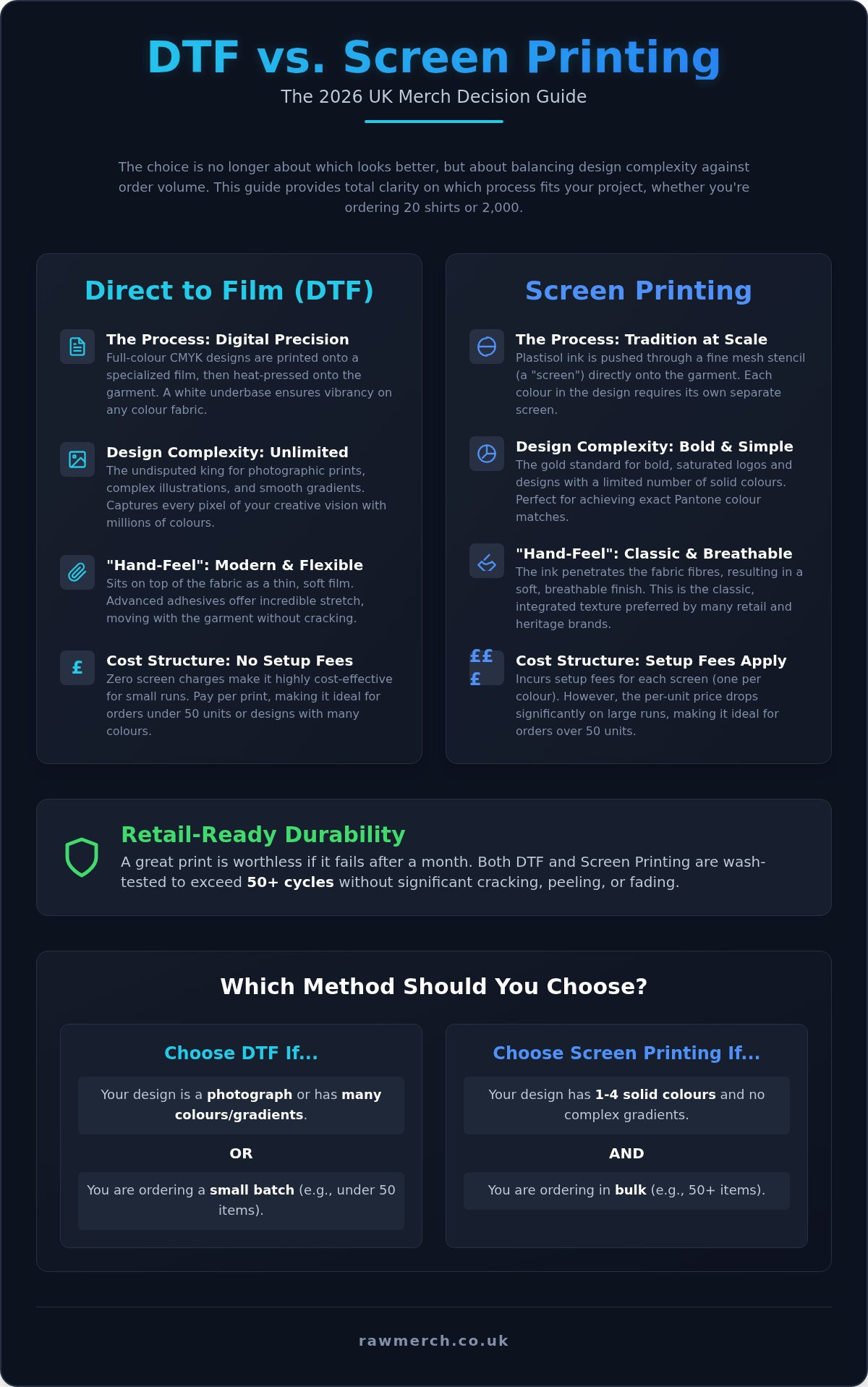
Think of screen printing as a high-speed mechanical assembly line. It relies on pushing plastisol ink through a fine mesh stencil directly onto the garment. Every single colour in your design requires its own physical screen. If your logo has four colours, we build four separate screens. This "one-colour-per-screen" rule is why setup time is the biggest cost factor in any project. We have to burn the image into the mesh, mix the inks, and align the press perfectly before a single shirt is printed. However, once that setup is complete, it is the most efficient way to produce hundreds of items with absolute consistency. It's the gold standard for cotton-heavy hoodies and t-shirts where a bold, saturated look is the priority.
The DTF Revolution: Digital Precision
The Direct-to-film (DTF) printing process has flipped the script for complex, multi-colour graphics. Because it's a digital process, there are zero screens to burn and zero setup fees. Our printers create full-colour CMYK designs in a single pass onto a specialized film. A critical component of this tech is the white underbase. The printer lays down a solid layer of white ink behind your colours, ensuring that even on a pitch-black garment, your design stays vibrant and opaque. This method allows for intricate gradients and photographic details that traditional screens simply cannot replicate without massive costs. For smaller runs or highly detailed artwork, DTF provides a level of digital precision that was impossible just a few years ago.
Print Quality, Durability, and the Hand-Feel Test
Quality in 2026 isn't a compromise. Whether you choose dtf vs screen printing uk, the result must be retail-ready and professional. The real difference lies in how the print interacts with the fabric and how your eyes perceive the detail. We've spent 25 years perfecting both methods at our UK facility; we know that a great-looking shirt is worthless if the print fails after a month of wear. Modern standards demand both visual impact and long-term resilience.
Vibrancy and Complex Designs
DTF is the undisputed king for high-detail illustrations and photographic prints. Because it uses digital CMYK technology, it reproduces millions of colours and complex gradients with ease. There are no "halftones" to worry about; those tiny dots often seen in screen-printed gradients are replaced by smooth, digital precision. Screen printing achieves its vibrancy through thick, opaque ink deposits. It creates a bold, saturated look that is hard to beat for simple logos. However, if your artwork contains fine lines, shadows, or 20 different shades, DTF is the only choice that captures every pixel. For brands that need their complex creative vision translated exactly to a custom t-shirt or hoodie, digital precision is the way forward.
The Texture and Wearability Factor
Industry experts use the term "hand-feel" to describe how a print feels to the touch. Screen printing is famous for its "sinking ink" quality. The ink often penetrates the fibres, especially with water-based processes, leaving a breathable and soft finish. Many heritage brands and touring bands prefer this classic, integrated texture. DTF, by contrast, sits on top of the fabric as a thin film layer.
Don't let the "plastic" myths of the past fool you. By 2026, the PET films and adhesive powders used in the DTF process have evolved to offer incredible stretch and softness. These prints move with the garment rather than feeling like a stiff patch. Durability is no longer a deciding factor between the two. Wash-test results for both methods now exceed 50 cycles without significant cracking or peeling. If you need exact Pantone matching for a corporate identity, screen printing remains the professional choice. If you want a soft, multi-colour print for a small run of promotional items, modern DTF delivers the durability you need without the setup hassle.
Calculating Your Costs: Setup Fees vs Unit Prices
Choosing between dtf vs screen printing uk is a financial calculation as much as a creative one. You need to understand where your money goes before the first garment hits the dryer. Screen printing relies on physical hardware. Industry averages for setup fees in 2026 typically range from £20 to £30 per screen. If your design has five colours, you are looking at £100 to £150 in setup costs alone. You also pay for film positives and precise ink mixing. DTF eliminates these "hidden" entry costs entirely. You pay zero setup fees because the process is purely digital.
The trade-off is the unit price. DTF has a higher cost per print because the specialized films and adhesive powders are expensive consumables. The "break-even point" is the magic number where one method becomes cheaper than the other. For simple designs with one or two colours, screen printing usually becomes more cost-effective once you hit 50 to 100 units. If your artwork is complex with four or more colours, DTF often remains the more economical choice for orders up to 150 pieces. For one-off prototypes or small runs of 20 shirts, DTF is the undisputed king of the budget.
Screen Printing: The Bulk Discount King
Volume is the engine that drives screen printing value. Once those screens are burnt and the press is aligned, the cost per shirt drops significantly as the order size grows. This is why touring bands and large corporations almost always choose this route for hundreds of items. It's built for scale. Keep in mind that large bulk orders are heavy. UK shipping costs for 500 hoodies can be substantial, but the steep drop in unit price usually offsets these logistics fees. If you are ordering for a national campaign, the bulk savings are impossible to ignore.
DTF: Flexibility Without the Fees
Small businesses and startups thrive on the flexibility of DTF. Because there are no minimum order quantities (MOQs), you can test a design with five shirts without losing money on setup. It allows for an "on-demand" style of ordering that protects your cash flow. To keep your costs even lower, ensure your artwork is ready for production. Providing high-quality vector images is the best way to avoid additional artwork preparation fees. This digital-first approach means you only pay for what you need, exactly when you need it.
Choosing Your Method: From Band Merch to Corporate Uniforms
Your choice between dtf vs screen printing uk often comes down to the specific environment where the garment will be worn. A heavy-duty work jacket requires a different approach than a vintage-style tour t-shirt. We guide you through these practical decisions based on 25 years of UK production experience. It is about matching the right technology to the right lifestyle. One method might save you money, but the other might better protect your brand's reputation in the field.
Streetwear brands frequently use DTF to launch limited edition drops without the risk of unsold bulk stock. You can test a highly detailed, multi-colour design on 30 premium hoodies and see how your audience reacts. For promotional giveaways, the decision usually shifts to perceived value versus total budget. If you need 1,000 low-cost shirts for a one-day event, screen printing is the winner. If you need 50 high-quality gifts for VIP clients with complex, photographic logos, DTF provides the detail that makes the item feel truly custom.
Bands and Music Merchandise
For companies looking to extend their branding beyond garments, The CEO Creative provides a wide selection of custom promotional products, including stationery and drinkware, to help build a cohesive brand identity.
Touring is a volume game. When you need hundreds of shirts for a UK tour cycle, screen printing is the industry standard for a reason. Fans expect that classic, breathable feel that integrates with the cotton fibres. If you are aiming for a vintage aesthetic with distressed graphics, screen printing delivers a saturated look that digital methods cannot quite replicate. It is the most reliable way to produce high-volume band merchandise that survives life on the road and multiple washes in hotel laundries.
Workwear and Professional Uniforms
Corporate branding often involves complex logos with specific gradients or very small text. DTF is superior for these precise placements on pockets, collars, or sleeves. It also solves the problem of fabric compatibility. While screen printing can struggle on waterproof shells or high-polyester activewear due to ink adhesion and "bleeding" issues, DTF bonds perfectly to these synthetic materials. This ensures your brand consistency remains identical across cotton polos, polyester softshells, and technical rain jackets. We ensure your team looks professional regardless of the weather or the fabric they are wearing.
Stop guessing which method fits your deadline and budget. Contact our UK team for an expert clothing printing quote today.
Expert UK Printing: Why RAW Merch Leads the Way
Experience isn't just a number. It's a guarantee of quality. At RAW Merch, we've spent 25 years navigating the evolution of the UK printing industry. We've seen trends come and go, but our commitment to reliability remains constant. Our facility is designed to handle the dtf vs screen printing uk dilemma by housing both technologies under one roof. We don't outsource. We don't guess. We execute with precision.
Having a dual-tech facility means we switch between methods seamlessly based on your specific deadline and design. If you're a band needing a thousand shirts for a tour starting Friday, we fire up the screen presses. If you're a startup needing a dozen high-detail samples for a pitch, our DTF printers are ready. This versatility ensures you never have to compromise on your creative vision or your budget. We provide the right tool for the right job, every time.
Our service goes beyond just printing. We provide end-to-end fulfillment and distribution. This is critical for touring acts who need merchandise delivered directly to venues across the country. We handle the logistics so you can focus on the performance. From initial design advice to the final delivery, we act as your seasoned partner in production. We understand the physical nature of these products and the urgency of your schedules.
The Benefit of a UK-Based Partner
Local production is your best defense against missed deadlines. International shipping is plagued by customs delays and unpredictable transit times. Choosing a UK-based partner means your gear moves from our facility to your door without crossing borders. You get direct communication with the experts handling your files. We understand the nuances of your artwork and can fix issues before they hit the garment. Supporting local industry isn't just good for the economy; it's the smartest move for your brand's punctuality and peace of mind.
Ready to Start Your Project?
Stop wasting time with generic online calculators. Get a quote tailored to your specific design, fabric choice, and order volume. Every single item we produce is inspected by hand. We check for ink saturation, adhesive strength, and registration accuracy before any box is sealed. We take pride in our work because we know it represents your brand. Contact us today for a free merch consultation. Let's build something that lasts 50+ washes and makes a lasting impression.
CHOOSE THE RIGHT PRINT TECH FOR YOUR BRAND TODAY
The choice between dtf vs screen printing uk is no longer a trade-off in quality. It is a strategic decision based on your specific volume and design complexity. If you are preparing for a massive tour or a national campaign, screen printing still offers the best bulk value. For startups and businesses requiring intricate, photographic detail on technical fabrics, DTF provides the flexibility you need without the burden of setup fees. Both methods now deliver retail-ready durability that lasts 50+ washes.
RAW Merch combines 25+ years of industry experience with our dedicated UK-based production facility. We adhere to Red Dot Quality Standards to ensure every garment meets your expectations for vibrancy and feel. You don't have to navigate technical hurdles alone; we are here to facilitate your creative vision with precision and speed. Stop worrying about setup costs or peeling prints and start building your brand's physical presence.
GET A FAST QUOTE FOR YOUR CUSTOM PRINTING
We are ready to handle the logistics while you focus on the growth. Let's create high-impact merchandise that your fans and employees will be proud to wear for years to come.
Frequently Asked Questions
Is DTF printing as durable as screen printing for workwear?
Modern DTF transfers are exceptionally durable for workwear. They are rated to withstand 50+ wash cycles without significant cracking or peeling. While traditional screen printing is known for its longevity; DTF offers better stretch and flexibility on technical workwear fabrics. We ensure every print meets our Red Dot Quality Standards before it leaves our facility. This means your uniforms stay looking professional even after heavy use in demanding environments.
What is the minimum order quantity for screen printing in the UK?
Screen printing in the UK is most cost-effective for orders of 50 units or more. This is due to the labor-intensive setup process involving physical screens and ink mixing. For smaller projects; we recommend DTF because it requires zero setup fees. This flexibility allows you to order exactly what you need without being forced into high minimums that don't fit your project's current budget or storage capacity.
Can I use DTF printing on 100% polyester sports shirts?
Can I use DTF printing on 100% polyester sports shirts?
You can absolutely use DTF printing on 100% polyester sports shirts. It is often the superior choice for synthetic fabrics because it bonds to the surface without the risk of "dye migration" often seen in screen printing. This ensures your logos stay vibrant and the fabric remains lightweight. It is the go-to method for technical activewear and team jerseys that require high-detail branding on technical materials. To see examples of premium garments in this category, you can discover REP Store and explore their range of specialized training apparel.
Screen printing strictly requires vector files to separate each colour into its own physical screen. While DTF can process high-resolution raster images like transparent PNGs; we always recommend vector files for the sharpest results. Using vectors helps you avoid additional artwork preparation fees and ensures your logo looks crisp at any size. Providing the right files is the fastest way to get your custom project into production.
How much are the typical setup fees for screen printing in 2026?
Typical industry setup fees for screen printing in 2026 average between £20 and £30 per screen. Since each colour in your design requires a separate screen; costs can add up quickly for multi-colour logos. In contrast; the dtf vs screen printing uk debate highlights that DTF has no setup fees at all. This makes digital printing the more economical choice for complex; colourful designs on smaller production runs.
Which method is better for a design with 10+ different colours?
DTF is the better method for designs with 10 or more colours. Screen printing would require 10 separate screens; making the setup costs prohibitive for most projects. DTF uses a digital CMYK process to print unlimited colours and gradients in a single pass. This allows you to maintain incredible detail and vibrancy without the massive financial overhead or the thick ink deposit of traditional multi-screen setups.
How long does shipping take for custom merch within the UK?
Shipping for custom merch within the UK is significantly faster than ordering from overseas. Because we produce everything in our own UK facility; you avoid international shipping delays and unpredictable customs charges. We prioritize efficient scheduling to meet your specific deadlines. Our end-to-end service includes managed distribution; which is perfect for touring bands who need their gear delivered directly to venues without any logistical friction.
Can I get a sample of my design before committing to a bulk order?
You can get a physical sample of your design using the DTF method before committing to a bulk order. DTF is ideal for one-off prototypes because it doesn't require the expensive setup of screen printing. This allows you to check the colour accuracy and hand-feel of your merchandise. It gives you total confidence in the final product before we scale up for your full production run at our facility.