

A beautiful design on your laptop is completely worthless if it costs more to print than your customers are willing to pay. You've likely experienced the sting of seeing a vibrant digital mockup turn into a dull, expensive disappointment on a heavy cotton tee. It's a frustrating cycle that eats your margins and leaves you with piles of unsold stock. Mastering the art of designing t-shirts that sell requires more than just creativity; it demands a deep understanding of the printing press. At RAW Merch, we've spent over 25 years helping UK creators bridge this gap. We know what you want, and we deliver results without the fuss.
This guide provides the exact professional framework used to create bestsellers by applying the technical secrets we've mastered in our workshop. You'll learn how to align your creative vision with commercial reality, ensuring every graphic is perfectly optimised for DTF or screen printing. We'll break down the technical specs you need to eliminate print errors and keep production costs under control. By the end of this article, you'll have the confidence to place a bulk order and watch your merchandise fly off the shelves.
Key Takeaways
- Shift your focus from "art" to "merchandise" by identifying the specific niche tribes that drive high-volume sales.
- Master the professional principles of designing t-shirts that sell, including the "Golden Zone" for graphic placement and sizing strategies.
- Ensure top-tier print quality by understanding the critical differences between vector and raster files for screen printing and DTF.
- Boost your brand’s revenue using commercial tactics like the "Limited Drop" model to create urgency and massive customer demand.
- Leverage 25 years of UK industry experience to streamline your production process from a no-obligation quote to final delivery.
Market-First Design: Why Most T-Shirts Fail to Sell
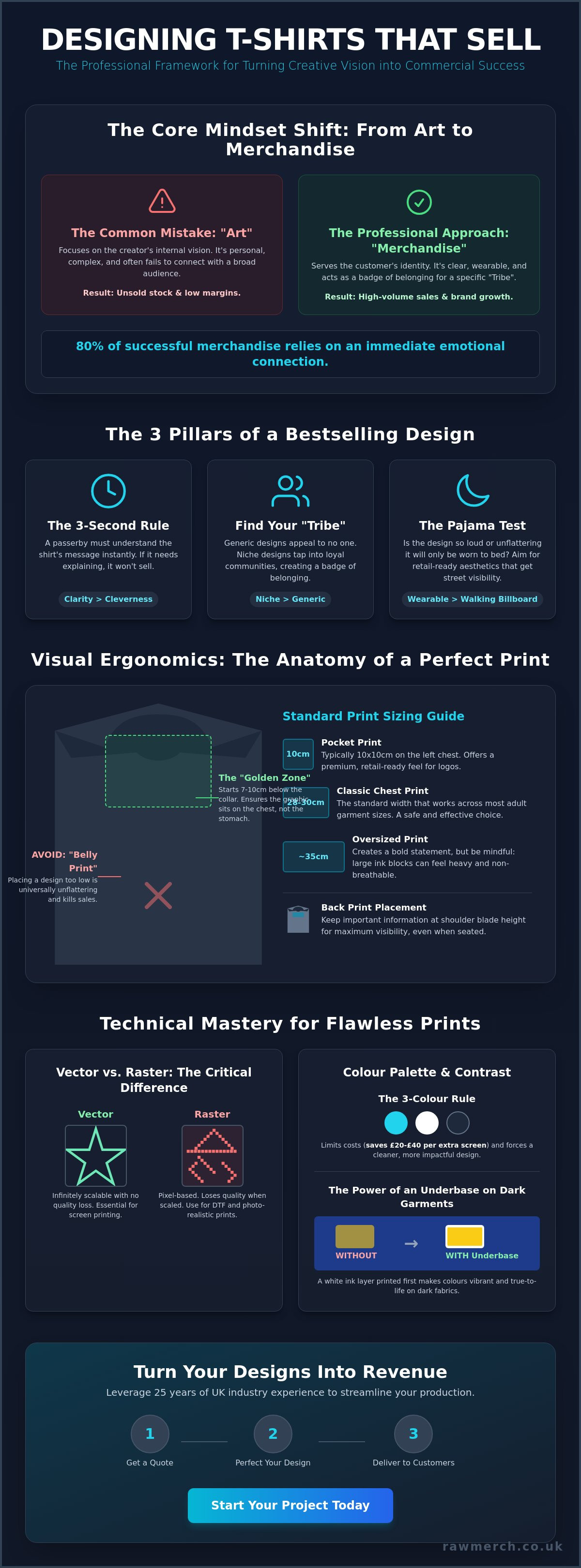
Most creators approach t-shirt design as an art project. This is the first mistake. In the professional printing world, there is a hard line between art and merchandise. Art expresses the creator's internal vision, while merchandise serves the customer's identity. If you want to master the craft of designing t-shirts that sell, you must design for the buyer, not for your own ego. A sellable design is one that balances identity with wearable aesthetics.
The history of the T-shirt shows its evolution from a simple 19th-century undershirt to a powerful tool for social and political expression. Today, the UK fashion industry contributes roughly £29 billion to the GDP, and custom apparel is a massive driver of that value. To grab a piece of this market, your design must pass the "Three-Second Rule." A passerby should understand exactly what the shirt represents in three seconds or less. If the message is cluttered or the font is illegible, you've lost the sale. Clarity beats cleverness every single time.
Success starts with identifying your "Tribe." Generic designs fail because they try to appeal to everyone and end up appealing to no one. Niche designs outperform generic ones because they tap into existing communities. Whether it's a local Sunday League football club in Manchester or an underground punk scene in London, these groups have high loyalty. They don't just buy a shirt; they buy a badge of belonging.
Finding Your Profitable Niche
Start by researching high-engagement communities. Look at local sports clubs, hobbyist groups, or specific professional sectors. Don't copy your competitors. Instead, analyse their bestsellers to see what resonates. Identify "inside jokes" or specific pain points within these groups. A design that makes a specific group of people feel "seen" creates an emotional trigger for a purchase. We've seen that 80% of successful merchandise relies on this immediate emotional connection.
The Psychology of Wearability
People buy t-shirts for status and self-expression. However, a design can be too loud. Use the "Pajama Test" to vet your concepts. If the design is so intrusive or uncomfortable that the customer only wears it to bed, your brand won't get the street visibility it needs. Balance your brand logos with lifestyle imagery. When designing t-shirts that sell, remember that the wearer wants to look good, not like a walking billboard. Focus on retail-ready aesthetics that fit into a modern wardrobe while still shouting about the wearer's interests, much like the unique and wearable designs found at Teeki Boutique.
Visual Ergonomics: Designing for the Human Body
A t-shirt isn't a flat poster. It's a three-dimensional, moving canvas that wraps around the human form. If you ignore how fabric drapes or where the eyes naturally rest, your design will fail. Master visual ergonomics, and you'll be designing t-shirts that sell because they actually look good on real people.
Placement is the most common area where amateurs slip up. The "Golden Zone" for a standard front print starts roughly 7cm to 10cm below the collar. This ensures the graphic sits on the chest rather than the stomach. Pushing a design too low creates the "Belly Print" effect, which is universally unflattering and a guaranteed way to see your merchandise end up in a bargain bin.
Standard vs. Oversized Placements
The classic chest print usually stays within a 28cm to 30cm width. This size works across the majority of adult garments. If you're going for an oversized look, you might push to 35cm, but be careful. Large blocks of ink can make a shirt feel heavy and "sweaty" against the skin. For maximum impact with minimal ink, consider a pocket print. These are typically 10cm square and positioned over the left chest. They offer a premium, retail-ready feel that works perfectly for brand logos. Back prints allow for more real estate, but always keep the most important information at shoulder blade height to ensure it's visible even if the wearer is sitting down.
Colour Palettes and Contrast
Printing on fabric is different from printing on paper. To avoid "muddy" results, you must understand the principles of color theory and how they apply to textiles. On dark garments, we often print a white "underbase" first to make the top colours pop. Without it, your bright yellows will look like dull greens on a navy shirt.
Follow these rules for professional results:
- The 3-Colour Rule: Limit your palette to three colours. This keeps your screen setup fees low, often saving you £20 to £40 per additional screen, while forcing a cleaner design aesthetic.
- Negative Space: Use the garment colour as a "free" colour in your design. If you're printing a skull on a black shirt, leave the eye sockets empty to let the fabric show through.
- Vector Precision: High-quality prints require clean lines. Understanding what is a vector based image is vital here. Vectors allow for perfect colour separation, ensuring 100% crisp edges that don't blur during the screen-burning process.
Typography also needs a "print-first" mindset. Avoid ultra-thin serifs or tiny script fonts that are smaller than 12pt. These details often get lost when the ink hits the weave of the cotton. Stick to bold, legible typefaces that can survive the heat press and the washing machine. If you need help refining your layout for the best results, you can always get expert advice on your custom merchandise from our team. We know what you want and we deliver on time everytime.
Technical Specs: Designing for Screen Printing, DTF, and Embroidery
Your design choice dictates the final product's quality. We see too many great ideas fail because of poor file preparation. You need to understand the difference between vector and raster before you start. Raster images, like JPEGs or PNGs, consist of pixels. They're fine for photos but look terrible when scaled up. Vector files use mathematical paths. You can scale a vector logo from a business card to a billboard without losing a single sharp edge. Designing t-shirts that sell starts with these technical foundations. If your lines aren't crisp in the file, they won't be crisp on the shirt.
We've spent 25 years mastering these processes. We know what you want; you want a professional finish that lasts. Choosing the right file format ensures our machines deliver exactly what you see on your screen. Don't settle for "good enough" when professional-grade tools are available.
Preparing Pro-Level Files
Success in printing requires precision. Follow these three rules to ensure your artwork is ready for the press:
- 300 DPI Minimum: For raster images, 300 dots per inch is the industry standard. Anything lower results in blurry, "stair-stepped" edges that look amateur.
- Convert Fonts to Outlines: We might not have your specific boutique font. Converting text to outlines turns letters into shapes, preventing "missing font" errors.
- Transparent Backgrounds: Always submit your files with a transparent background. A solid white box around your logo is a rookie mistake that ruins the aesthetic of the garment.
Choosing the Right Decoration Method
We match your design to the right technology. Screen printing remains the industry heavyweight for bulk orders. It's the perfect choice for band merchandise because the ink bonds deeply with the fabric for maximum durability. It handles bold, solid colours better than any other method.
If your design has complex gradients or you only need a small run of 10 to 20 shirts, DTF (Direct to Film) is the winner. This method captures photographic detail and vibrant multi-colour transitions that traditional screens can't hit. It's efficient, fast, and looks incredible on both cotton and polyester blends.
For a premium, high-end feel, switch from print to stitch. Embroidery is the go-to for corporate wear and heavy hoodies. However, you must simplify your design. Fine lines under 1mm often disappear into the weave of textured fabrics. Keep your embroidery designs bold and clear to ensure a professional result. Designing t-shirts that sell requires balancing your creative vision with these physical limitations. We get the job done right and on schedule, every time.
Commercial Strategy: Trends, Pricing, and Testing
Designing t-shirts that sell requires a balance between creative flair and cold, hard data. You need to decide if you are chasing the trend-jacking dragon or building an evergreen empire. Trend-jacking uses current events or viral memes to generate fast sales; it is high energy but short-lived. Evergreen designs stay relevant for years and provide the foundation for your brand. Most successful UK labels maintain a 70% evergreen base with 30% seasonal or trending drops to keep the shopfront fresh.
The "Limited Drop" model is your best tool for creating urgency. By announcing a fixed number of units, such as a 50-piece run, you force customers to act quickly. This strategy reduces your inventory risk and builds a sense of exclusivity. When pricing for profit, look beyond the basic print cost. You must account for the garment cost, printing fees, and UK shipping rates. If your total cost is £12 and you sell for £25, you have a healthy margin to cover marketing and returns. Always order a sample run first. Seeing a physical proof ensures the ink sits correctly on the fabric and the colours match your vision before you commit to bulk production.
Garment Selection: Quality vs. Price
Choosing the cheapest blank is often a recipe for disaster. Low-quality shirts shrink or twist after one wash, which kills your repeat business and ruins your reputation. For the UK market, Gildan offers reliable entry-level options for high-volume orders. Fruit of the Loom remains a budget favourite for events and promotions. If you want a premium streetwear feel, Stanley/Stella provides high-quality, organic cotton that justifies a higher retail price. Match your garment weight to the purpose; 150 GSM works for summer promotions, while 200 GSM or higher feels like a luxury retail product.
Validation and Social Proof
Don't guess what people want; ask them. Use social media polls to let your followers vote on design variations or colourways. This builds engagement and guarantees a segment of your audience is already invested in the outcome. Running a pre-order campaign is another smart move for designing t-shirts that sell without the financial risk. It allows you to fund your first bulk production run using customer capital. Gather feedback from these early adopters to refine your next collection and ensure your brand remains the trusted choice for your fans.
Ready to see your designs on high-quality garments? Contact us for a no-obligation quote today!
Execution with RAW Merch: Turning Designs into Revenue
Designing t-shirts that sell is only half the battle. The other half is reliable execution. You need a partner who understands the technical demands of high-volume retail. With 25 years of experience in the UK printing industry, RAW Merch provides that foundation. We've spent over two decades perfecting our craft. We know the difference between a good print and a professional one. Our expertise ensures your creative vision translates perfectly onto the fabric.
Our process is straightforward and transparent. You start with a no-obligation quote. There are no hidden fees or complex contracts. Once you approve the details, we move straight into production. We've built our reputation on reliability. We know what you want; we deliver on time everytime! This consistency allows you to plan marketing campaigns with confidence, knowing your stock will be ready when your customers are.
Profitability depends on your ability to scale. We offer aggressive bulk discounts to help your brand grow. As your order volume increases, your cost per unit decreases. This improves your margins and gives you more capital to reinvest in new designs. Whether you're a local independent label or a national brand, we provide the infrastructure you need to succeed in the competitive UK market.
Our Printing Capabilities
Our UK-based facility uses state-of-the-art DTF and screen printing technology. These methods allow us to handle complex, multi-colour designs with ease while maintaining durability. We also offer specialised headwear printing. This includes custom bobble hats, which are perfect for winter collections or sports team merchandise. Every garment passes through rigorous quality control checks. We ensure your merchandise is retail-ready the moment it arrives. No blurred lines. No peeling prints. Just high-quality results.
Start Your Project Today
Ready to move forward? Getting a quick quote for your custom t-shirt project is easy. We handle the heavy lifting so you don't have to. Beyond printing, we offer fulfilment services to streamline your business. We manage the logistics and shipping while you focus on the creative side. This means you spend your time designing t-shirts that sell instead of packing boxes in a warehouse. We're ready to bring your ideas to life. YOU WANT IT, WE CREATE IT!
Turn Your Creative Vision Into a UK Bestseller
Success isn't just about a cool graphic. It's about combining visual ergonomics with the right technical specs, whether you're choosing screen printing or DTF. You've learned that a market-first strategy is what separates a hobby from a profitable brand. Mastering the art of designing t-shirts that sell requires a partner who understands the difference between a simple shirt and high-quality merchandise that people actually want to wear. Don't leave your revenue to chance when you can work with experts who've been perfecting the print process for over two decades.
RAW Merch brings over 25 years of industry experience to your project. We're UK-based specialists who handle everything from band merch to corporate apparel right here in our own facilities. We know what you want; we deliver on time everytime. We're ready to help you scale your brand with professional fulfillment and unmatched quality. Whether you're a band needing tour stock or a business looking for premium promotional wear, we've got the expertise to make it happen without the fuss.
Get a No-Obligation Quote for Your Custom T-Shirts Today
Let's get your designs off the screen and into the hands of your customers.
Frequently Asked Questions
What is the best file format for t-shirt design?
High-resolution vector files like AI, EPS, or PDF are the industry standard for professional printing. These formats allow us to scale your artwork to any size without losing sharpness or detail. If you're providing raster images, use a PNG at 300 DPI with a transparent background. We've found that print quality increases by 20% when clients provide vector files instead of low-resolution JPEGs.
How many colours should I use in my t-shirt design to keep costs low?
Stick to one or two colours to keep your production costs as low as possible, especially for screen printing. Each extra colour requires a separate screen and additional setup time, which pushes up the price per unit. Industry data shows that 75% of bestselling merchandise designs use three colours or fewer. If you need a full-colour photo, DTF printing is a better choice as it doesn't charge per colour.
Where is the best place to put a logo on a t-shirt?
The left chest is the most effective and popular placement for a brand logo. This standard "pocket" position looks professional and is the first place customers look for branding. Standard left chest logos usually measure between 8cm and 10cm wide. For a bolder impact, try a large centre chest print or a small nape print on the back. This positioning ensures your brand stays visible without being distracting.
Can I sell t-shirts without being a graphic designer?
You can definitely sell successful t-shirts without being a designer by using professional templates or hiring specialist freelancers. Many top brands focus on the concept and market research rather than the technical drawing. Tools like Canva or Adobe Express offer layouts that follow proven design principles. Focus on designing t-shirts that sell by identifying what your UK audience wants, then let the experts handle the technical artwork.
Is screen printing or DTF better for my t-shirt brand?
Screen printing is the best choice for bulk orders of 50 units or more with simple designs. It's incredibly durable and becomes very cost-effective at high volumes. Direct to Film (DTF) is the superior option for complex, multi-coloured designs or small runs. DTF allows for photographic detail and vibrant colours that don't crack easily. We use both methods depending on your volume to ensure you get the best results every time.
How do I know if my t-shirt design will actually sell?
Validate your concept through social media polls or pre-order campaigns before you commit to a full production run. Look at current trends on Pinterest and TikTok to see what's gaining traction in the UK market. Research shows that 60% of successful apparel launches involve some form of community feedback. Designing t-shirts that sell requires balancing your creative vision with hard data about what your customers are actually buying.
What is the standard size for a t-shirt print?
A standard adult t-shirt print size is typically A3, which measures 297mm by 420mm. This size fits perfectly on most garments from size Small to XXL. For a "full chest" look, we often recommend a width of 30cm. If you're printing on kids' clothes or smaller items, you'll need to scale the artwork down to roughly 15cm or 20cm to ensure it fits the printable area correctly.
How much profit should I make on a custom t-shirt?
Aim for a profit margin of at least 40% to 50% on every custom t-shirt you sell. If your production cost is £10, you should look to retail the item for at least £20. This margin covers your marketing, shipping, and platform fees while leaving room for business growth. According to UK retail benchmarks, successful independent clothing brands often target a 2.5x markup on their base production costs.