

Your merchandise isn't just a product; it's a physical extension of your brand's identity. If you're still slapping a logo on a basic tee and hoping for the best, you're wasting your budget. A successful merchandise strategy for brands UK businesses can rely on in 2026 must be audience-first. It's the difference between creating a bestseller and ending up with a garage full of unsold stock you're legally banned from destroying as of July 2026.
We understand the fear of choosing the wrong garment style or feeling overwhelmed by technical printing methods. You need professional results that your specific demographic will actually value and wear. This article provides a clear roadmap to master audience research and technical design. We'll show you how to match your creative vision with the right production techniques to ensure your next bulk order sells out. From managing new PFAS chemical restrictions to substantiating your environmental claims, you'll gain the expert knowledge required to lead the market with confidence.
Key Takeaways
- Stop "logo slapping" and start creating "badges of belonging" that your audience feels proud to wear.
- Build a merchandise strategy for brands UK businesses can use to navigate 2026's strict new waste and sustainability regulations.
- Use the Demographic Uniform Framework to choose garments that match your fans' daily activities and existing style.
- Match your design's aesthetic to the right technical method, whether it's traditional screen printing or high-detail DTF.
- Boost conversions by using non-traditional placements and typography that speaks directly to your community's sub-culture.
Why Audience-First Design is the Only Way to Sell Merch
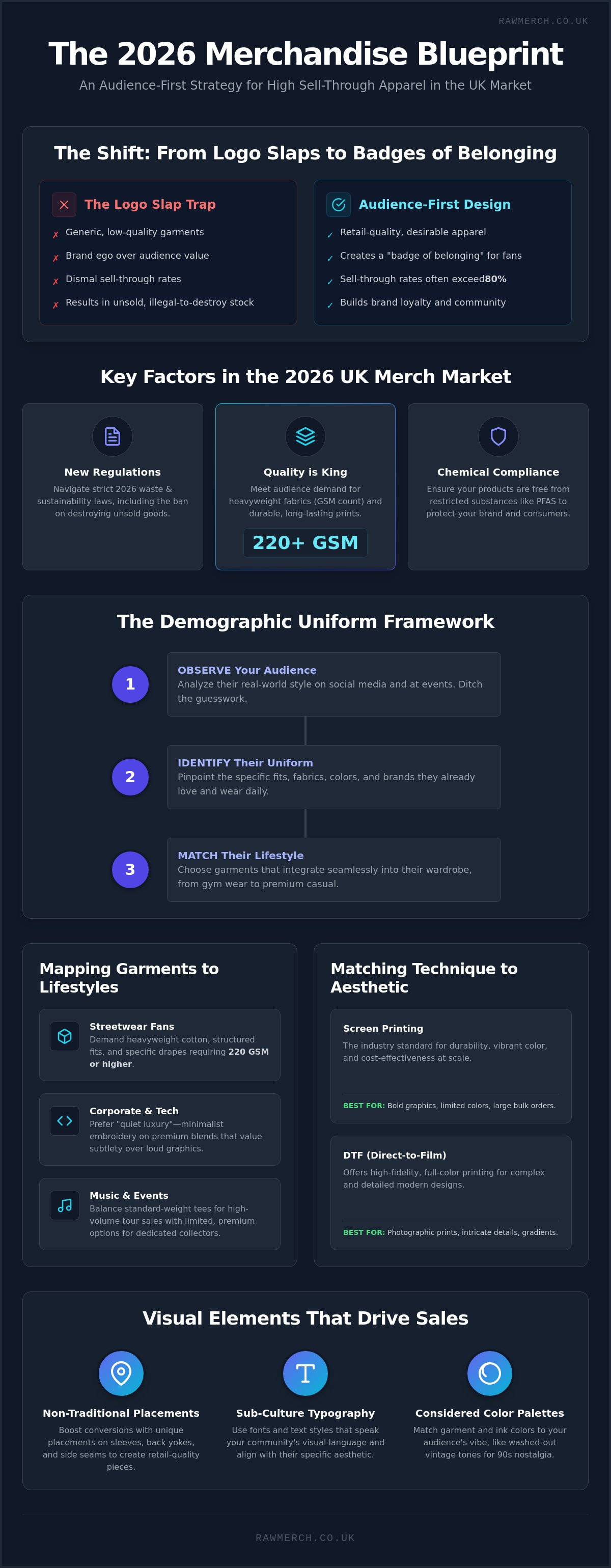
Designing a successful promotional merchandise line starts with the person, not the product. An effective merchandise strategy for brands uk companies must prioritize the audience's identity over the brand's ego. In 2026, your customers don't want to be walking billboards. They want to wear a badge of belonging. This is the core of audience-first design. It transforms a simple garment into a social signal that says, "I am part of this tribe." When you design for a specific niche, you create an emotional connection that generic products can never replicate.
The "Logo Slap Trap" is a fast way to lose money. Putting a small logo on a cheap, basic t-shirt is a strategy that failed years ago. In the current market, this approach leads to boxes of unsold stock gathering dust. Fans want products that reflect their specific aesthetic and values. Generic designs suffer from dismal sell-through rates. In contrast, niche-focused apparel often sees sell-through rates exceeding 80% because the product feels tailor-made for the wearer. Merchandise serves as social proof. It signals to others that the wearer belongs to a specific community or shares certain values.
Moving Beyond the Logo: Identity Signalling
Your audience wants to identify with your brand, not just advertise it. They use your apparel to express their own personality. Successful communities have distinct visual languages. Think of the minimalist, sleek designs favoured by tech professionals or the intricate, dark aesthetics of the heavy metal scene. You must learn these visual cues. Shift your mindset from "merch" to "retail-quality apparel." If your garment doesn't meet the standards of a high-street retail shop, your fans won't wear it. Focus on creating pieces that integrate seamlessly into their existing wardrobe.
The 2026 Merch Landscape: Quality Over Quantity
UK consumer expectations have evolved rapidly. Fabric feel and print durability are now top priorities. We are seeing a major shift toward heavyweight trends, where audiences demand specific GSM (grams per square metre) counts. A 220 GSM t-shirt provides the premium, structured fit that modern streetwear fans crave. Disposable, low-quality merch is now a brand killer. In an eco-conscious UK market, durability is a requirement. Buyers want items that survive dozens of washes without fading or losing shape. High-quality production isn't just about aesthetics; it's about building a sustainable, reliable brand reputation.
Profiling Your People: The Demographic Uniform Framework
Stop guessing what your fans will buy. Most people can't describe their style accurately, but they show it every day through their clothing choices. Look at the clothes your audience wears to your events or on their social feeds. This real-world data forms your Demographic Uniform Framework. It's the most reliable way to build a merchandise strategy for brands uk audiences will actually support. If your fans live in oversized streetwear, don't hand them a tight, lightweight promotional shirt. Match their daily habits. Gym-goers need performance fabrics. Tech professionals often want minimalist, high-end pieces they can wear in a boardroom.
Perceived value is the distance between your production cost and the customer's willingness to pay. A fan might happily spend £35 on a hoodie, but only if the weight and texture justify that price point. If the garment feels thin or the print has a cheap, "plasticky" texture, you've failed the vibe check. High-end niches expect premium features. Look for side-seams, twin-needle stitching, and high GSM counts to ensure your merch feels like a retail purchase rather than a giveaway.
Mapping Garments to Lifestyles
Streetwear fans demand heavyweight cotton. They want structure and a specific drape, usually requiring 220 GSM or higher. Corporate and tech audiences often lean toward "quiet luxury." They prefer minimalist embroidery on premium blends that value subtlety over loud graphics. For those in the music industry, requirements vary based on the genre and venue. You might need a standard-weight tour tee for high-volume sales at a festival, or a premium limited edition for a dedicated collector. For more specific tactics, check out our complete guide to band merchandise.
Cultural Cues and Colour Palettes
Colour triggers immediate emotional responses. While black is a safe bestseller, it can also feel uninspired. Identify the aesthetic era your audience gravitates towards. If they love 90s nostalgia, washed-out vintage blacks and muted pastels will outperform bright primaries. The base colour of the garment is your canvas. It's just as vital as the ink colours you choose. A clashing base will ruin even the best design. If you're ready to start your next project, view our range of custom hoodies to find the perfect base for your brand.
Technical Design: Matching Printing Techniques to Aesthetic Standards
Choosing the right printing method is as critical as the design itself. Your merchandise strategy for brands uk success depends on how the physical print interacts with the garment. A design that looks great on a screen can fail in production if the texture doesn't match the sub-culture's expectations. For example, a vintage band aesthetic requires the heavy, durable feel of traditional screen printing. Conversely, a high-detail streetwear graphic might need the precision of modern digital methods. You must match the technical execution to the aesthetic standards of your niche. The wrong choice makes a premium design look like a cheap knock-off.
- Screen Printing: This is the gold standard for high-volume retail and band merch. It offers incredible durability and a classic feel that fans expect. It's perfect for bold, solid colours and large runs.
- DTF (Direct to Film): This is the best choice for high-detail, vibrant designs. It works exceptionally well for smaller, diverse batches where screen setup costs would be prohibitive. It provides a smooth, thin finish.
- Sublimation: Use this for technical sportswear or all-over prints. It dyes the fabric directly; this ensures the garment remains breathable and lightweight.
- Embroidery: This elevates your brand for corporate wear and premium streetwear. It adds tactile value and a sense of permanence that print cannot match.
Texture Matters: The Hand-Feel of Success
The "hand-feel" of a print determines if a customer keeps the shirt or leaves it in the drawer. Soft-hand inks are essential for high-end fashion audiences. These inks sink into the fabric rather than sitting on top. This creates a soft, breathable finish that doesn't feel like a plastic sheet on the chest. If you want a "Vintage Crackle" effect, you must design specifically for how screen print ink ages and breaks over time. For headwear or premium hoodies, consider high-build or 3D embroidery. This adds a physical dimension to your logo, making it stand out literally and figuratively. Tactile quality drives repeat purchases.
Design Specs for Pro-Level Results
Professional results require professional files. The use of vector files is non-negotiable in high-quality printing. Unlike raster images, vectors can be scaled infinitely without losing quality. You can learn more in our guide to vector images for merch. Beyond file type, you must manage line weights and halftones. Screen printing has physical limits on how thin a line can be before it disappears. Digital methods like DTF are more forgiving with gradients, but they still require high-resolution assets to avoid pixelation. We ensure your technical specs match the production method for a flawless finish every time.
The Design Framework: Visual Elements That Drive Sales
Visual appeal is only half the battle. To create a merchandise strategy for brands uk that actually converts, you must apply rigorous design principles to every garment. Commercial success depends on how your artwork interacts with the wearer's body and their lifestyle. A design that looks perfect on a flat Photoshop canvas often fails when draped over a human torso. You need to move beyond the "big logo in the middle" approach. High-conversion apparel uses strategic placement and thoughtful hierarchy to create a product that feels like a premium retail item rather than a giveaway.
The "Wearability Test" is your ultimate filter. Ask yourself: would a fan wear this to a nice dinner, or is it destined to be a sleep shirt? If the branding is too loud or the design is too cluttered, it loses its versatility. You want your merch to be the first thing your audience grabs from their wardrobe. Start by designing a "Hero" piece; a single, high-impact item that defines the collection. Once that sells out, you can scale into a full line with supporting pieces like headwear or promotional items that carry the same visual DNA.
Placement and Composition
Strategic placement increases the perceived value of your apparel immediately. Apply the Rule of Thirds to your t-shirt designs. Instead of centring everything, try placing graphics in the upper third of the garment to better frame the face. For streetwear demographics, oversized back prints are currently dominating the UK market. These large-scale graphics provide high visibility and a modern silhouette. Conversely, subtle branding often commands a higher price point. Small details like pocket prints, sleeve hits, or nape logos at the back of the neck suggest a level of craftsmanship that generic brands ignore. Using hem tags and custom neck prints further reinforces this retail-quality feel.
Typography and Graphic Hierarchy
Typography communicates sub-culture faster than any image. Your choice of font tells the viewer exactly who this product is for before they even read the words. In many niches, like brutalist streetwear or niche music genres, unreadable fonts are often the correct choice because they signal "insider" status to the community. You must establish a clear hierarchy of information. Decide whether the artistic concept or the brand name should dominate the visual space. Often, the most expensive-looking designs use significant negative space. Don't feel the need to fill every square inch of the fabric. Clean, professional layouts with room to breathe always outperform crowded, amateurish designs. Ready to see your vision on a premium garment? Explore our clothing printing options to start building your hero piece today.
From Concept to Crate: Scaling Your Merch with RAW Merch
Turning a creative concept into a profitable reality requires more than just a good design. You need a production partner that understands the logistical demands of the UK market. We bring 25 years of industry expertise to your merchandise strategy for brands uk, helping you avoid the common pitfalls that drain budgets. Our process is built for speed and precision. Whether you need high-speed DTF for a limited drop or traditional screen printing for a large-scale tour, we handle the technical heavy lifting. You focus on your audience; we focus on the execution.
Requesting a quote shouldn't be a guessing game. To get the best price-per-unit, you need to be specific about your garment choice and volume. We help you align your order with your audience's willingness to pay. This ensures your margins remain healthy while your fans get a product they value. Scaling an empire means moving from a single shirt to a consistent, high-quality output. We provide the infrastructure to make that happen without the stress of managing production yourself.
Bulk Orders and Cost Efficiency
Don't fall for the low-margin trap of automated dropshipping. Bulk manufacturing offers the control and profitability you need to scale. For screen printing, the sweet spot usually starts at 50 units per design. This is where your price-per-unit drops significantly, allowing for retail margins that actually sustain a business. You can mix and match garment sizes and colours within a single print run. This allows you to cater to your entire demographic without blowing your budget on separate setups. Professional proofing is the most critical step in this journey. We ensure every detail is locked in before the first ink hits the fabric. This eliminates waste and guarantees satisfaction.
Partnering for Long-Term Growth
Scaling a merch empire means moving beyond your garage. We offer storage and shipping services designed for touring bands and growing online stores. Outsourcing your logistics is the secret to rapid growth. It allows you to fulfill orders faster and maintain high customer satisfaction. Being "Made in the UK" isn't just a label; it's a trust signal. It ensures faster shipping speeds and higher quality standards than overseas alternatives. We are here to be your long-term partner in growth, providing reliable results every time you place an order. GET A FAST QUOTE FROM RAW MERCH TODAY.
READY TO DOMINATE THE UK MERCH MARKET?
Success in custom apparel isn't about luck. It's about a disciplined approach to audience research and technical execution. You now have the framework to move beyond generic logos and create garments that your fans will value as retail-quality pieces. By matching specific sub-culture aesthetics with professional production methods, you ensure every piece adds value to your brand identity. A robust merchandise strategy for brands uk requires a partner that understands both the creative vision and the logistical reality of the 2026 market.
RAW Merch brings over 25 years of industry experience to your project. We specialise in high-impact techniques including DTF, traditional screen printing, and premium embroidery. With our UK-based fulfillment and distribution services, you can scale your brand without the headaches of inventory management. We handle the technical details so you can focus on building your community and growing your niche. It's time to turn your creative vision into a sell-out reality.
START YOUR CUSTOM MERCH PROJECT WITH RAW MERCH
Your audience is waiting for their new favourite garment. Let's build it together.
Frequently Asked Questions
What is the best way to research what my audience wants in merchandise?
The most effective research method is observing your fans in their natural environment. Analyze the specific garments they wear to your events or tag you in on social media. This real-world data defines a successful merchandise strategy for brands uk. It ensures you select styles that fit seamlessly into their existing wardrobe rather than guessing based on generic trends that don't resonate.
Do I need to be a professional designer to create merch for a niche audience?
You don't need to be a professional designer, but you must understand your community's visual language. Focus on the core identity signals that matter to your specific niche. While we don't provide graphic design services, we require high-quality vector files to ensure your vision translates perfectly to the fabric. A clear, meaningful concept always beats complex art that lacks a connection to the wearer.
Which printing method is best for high-detail designs: DTF or Screen Printing?
DTF (Direct to Film) is superior for high-detail designs, especially when working with gradients or intricate photographic elements. It provides a vibrant, durable finish on both small and diverse batches. Screen printing remains the gold standard for high-volume orders with solid blocks of colour. It offers a classic feel that specific sub-cultures, such as band fans or vintage enthusiasts, still demand for their apparel.
How many different designs should I launch in my first merch line?
Launch with one "Hero" piece to validate your concept before investing in a full collection. Focusing your energy on a single, high-impact garment allows you to test your audience's willingness to pay without overextending your budget. Once that item sells out, use that data to expand into a broader range of promotional items or headwear with the confidence that your designs will sell.
Is it better to use 100% cotton or poly-blends for custom apparel?
100% cotton is the industry standard for streetwear and retail-quality merch. It offers the structure and "hand-feel" that premium audiences expect from high-end brands. Poly-blends are more suitable for technical sportswear or uniforms where moisture-wicking and stretch are the primary priorities. Always choose the material that matches your audience's daily activities and the specific aesthetic you want to achieve.
What are the most popular merchandise items in the UK for 2026?
Heavyweight t-shirts and premium hoodies are the dominant items for the UK market in 2026. There is also a massive shift toward durable, sustainable products like long-handle cotton shoppers. Avoid novelty items that feel disposable. Your audience wants practical, high-quality pieces that function as part of a circular economy. Focus on items that your fans will use and wear for years, not weeks.
How do I ensure my merch designs don't look cheap?
Focus on strategic placement and garment weight to avoid a "cheap" or promotional look. A successful merchandise strategy for brands uk relies on high GSM fabrics and non-traditional placements like nape prints or sleeve details. Using soft-hand inks also ensures the print feels like part of the fabric. These technical choices make your apparel feel like a premium retail purchase rather than a budget giveaway.
Can RAW Merch help with the distribution of my audience-specific products?
Yes, we provide full UK-based fulfillment and distribution services to help you scale your brand. We handle the storage and shipping of your products directly to your customers. This allows you to focus on growth and community building while we manage the logistical punctuality your fans expect. Partnering with a seasoned specialist ensures your merch reaches your audience quickly and professionally every time.