
A striking design means nothing if the graphic cracks after two washes. Most print failures don't happen because of poor artwork; they happen when a printer pairs the wrong decoration method with heavy fleece. When organizing custom hoodie printing UK orders, matching your print technique directly to fabric weight is the only reliable way to guarantee retail-ready durability.
You already know the frustration of deciphering inconsistent sizing, second-guessing the difference between DTF, screen printing, and commercial embroidery, or worrying whether your shipment will arrive before an event date. Whether you are building tour merchandise, outfitting staff, or launching a streetwear label, you need garments that feel substantial and prints that hold up under heavy wear.
This guide gives you the exact blueprint. You will master how to choose the ideal fabric blend, pick the right print method for your design complexity, and secure on-time UK production with complete confidence.
Key Takeaways
- Match your fabric weight (GSM) and fleece blend directly to your print method to avoid premature cracking and peeling.
- Discover when to choose Direct-to-Film (DTF), traditional screen printing, or commercial embroidery based on your artwork complexity and run volume.
- Learn critical print placement rules around kangaroo pockets and drawstrings to keep your branding sharp and unobstructed.
- Streamline your custom hoodie printing UK orders by dialling in practical sizing curves and planning around seasonal production lead times.
- Leverage professional, production-tested garment workflows to ensure reliable, high-volume apparel drops arrive strictly on schedule.
Understanding Custom Hoodie Printing: Fabric, Fit, and Production Standards in the UK
Hoodies aren't just heavy t-shirts. Treating them like simple cotton tees is the quickest route to failed production runs. The high loft, brushed interior, and variable yarn density mean that professional custom hoodie printing UK setups require adjusted platen heights, dedicated ink viscosities, and careful fabric selection from day one.
Key Hoodie Styles and Fabric Blends
The base garment dictates how sharp your print looks and how long it lasts. In the UK market, your choice usually comes down to two fabric structures:
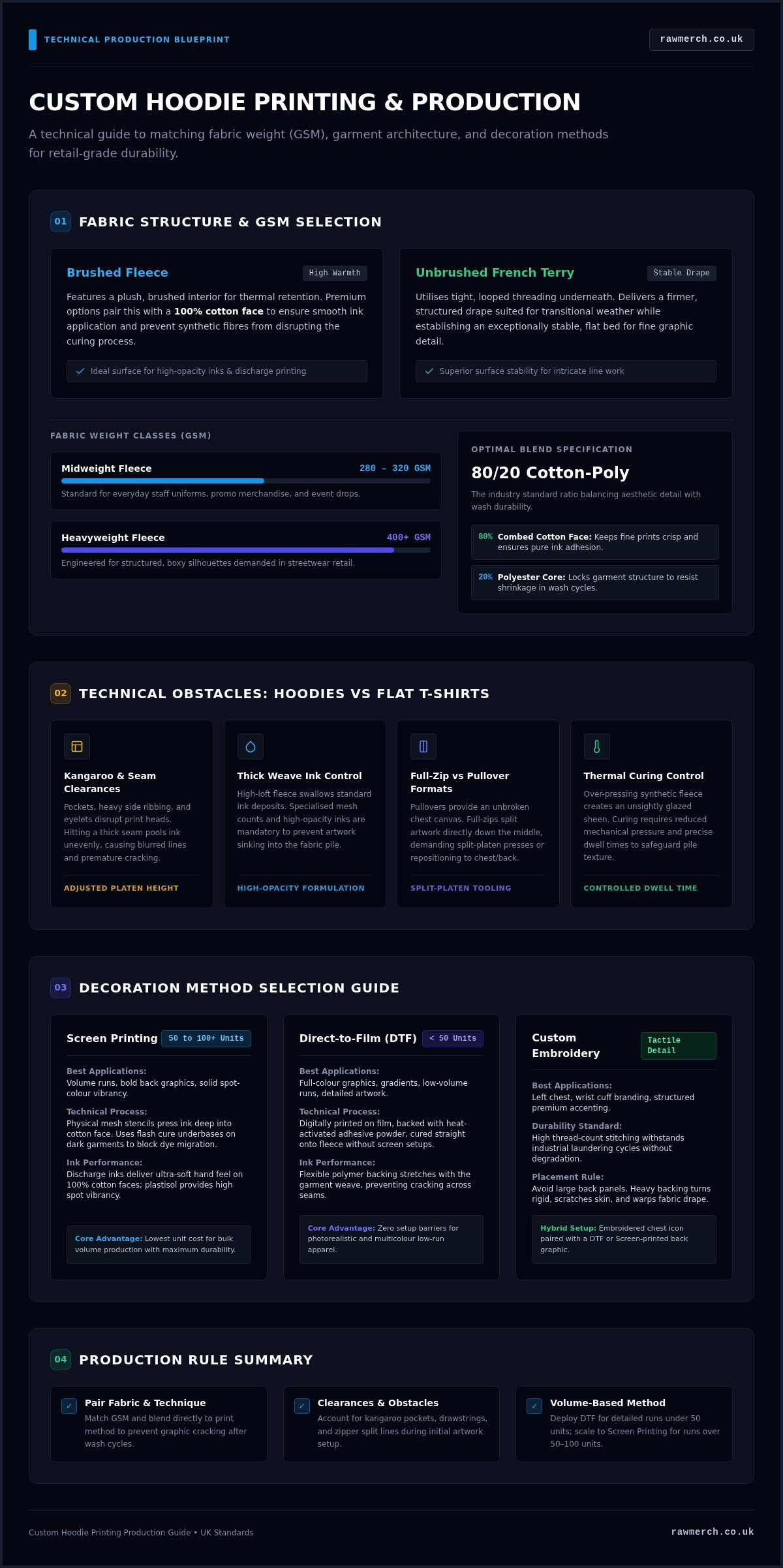
- Brushed fleece: Features a brushed, plush interior designed for warmth. Premium options pair this with a 100% cotton face, giving you a smooth surface that prevents synthetic fibres from interfering with ink curing.
- Unbrushed French terry: Uses tight, looped threading underneath. It yields a firmer drape ideal for transitional weather and provides a remarkably stable, flat bed for detailed prints.
Fabric weight is equally decisive. Midweight fleece (280 to 320 GSM) suits everyday staff uniforms and event runs. Heavyweight fabrics (400+ GSM) deliver the boxy, structured fit expected in streetwear retail. Aim for an 80/20 cotton-polyester blend: the polyester core locks in garment shape to resist wash shrinkage, while the combed cotton face keeps fine details crisp.
Why Hoodie Printing Differs from T-Shirt Printing
Flat t-shirts load effortlessly onto standard print pallets. Hoodies introduce physical obstacles everywhere. Kangaroo pockets, heavy side ribbing, drawstrings, and metal eyelets disrupt print carriage clearances. If a screen or print head hits a thick seam, ink pools unevenly, resulting in blurred line work and premature cracking.
The thick weave also challenges ink deposit control. While the technical history of screen printing shows how the craft adapted to rough industrial materials, thick fleece still requires specialised screen meshes and high-opacity inks to prevent the design from sinking into the fabric pile. Pullovers give you a continuous chest area, but full-zip designs split artwork down the middle; this demands split-platen presses or repositioning prints across the chest, sleeves, and back.
Thermal control is the final test. Over-pressing during the curing cycle glazes synthetic blends, leaving an ugly, shiny imprint on the fleece. Dialling in reduced mechanical pressure and precise dwell times cures the ink without crushing the garment's texture.
Screen Printing vs DTF vs Embroidery: Choosing the Best Method for Custom Hoodies
Every decoration technique interacts differently with brushed fleece. Choosing the wrong method leads to heavy, stiff prints or blown-out production budgets. Selecting the optimal technique for your custom hoodie printing UK order comes down to three factors: run size, artwork detail, and intended garment use.
Screen Printing for Bulk Runs and High Vibrancy
Screen printing remains the premier production method for volume runs exceeding 50 to 100 units. It uses physical mesh stencils to press opaque inks deep into cotton faces. On dark hoodies, applying an underbase flash cure prevents synthetic fabric dyes from migrating into your top inks. Discharge inks create an ultra-soft hand feel on 100% cotton outer faces, while plastisol ensures bold, solid spot-colour vibrancy on large back prints.
Direct-to-Film (DTF) Printing for Detailed Graphics
DTF printing transforms full-colour apparel production. Your graphic prints digitally onto a specialized film, coated with a heat-activated adhesive powder, and cured directly onto the fleece. This method removes screen setup barriers entirely, making it ideal for runs under 50 units. The flexible polymer backing stretches with the garment, preventing the cracking commonly seen when thick inks stretch over heavy seams.
Custom Embroidery vs Print: When to Stitch
Embroidery provides unmatched tactile durability. It excels on structured areas where flat ink can feel generic:
- Left chest and cuff branding: High thread-count embroidery delivers crisp, raised stitch definition that withstands industrial laundering.
- Hybrid applications: Pair clean embroidered chest branding with an expansive DTF back graphic for balanced, retail-grade aesthetics.
- Back panel limitations: Never stitch massive illustrations directly across the back fleece. Heavy embroidery backings turn rigid, scratch against the wearer's skin, and warp the fabric drape.
If you sell finished merchandise commercially, remember that your garments must comply with legal UK textile labelling regulations, clearly listing exact fibre contents on durable internal tags. Balancing run volumes, detail requirements, and compliance keeps your production efficient. When you need seasoned guidance to select the right approach for your project, team up with proven specialists in clothing printing to secure a clean, durable finish every time.
Hoodie Print Placements and Artwork Preparation Guidelines
Print location errors ruin great apparel designs. Unlike flat tees, hoodies feature structural hurdles like deep pouch seams, hood drop zones, and chunky cuffs. When setting up custom hoodie printing UK orders, getting your placement zones and artwork files right before hitting production keeps graphics sharp, legible, and unhindered by seams.
Strategic Print Placement Zones on Hooded Sweatshirts
Garment anatomy dictates where your graphics sit. Master these primary placement zones to protect your artwork from distortion:
- Back Prints: Keep the top edge of back artwork at least 10 to 12 cm below the collar. This prevents a resting hood from covering your graphics when worn down. Large 30x40 cm prints work brilliantly here for tour merchandise and streetwear collections.
- Front Chest: Kangaroo pockets restrict vertical space. Limit central chest graphics to a maximum height of 20 to 25 cm, stopping at least 2.5 cm above the pouch seam to prevent ink pooling near the stitching.
- Sleeves and Cuffs: Long running text or repeating motifs along the outer arm add retail value. Always stop sleeve prints 5 cm short of the ribbed wrist cuffs to prevent cracking over the elasticated seams.
- Hood Edge: Small text or insignia printed along the outer rim creates subtle branding visible even from side profiles.
Artwork Specifications and Vector Preparation
Fleece texture magnifies blurry artwork. If your source files lack resolution, fuzzy edges will bleed into the fabric weave. Supply raster files at a strict minimum of 300 DPI at full print size using RGB color mode for DTF runs. For screen printing, clean vector line work is non-negotiable. Converting typography to outlines prevents missing font errors. If you aren't sure how geometric lines compare to pixels, check out our guide on what is a vector based image to prep your files cleanly.
Specify exact Pantone spot colours for corporate logos so physical inks match screen proofs. Professional production houses maintain rigorous environmental standards, strictly aligning workshop machinery with UK textile industry health and safety standards to ensure clean air during print drying and curing cycles. Preparing compliant vector artwork upfront speeds through pre-press checks and delivers crisp, professional hoodies ready for immediate wear.
Planning Your Bulk Custom Hoodie Order: Sizing, Lead Times, and UK Logistics
A flawless print execution falls flat if your order arrives three days after your tour begins or half your boxes end up packed with unsold extra-smalls. Successful custom hoodie printing UK campaigns demand realistic logistical timelines and disciplined sizing breakdowns. Managing your production pipeline early prevents stockouts, cuts dead-weight costs, and protects hard delivery commitments.
Calculating Ideal Size Breakdowns for Merch and Workwear
Never guess your size ratios. For general UK retail drops, corporate teams, and touring merchandise, follow a proven bell curve distribution to avoid ending up with dead stock in fringe sizes:
- Small: 10%
- Medium: 25%
- Large: 35%
- X-Large: 20%
- 2X-Large: 10%
Adjust these percentages based on your specific audience and garment silhouette. Oversized streetwear cuts with drop shoulders already offer a relaxed drape, meaning customers frequently buy their true size rather than sizing up. Fitted corporate styles, however, prompt wearers to size up for layering over workwear. If you are ordering for an internal team, run a direct survey before placing the order to lock down exact sizing needs.
Managing Production Timelines and Event Deadlines
Wholesale apparel logistics in Britain experience massive spikes during the autumn and winter months as universities, corporate clients, and seasonal campaigns book out machine time. Factoring in supplier blank availability, pre-press proofing, screen preparation or film output, curing, and final quality checks, a typical production run requires roughly 5 to 10 business days. Large-scale bulk orders often require 14 to 21 working days, particularly when complex embroidery or multiple print zones are involved.
Always build in a five-day buffer ahead of tour kick-offs or product launches. If you are managing inventory across multiple dates, check out our dedicated guide on band merchandise to keep your tour supply chains moving smoothly. Coordinate your couriers to track boxed weights and ensure multi-carton shipments arrive signed and intact at your venue dock or warehouse.
Need your inventory printed and delivered on a rock-solid timeline? Speak with our team to order custom hoodies today and get your production schedule secured.
Why Work with RAW Merch for Your Custom Hoodie Production
Automated print portals treat orders like anonymous numbers on a spreadsheet. They don't check whether an intricate raster file will blur into heavy fleece, and they won't tell you if a chest graphic sits too close to an eyelet seam. Over 25 years of hands-on UK apparel printing experience sets RAW Merch apart. We operate as a dedicated production partner, ensuring your garments meet rigorous quality thresholds before a single squeegee moves or heat press closes.
Seasoned UK Print Expertise and Rigorous Pre-Press Review
Technical craftsmanship matters. Heavy fleece handles heat and ink deposits differently than light jerseys do. Our in-house workshop is purpose-built to navigate those exact textile variables, housing commercial screen print presses, precision DTF hardware, and industrial multi-head embroidery machines.
Every single artwork file undergoes manual inspection by seasoned textile specialists. We review resolution limits, inspect vector paths, verify Pantone accuracy, and assess fabric compatibility. If a tiny detail threatens to bleed during curing, we advise you upfront. You receive an accurate pre-production digital proof to confirm alignments, eliminating expensive misprints and guaranteeing predictable results.
Complete Merch Solutions Beyond Just Printing
Great merchandise programs rarely stop at a single sweatshirt. Building a compelling brand requires coordinated gear that delivers retail impact across the board. You can expand your line seamlessly by pairing heavy fleeces with custom headwear, including matching custom bobble hats designed to round out winter releases and tour drops.
We take operational friction off your hands through end-to-end merchandise handling:
- Production agility: Scale effortlessly from focused sample runs to multi-thousand unit bulk deliveries.
- Tour and brand fulfilment: Access dedicated warehousing, inventory picking, and secure dispatch built specifically for touring bands, independent brands, and corporate clients.
- Dependable timelines: Clear, scheduled delivery commitments ensure your stock arrives on site without logistical panic.
Protect your brand with dependable custom hoodie printing UK production built on 25 years of workshop reliability. Request a quick custom hoodie quote today and get your next run moving on schedule.
Lock In Retail-Quality Custom Hoodie Production
Producing retail-grade apparel doesn't have to be a guessing game. Pairing the right GSM fleece weight with the ideal decoration technique protects your artwork from cracking, while dialed-in sizing ratios and realistic production schedules keep your release on track. When done right, custom hoodie printing UK projects deliver standout merchandise that builds lasting brand equity.
RAW Merch brings over 25 years of hands-on UK print and apparel experience directly to your project. With dedicated in-house screen printing, DTF, and embroidery technology, plus comprehensive merchandise fulfilment and distribution capabilities, we eliminate production roadblocks before they reach the press. We make sure your stock arrives looking sharp, feeling premium, and landing strictly on time.
Ready to turn your designs into premium garments your audience will love wearing? Get a quick quote on your custom hoodies with RAW Merch and let's get your next run moving today.
Frequently Asked Questions
What is the minimum order quantity for custom printed hoodies in the UK?
Minimum order quantities vary depending on the chosen decoration technique. Direct-to-Film (DTF) printing accommodates small runs and single-sample testing without setup charges, making it accessible for pilot projects. Screen printing typically requires minimums of 25 to 50 garments due to physical screen creation and calibration time. Discussing your artwork style with your printer early on helps identify the most cost-effective method for your specific run size.
Will the print on my custom hoodie crack or peel after washing?
Properly cured prints will not crack or peel under standard domestic wash cycles. Print failure usually happens when an inexperienced printer fails to flash-cure inks adequately on thick fleece or over-presses synthetic blends. Garments featuring a combed 100% cotton print surface yield the strongest chemical bond. Washing hoodies inside out at 30°C and avoiding high-heat tumble drying ensures prints stay pliable and vibrant for years.
Can you print over the pocket or zipper of a hoodie?
Printing directly over raised kangaroo pocket seams or metal zippers is not recommended. Heavy seams lift the print carriage and screen edges, which causes ink pooling, uneven deposits, and blurred artwork lines. To keep designs crisp, maintain at least 2.5 cm of clearance above pocket stitching. For full-zip garments, place artwork across the left chest, upper back, or along outer sleeves to avoid hardware interference.
What is the difference between DTF printing and screen printing on hoodies?
Screen printing pushes liquid ink through mesh stencils directly into garment fibers, offering unmatched cost-efficiency for bulk runs with bold spot colours. Direct-to-Film (DTF) prints digital artwork onto specialized transfer sheets bonded with heat-activated adhesive powder. For custom hoodie printing UK orders featuring gradients, photographic details, or smaller batch sizes, DTF eliminates setup charges while flexing naturally with stretchy fleece textures.
Which hoodie fabric weight is best for corporate merchandise versus streetwear?
Midweight fleece between 280 and 320 GSM provides the ideal balance of comfort, layering ease, and neat drape for corporate workwear and staff apparel. Premium streetwear collections and tour merchandise typically demand heavyweight fabrics of 400 GSM and above. These heavier garments deliver the dense, boxy silhouette expected by retail buyers, while providing a stable, thick surface that handles expansive back graphics effortlessly.
How should I set up my artwork files to ensure the best hoodie print quality?
Submit artwork in vector formats like .AI, .EPS, or print-ready PDF with all fonts converted to outlines. For full-colour photographic prints using DTF, provide high-resolution PNGs at a minimum of 300 DPI at full print dimensions with transparent backgrounds. Assign Pantone spot references to critical brand colours so production technicians match inks accurately. Supplying clean files prevents line blurring across coarse fleece weaves.
How long does custom hoodie printing take from proof approval to UK delivery?
Standard custom hoodie printing UK production typically takes 5 to 10 business days following digital proof sign-off. High-volume bulk runs or hybrid projects combining screen print with detailed embroidery generally require 14 to 21 working days. UK garment pipelines experience intense demand during the autumn and winter seasons, so submitting your artwork early guarantees delivery well ahead of scheduled tour dates or company events.