

A box of misprinted, stiff hoodies arriving hours after your tour bus departs isn't just bad luck; it destroys your margins and damages your brand. When you have fixed gig dates, trade show launches, or retail deadlines on the line, you cannot afford production guesswork. That is why choosing a reliable merch partner is the single most important operational decision you'll make this season.
You already know the frustration of chasing unresponsive suppliers, absorbing surprise setup fees, or watching fresh designs crack after a single wash cycle. In this guide, you'll discover how to vet custom apparel suppliers thoroughly, eliminate costly production bottlenecks, and secure premium garments that last. We'll provide a practical vendor evaluation checklist, compare key print methods like screen printing and DTF for specific run sizes, and explain how partnering with a seasoned UK production team keeps your schedule airtight from proofing to final distribution.
Key Takeaways
- Understand why choosing a reliable merch partner is critical to protect your brand reputation against rushed production, poor ink curing, and missed event deadlines.
- Learn how to audit vendor production capabilities, distinguishing genuine in-house manufacturers from third-party print brokers who lack quality control.
- Identify the right decoration technique, comparing screen printing, DTF transfers, and sublimation to match your specific run size and fabric requirements.
- Discover the operational value of integrating apparel production with UK storage, packing, and touring logistics to eliminate dispatch bottlenecks.
- Use a practical vetting checklist to review physical garment samples, assess fabric GSM weights, and confirm delivery contingencies before committing your budget.
Why Choosing a Reliable Merch Partner Determines Your Brand Success
Branded apparel is tactile. It puts your identity directly into the hands of fans, staff, and clients. High-grade promotional merchandise builds immediate trust, but poor execution does the exact opposite. A blurry crest, misaligned graphic, or stiff, under-cured print tells recipients that your organisation cuts corners. That is why choosing a reliable merch partner safeguards far more than a production run; it protects your hard-earned reputation. True reliability balances technical print craft with clear communication and verified dispatch schedules.
The True Cost of Subpar Merchandise Production
Cheap production shortcuts create immediate financial waste. When garments shrink unevenly, unravel at the seams, or lose their print after one domestic wash, your brand absorbs the damage. You face customer chargebacks, frustrated followers, and lost repeat business. Defective stock drains your marketing capital without delivering any measurable return. To make matters worse, unvetted suppliers routinely vanish when technical errors stall a print run. You cannot afford silence when a deadline looms. You need direct access to specialists who take total ownership of quality control from the initial digital proof to the final box tape.
Meeting Event-Critical and Tour Deadlines
Live event merchandise offers zero margin for error. A festival slot, industry trade show, or national tour will not delay its start date because an offshore container got stuck or a screen press clogged. If custom t-shirts or promotional items arrive twenty-four hours late, you miss the sales window completely. That revenue is lost permanently. You can explore strategic scheduling in our guide to band merchandise to see how experienced road crews plan complex inventory timelines.
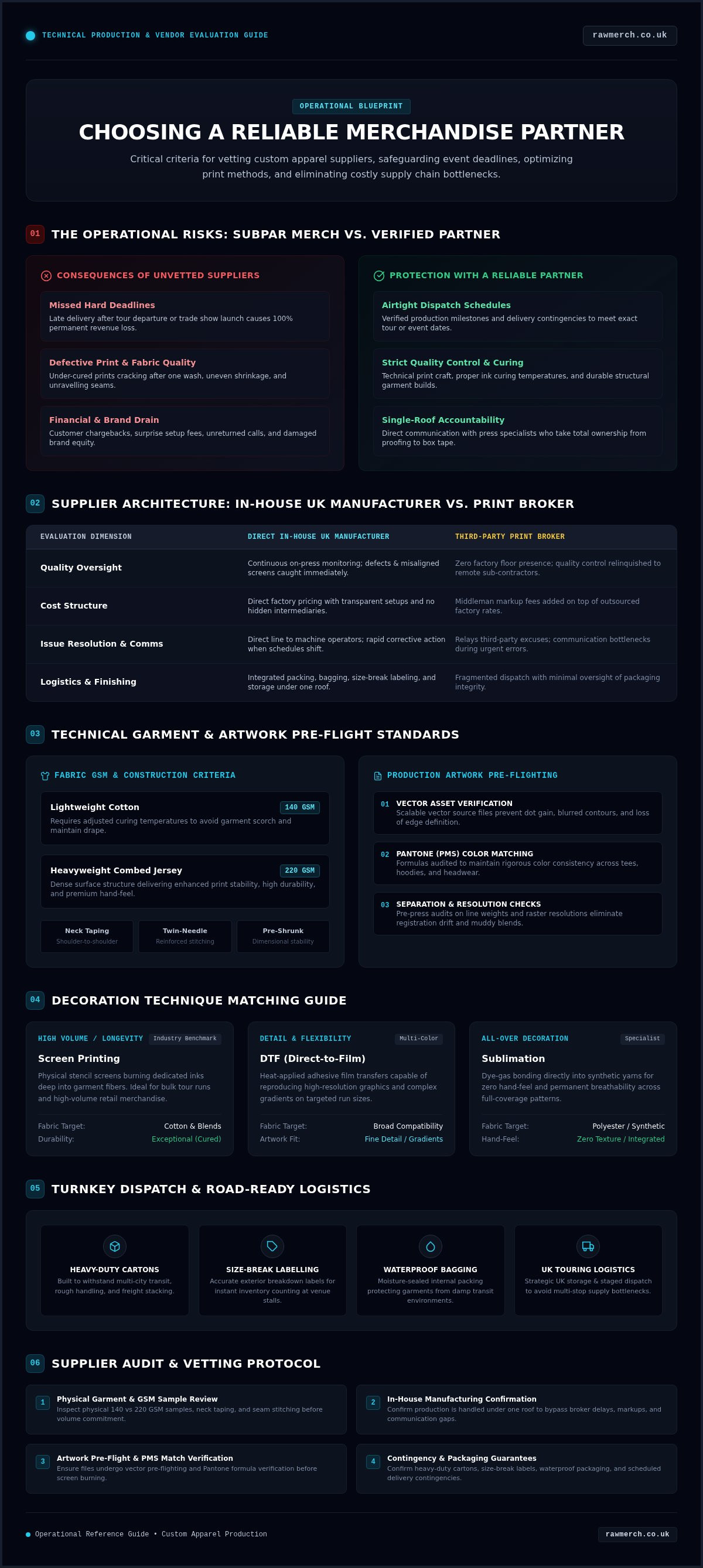
Punctuality is only half the battle. Your stock must also survive gruelling multi-city transit intact. That requires heavy-duty outer cartons, accurate size-break labelling, and waterproof bagging. Choosing a reliable merch partner ensures that your stock arrives fully accounted for, cleanly separated, and ready to sell straight out of the box.
Essential Criteria for Evaluating Custom Merchandise Suppliers
Evaluating a merchandise vendor requires looking far beyond polished digital mockups. When choosing a reliable merch partner, you need clear evidence of technical skill, robust garment construction, and strict production discipline. Assess fabric weights carefully. Lightweight 140 GSM cotton behaves completely differently under cure temperatures than heavyweight 220 GSM combed jersey. Inspect shoulder-to-shoulder neck taping, twin-needle stitching, and pre-shrunk finishes. A dedicated supplier explains how these structural details impact print durability and overall garment longevity.
Artwork Checks and Production Pre-Flighting
Flawless apparel starts with disciplined artwork pre-flighting. Seasoned printers audit files long before burning screens or generating print files. They inspect line weights, raster resolutions, and colour separations to align with established printing industry standards. Clean source files prevent dot gain, muddy ink blends, and registration drift. To avoid blurred contours on apparel, review our breakdown of what is a vector based image to see why scalable artwork is essential for crisp print definition. Dependable suppliers also reference Pantone Matching System (PMS) formulas, ensuring your brand colours remain consistent across custom t-shirts, hoodies, and headwear.
In-House Manufacturing vs Print Brokers
Many merchandise websites act solely as print brokers. They route your purchase to third-party factories, adding middleman markups while relinquishing oversight of daily scheduling and finishing quality. If an ink formula cures improperly or a courier misses a collection, brokers simply relay excuses.
Working directly with an established UK manufacturer gives you direct communication and total accountability. Hands-on machine operators monitor your run continuously. They spot misaligned screens, garment flaws, and uneven ink coats right at the press before boxes are taped. If you want full transparency across your production line, the experienced crew at rawmerch.co.uk keeps your projects running efficiently under one roof.
Comparing Key Print Techniques: Screen Printing, DTF, and Sublimation
Every print technique serves a specific production need. One method does not suit every fabric or order size. An inexperienced supplier pushes whatever press happens to sit idle on their floor. When choosing a reliable merch partner, look for a specialist who balances your graphic complexity, order volume, and base garment material before setting up a run.
Screen Printing for High-Volume Durability
Screen printing remains the gold standard for bulk tour merchandise, retail lines, and staff uniforms. Ink is pushed directly through prepared mesh stencils onto the garment, then fully heat-cured through a conveyor dryer. This process delivers rich, opaque colours with unmatched wash durability. It withstands repeated commercial washing without cracking or peeling. Setup involves physical screens for each colour, making it exceptionally cost-efficient as your volume increases. For runs of hundreds or thousands of custom t-shirts and hoodies, nothing beats screen printing on price or longevity.
Direct-to-Film (DTF) for Fine Detail and Complex Artwork
Direct-to-Film (DTF) has transformed apparel customization. The design is printed digitally onto a coated PET film, backed with an adhesive powder, and cured before heat-pressing onto the garment. This technique excels at rendering photorealistic graphics, smooth tonal gradients, and intricate line work that screen printing struggles to reproduce on short runs.
DTF offers broad material flexibility:
- Universal fabric adhesion: Bonds cleanly to 100% cotton, polyester blends, heavy workwear canvas, and performance synthetics.
- Zero screen fees: Eliminates individual screen setup charges, making multi-colour artwork viable on low-to-medium runs.
- High stretch resistance: The cured adhesive film moves with the knit of the fabric without snapping or distorting under tension.
Sublimation and Specialty Item Decoration
Dye sublimation uses heat and pressure to turn solid inks into a gas that infuses directly into synthetic fibres. Because the ink bonds at a molecular level rather than sitting on top, the finished garment has zero hand-feel. The fabric stays completely breathable and lightweight.
Sublimation requires high-polyester textiles, making it ideal for moisture-wicking athletic jerseys, technical sportswear, and custom polyester accessories. For non-apparel winter merchandise, check out our guide on custom bobble hats to explore jacquard knitwear and patch decoration methods. Choosing a reliable merch partner means working with a production team that operates these core decoration methods in-house, ensuring every product category gets the exact manufacturing process it demands.
Beyond Printing: Warehousing, Distribution, and Turnkey Logistics
Flawless print quality counts for nothing if your apparel sits trapped in a loading bay while fans queue outside the venue. Merchandising does not end when the dryer belt stops rolling. Choosing a reliable merch partner means securing a complete operational pipeline that handles stock management, packing, and precision transit across the UK. Combining manufacturing with logistics eliminates handoff friction between separate printers and third-party warehouses, cutting administration overheads and operational stress.
Touring Merchandise and Event Logistics
Touring acts cannot pack three months of inventory into a single nightliner or splitter van. Space is tight, and weight limits are real. Experienced merchandise specialists solve this by splitting bulk production into planned consignments:
- Timed venue drop-offs: Freight arrives directly at stage doors or festival production offices within specific delivery windows.
- Organised carton packing: Boxes are clearly labelled by design, garment style, and exact size breakdown, letting road crews set up concession stalls in minutes.
- Mid-tour replenishment: Rapid in-house re-runs top up best-selling sizes before inventory dries up completely.
End-to-End Fulfillment and eCommerce Storage
Brands, creators, and corporate operations face a different challenge: managing daily stock without clogging up office space. Storing pallets of custom hoodies, branded uniforms, and promotional merchandise off-site keeps your team focused on sales rather than packing tape.
An integrated fulfillment workflow routes store orders straight to active warehouse shelves. Trained pick-and-pack teams bag items securely, attach barcode labels, and dispatch via verified UK parcel networks. Real-time inventory tracking provides clear stock visibility, eliminating accidental backorders and customer service backlogs.
Take control of your entire distribution chain. Discover how the logistics team at rawmerch.co.uk handles print manufacturing, secure warehousing, and reliable UK touring dispatch under one roof.
How to Vet Your Merch Supplier: Checklist and Final Decision
Do not commit your budget based on an attractive website catalog alone. Choosing a reliable merch partner requires thorough vetting before you issue an initial deposit. Request physical garment samples from previous production runs. Inspect the print surface directly. Stretch the print horizontally; properly cured inks snap back into place without cracking or exposing white underbase. Pull hard on the side seams and hem stitching to confirm the garment construction holds up to rigorous wear. When evaluating client case studies, focus specifically on feedback from organisations in your exact sector, whether that is touring live acts, sports brands, or commercial enterprises requiring branded workwear.
The Essential Supplier Vetting Checklist
Put potential vendors to the test with direct operational questions:
- Machinery ownership: Do they own and operate commercial print equipment in their own facility, or do they broker jobs out to third parties?
- Production versatility: Can they execute screen printing, DTF transfers, sublimation, and laser engraving internally to match diverse product requirements?
- Lead time transparency: Do they commit to firm calendar production dates, specifying courier cut-offs and dispatch tracking protocols?
- Human communication: Can you speak directly with experienced account managers, or are you forced through automated support ticket queues?
- Contingency plans: What specific protocols exist if raw garment blanks face mill delays or courier consignments get disrupted?
Why Experience Matters: Partnering with RAW Merch
Execution beats empty promises. With over 25 years of hands-on experience in the UK print and merchandise industry, RAW Merch understands the fine margin between success and expensive operational failure. We produce everything under one roof, providing full capability across custom t-shirts, hoodies, headwear, uniforms, promotional merchandise, and precision laser engraving.
We build our production schedules around your actual deadlines. We do not hide behind automated ticketing systems or offshore broker networks. When choosing a reliable merch partner, partnering with our seasoned UK production team gives you dependable technical craftsmanship, hands-on quality checks, and reliable fulfillment logistics from start to finish. Bring your creative ideas to life with RAW Merch custom printing and keep your brand moving forward with complete confidence.
Take Control of Your Next Merchandise Run
Your custom merchandise speaks directly for your brand. When the pressure is on, choosing a reliable merch partner isn't just about securing a quote; it's about protecting non-negotiable event dates and guaranteeing retail-standard print quality. Matching the right print method to your fabric, auditing in-house production machinery, and combining manufacturing with UK distribution stops costly reprints and transit snags before they start.
With over 25 years of hands-on industry experience, RAW Merch provides comprehensive in-house screen printing, DTF transfers, and sublimation alongside turnkey storage and event-ready logistics. We take the guesswork out of apparel production so you can focus on building your business or preparing for the stage. Get a Fast, Reliable Merchandise Quote with RAW Merch today and bring your vision to life with complete confidence.
Frequently Asked Questions
How do I verify the print quality of a merchandise supplier before placing a bulk order?
Request physical production samples from past client jobs rather than unprinted blanks. Inspect ink opacity against dark fabrics, check edge sharpness on detailed typography, and pull the print to test elasticity. High-grade curing will not split or reveal underlying shirt fibres. Washing a sample garment twice also quickly exposes whether inks peel or retain their original vibrancy.
What is the difference between direct-to-film (DTF) and traditional screen printing for merchandise?
Screen printing pushes liquid ink through mesh stencils directly into the fabric, making it the most durable, economical option for high-volume orders with fewer colours. DTF prints digital inks onto a transfer film coated with adhesive powder, which is then heat-pressed onto the garment. DTF excels at capturing photographic gradients and complex multi-colour artwork on low-to-medium runs across diverse fabric types.
How much lead time should I give a merchandise partner for a time-sensitive event?
Allow at least two to three weeks before your event date or tour departure. While straightforward runs finish faster, this buffer accommodates artwork pre-flighting, digital proof approvals, raw blank restocking, press scheduling, and tracked UK transit. Building in contingency time protects your launch against courier disruptions or sudden supply mill shortages.
Why is working with a direct UK manufacturer better than using a print broker?
Direct UK manufacturers own their production machinery, giving you hands-on oversight, faster technical answers, and strict quality control on the shop floor. Print brokers simply outsource your job to third-party facilities, adding markup fees and communication lag. Choosing a reliable merch partner with in-house facilities ensures machine operators catch garment defects immediately before orders ship.
What file formats do reliable merchandise printers require for artwork approval?
Printers require vector files supplied as AI, EPS, or vector-based PDFs with all text converted to outlines. Vector art scales infinitely without pixelation or blurred edges during film output and screen exposure. If submitting high-resolution raster files for DTF or sublimation, supply transparent PNG or PSD files rendered at a minimum of 300 DPI at actual print dimensions.
Can a merchandise partner store my stock and handle order distribution directly?
Yes, comprehensive UK partners offer secure warehousing alongside custom printing. They manage bulk inventory, pack tour consignments for timed venue deliveries, and process online eCommerce orders directly through daily pick-and-pack services. Choosing a reliable merch partner with integrated logistics eliminates the friction of moving pallets between separate printers and third-party storage facilities.
What happens if garments arrive damaged or with incorrect print colours?
Reputable production partners conduct rigorous pre-flighting and match approved digital proofs against physical Pantone standards to prevent colour discrepancies entirely. If a defect slips through, a dependable partner takes immediate ownership, prioritising swift reprints or dispatching replacement stock on expedited freight to meet your critical event timeline.