

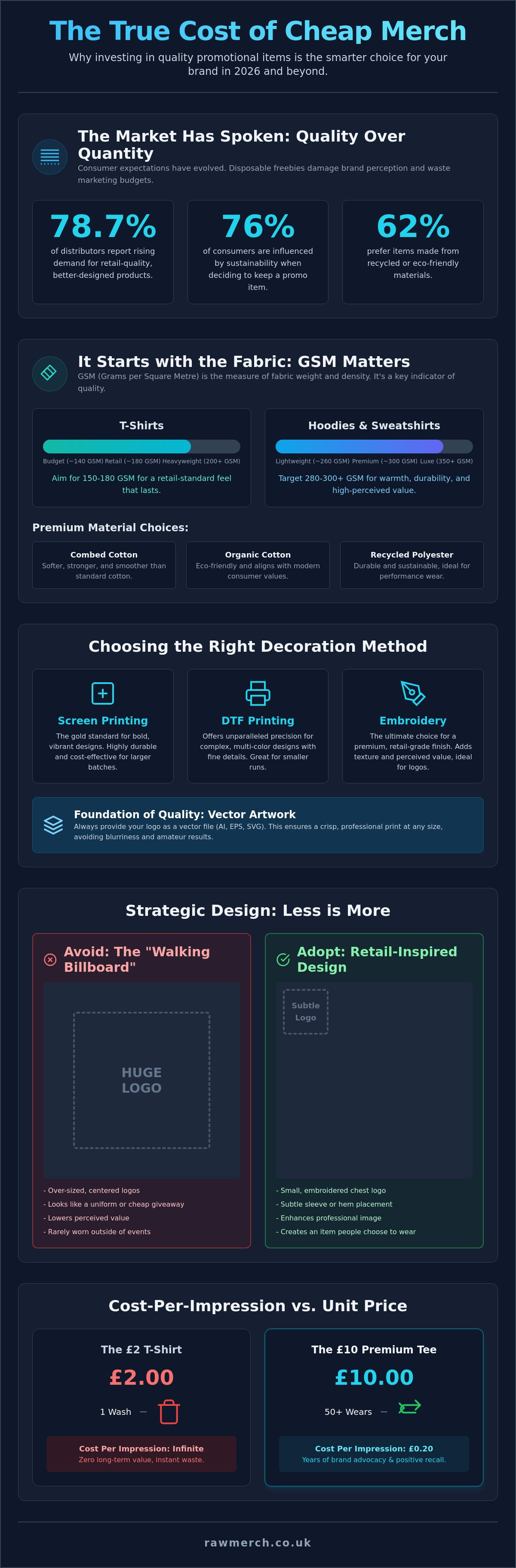
78.7% of promotional product distributors report a rising demand for better-designed, retail-style products in 2026. You've likely felt the sting of investing in gear only to watch the print peel or the fabric fail. It's frustrating to hand out low-quality items that end up in the bin. Avoiding cheap-looking promo items is the only way to ensure your brand stands out for the right reasons. Your merchandise is a physical handshake with your audience, so make it count.
We know you want gear that people actually keep and wear. This guide shows you how to select premium materials and technical decoration methods that elevate your brand reputation. We'll explore how to achieve high-perceived value through retail-grade embroidery and sustainable certifications like GOTS and OEKO-TEX. Stop wasting your budget on disposable swag. Learn the professional strategies for creating long-lasting brand exposure and high-quality gifts. We focus on results and reliability, ensuring your custom apparel and gifts reflect your company's commitment to excellence every time.
Key Takeaways
- Stop wasting budget on flimsy freebies. Learn how to select high-perceived value gear that recipients actually keep and use.
- Master the technical side of avoiding cheap-looking promo items by understanding GSM and premium fabric choices.
- Choose the best decoration method for your design, whether it's the gold standard of screen printing or the precision of DTF.
- Use strategic logo placement and restrained design to create retail-quality apparel that enhances your professional image.
- Leverage 25 years of technical expertise to ensure your merchandise delivers a high-end result without the stress of production errors.
Why "Cheap" Promotional Items Are Costing Your Brand More Than You Think
Handing out flimsy gear is a gamble your reputation can't afford. Most freebies end up in the bin before the event even finishes. This is the "Bin Factor," and it's the fastest way to waste a marketing budget. When you distribute low-quality goods, you aren't just losing money on the unit price. You're actively telling your customers that your standards are low. The broad category of Promotional merchandise covers everything from pens to premium apparel, but the goal remains the same: positive brand recall. A leaking pen or a scratchy, thin t-shirt defines your service quality in the eyes of the recipient. If the product fails, they'll assume your service will too.
In 2026, the shift from quantity to quality is no longer optional. UK marketing trends show a massive move toward durable, retail-grade items. Recent data indicates that 76% of consumers say sustainability influences their decision to keep or use a promotional product. Furthermore, 62% prefer items made from recycled or eco-friendly materials. Avoiding cheap-looking promo items is now a requirement for any brand that wants to be taken seriously. There are also hidden costs to consider. When a batch of low-quality gear fails to impress, you're forced to re-order better items anyway. You end up paying twice for a job that should've been done right the first time. Experience matters, and choosing the right partner prevents these "merch disasters" before they happen.
The Psychology of High-Perceived Value
Weight and texture are non-verbal cues for reliability. When a client picks up a heavy-duty canvas bag or a thick, high-GSM hoodie, they immediately associate that physical weight with brand authority. We recommend the "Retail-Ready" test for every item you consider. Ask yourself: would someone actually pay for this in a shop? If the answer is no, don't put your logo on it. Quality merchandise turns customers into walking brand advocates. They'll wear a premium hoodie to the gym or use a laser-engraved bottle at the office, giving you years of free advertising. High-perceived value isn't an accident; it's the result of choosing the right materials and finishes from the start.
Calculating Cost-Per-Impression vs. Unit Price
Smart brands look past the initial invoice. A £2 t-shirt that gets used as a rag after one wash has an infinite cost-per-impression because it provides zero value. Contrast that with a £10 premium t-shirt. If that shirt is worn 50 times over three years, your cost per impression is negligible. Long-term visibility is the goal. Durable items like laser-engraved drinkware or high-quality headwear stay in circulation for years. This is how you build a sustainable merch strategy for 2026. Prioritise items that people value, and you'll see a much higher return on your investment. Avoiding cheap-looking promo items ensures your brand stays in the hands of your audience, not in the landfill.
The Anatomy of Quality: Materials and Finishes That Scream "Premium"
Quality starts with the raw materials. You can't hide a poor fabric behind a big logo. When avoiding cheap-looking promo items, start by looking at the GSM (Grams per Square Metre). This measures the weight and density of the fabric. For t-shirts, a retail-standard weight is typically between 150 and 180 GSM. For hoodies, you want a minimum of 280 to 300 GSM to ensure warmth and durability. If the fabric is translucent when held up to the light, it's too thin. It will lose its shape after one wash.
One critical error many brands make is ignoring the source file for their logo. Even the most expensive hoodie looks amateurish with a blurry print. Always provide a vector image for your clothing printing requirements. This ensures every line stays crisp and professional regardless of the decoration method. A high-resolution file is the foundation of a high-end finish.
Retail-Grade Blanks vs. Budget Promo Blanks
We prioritise blanks that bridge the gap between price and performance. Brands like Gildan Softstyle offer a ring-spun finish that rivals high-street fashion without the designer price tag. The construction matters too. Side-seamed t-shirts follow the natural shape of the body and maintain their fit. Budget "tubular" shirts are cheaper to manufacture but often twist and sag after use. If you want gear that stays in the wardrobe, choose side-seamed blanks with reinforced stitching and double-needle hems.
Drinkware and Hard Goods: Beyond Plastic
Plastic is out. Powder-coated stainless steel and bamboo are in. High-quality promotional items should have a physical "heft" that implies value. When it comes to branding hard goods, laser engraving is the superior choice. Unlike pad printing, which can scratch or fade over time, laser engraving is permanent. It creates a precise, high-contrast finish that looks sophisticated. It turns a simple bottle into a piece of equipment your clients will use daily. If you want to explore Direct-to-Consumer Product Sales to see how brands like Backyard Crafts create high-value wooden items, it provides excellent inspiration for your own premium hard goods. Focus on items that feel substantial in the hand.
Technical Execution: Screen Printing vs. DTF vs. Embroidery
The best garment in the world looks like a bargain-bin find if the branding is executed poorly. Avoiding cheap-looking promo items requires matching your artwork to the right technical process. You need a finish that doesn't just look good on day one but stays vibrant after months of use. We prioritise methods that ensure your logo remains sharp, tactile, and durable. Whether you're ordering a dozen custom hoodies or a thousand event tees, the application method defines the final value of the product.
Screen printing remains the gold standard for bulk apparel. It uses high-quality inks that bond deeply with the fabric fibres, creating a vibrant finish that is famous for its longevity. For complex, full-colour designs, Direct to Film (DTF) is the 2026 secret to success. Modern DTF technology allows for incredible detail and a soft, stretchable hand-feel that won't crack or peel. If you need an executive or workwear look, embroidery is the superior choice. It adds a 3D texture and premium weight to headwear and uniforms. For technical fabrics or all-over designs, sublimation offers a "zero-feel" print that never fades because the dye becomes part of the fabric itself.
Which Method Fits Your Project?
Choosing between embroidery vs print is the most common dilemma for businesses. Each project has different requirements for cost, durability, and detail. Consider these factors before you commit:
- Screen Printing: Best for high-volume orders and 1-4 colour designs. Extreme durability.
- DTF Printing: Best for low-to-medium volumes and complex, multi-colour artwork. High detail.
- Embroidery: Best for hats, jackets, and polos. Provides a high-end, tactile finish.
- Sublimation: Best for polyester sports gear and vibrant, edge-to-edge designs.
Recipients judge your brand by the "Wash Test." If a print cracks after five cycles, it looks cheap. Our technical execution ensures your gear holds up after 50 cycles, maintaining that professional look for the life of the garment.
The "Vector" Requirement: Why Your File Matters
Blurry edges and pixelated gradients are the hallmarks of amateur merchandise. A low-resolution JPEG might look fine on your phone, but it will lead to a "cheap" looking print every time. You must use a vector based image for all branding. Vector files allow us to scale your logo to any size without losing a single drop of clarity. This ensures sharp edges and perfect colour matching. Professional tip: always ask for a digital proof before the full run starts. It's the only way to guarantee the final product matches your creative vision exactly. We don't guess; we execute with precision.
Strategic Design: How to Avoid "Over-Branding" Your Merch
Design restraint is the difference between a shirt someone wears to the gym and one they use to paint the fence. Avoiding cheap-looking promo items starts with a "less is more" approach. A massive, plasticky logo slapped across the chest screams "freebie." It kills the wearability of the garment instantly. Instead, look toward sophisticated placement. Use the nape of the neck, the sleeve, or discrete hem tags. These subtle touches align your brand with high-end retail fashion rather than disposable advertising. You want your audience to feel like they're wearing a lifestyle brand, not a walking billboard.
Clean typography is another essential for 2026. Move away from dated styles or overly complex fonts that become illegible when printed. Modern aesthetics favour minimalist, sans-serif typefaces that project a sense of professional capability. We're also seeing a massive surge in tone-on-tone branding for corporate gifts. Imagine a black logo embroidered on a black hoodie or a navy print on a navy tee. It’s subtle, stylish, and highly sought after. This level of design restraint makes your gear feel like a premium gift rather than a cheap giveaway. It shows you value the recipient's style as much as your own brand visibility.
Designing for Your Audience
Context is everything. The way you approach band merchandise is fundamentally different from corporate workwear. Fans want bold, creative expressions of identity. Corporate clients, however, often prefer a "Brand Lifestyle" approach where the logo is secondary to the quality of the item. Use colour palettes that people actually want to wear in public. Stick to neutral tones like charcoal, navy, or olive. If you want results that last, start your custom print project with us today and let our experts guide your design choices.
The Utility Test: Is It Actually Useful?
If an item doesn't solve a daily problem, it's destined for the bin. High-utility items like heavy-duty tote bags or laser-engraved bar blades have a much higher retention rate than plastic keyrings. Match the item to the event and the season. Handing out beanies at a summer festival is a waste of resources. Research shows that 76% of consumers keep promotional products that are useful to them. Ensure your merchandise serves a purpose, and you'll secure long-term brand exposure. We help you choose items that recipients will value for years, ensuring your marketing budget works harder for your business.
Partnering with Pros: How RAW Merch Guarantees High-End Results
Experience is the ultimate safeguard against marketing failure. With over 25 years of UK-based printing expertise, we've seen every possible "merch disaster" and know exactly how to prevent them. Avoiding cheap-looking promo items isn't just about picking a more expensive shirt. It’s about technical precision, logistical reliability, and choosing a partner who understands the physical nature of the products. We provide a seasoned, no-nonsense approach to production that ensures your creative vision translates perfectly onto the final product every time.
We don't outsource your reputation to third-party platforms. Having direct access to DTF, screen printing, and laser engraving under one roof gives our team total control over the manufacturing process. This in-house capability means we monitor every critical variable, from ink viscosity and curing temperatures to the precision of laser paths on hard goods. Our end-to-end service handles everything from the initial design consultation through to final fulfillment and distribution. You get a streamlined, transactional experience that prioritises execution and scheduling over abstract concepts.
THE RAW MERCH DIFFERENCE
We believe in empowerment through honest expertise. If a specific product or decoration method isn't right for your brand, we'll tell you directly. Our team provides practical, clear advice focused on technical results. We only use retail-quality blanks and premium inks that meet the high standards of the 2026 market, ensuring your gear feels as good as it looks. You get a fast turnaround without any compromise on technical execution or durability. Every single batch undergoes rigorous quality control checks. We inspect for print clarity, colour accuracy, and garment integrity before anything leaves our facility. This commitment to reliability is why our clients trust us with their most important projects.
GET YOUR PROJECT STARTED TODAY
Ready to elevate your brand presence? Requesting a bulk quote for custom hoodies, headwear, or promotional items is fast and efficient. Our specialists are ready to consult with you on the best print method for your specific budget and brand goals. We help you navigate the technical choices between screen printing and embroidery to ensure a professional finish. Whether you need durable workwear uniforms or high-detail event gear, we have the tools and the tenure to deliver. Don't leave your brand's physical handshake to chance. Work with a partner who prioritises quality as much as you do.
STOP SETTLING FOR CHEAP MERCH – START YOUR PREMIUM PROJECT WITH RAW MERCH
ELEVATE YOUR BRAND WITH RETAIL-QUALITY MERCHANDISE
Your merchandise is a physical extension of your company's values. Don't let a low-quality t-shirt or a blurry print undermine your hard-earned reputation. We've explored how retail-grade fabrics and expert technical execution transform simple items into powerful brand assets. Success in 2026 requires a focus on durability, utility, and sophisticated design restraint. Avoiding cheap-looking promo items is a strategic move that protects your budget and your professional image. It ensures your handshake with the customer remains firm and reliable.
We bring over 25 years of experience and UK-based production to every order. Our facility operates with Red Dot design standards to guarantee that every garment and gift meets your expectations. As DTF and screen printing experts, we handle the technical complexities so you don't have to. We are the enablers for your creative vision, providing the reliability and expertise you need for high-end results. Stop settling for disposable swag and start building a lifestyle brand that lasts. We are ready to turn your vision into reality.
GET A QUOTE FOR PREMIUM CUSTOM MERCH
Frequently Asked Questions
How can I tell if a t-shirt is high quality before ordering?
Check the GSM and the fabric construction first. A high-quality retail-standard t-shirt typically sits between 150 and 180 GSM. Look for ring-spun or combed cotton, as these processes remove shorter, coarser fibres to create a smoother hand-feel. Always ask if the shirt is side-seamed; this ensures the garment maintains its shape after washing rather than twisting like cheaper tubular alternatives.
What is the best printing method for a logo with lots of detail?
Direct to Film (DTF) is the superior choice for high-detail artwork in 2026. It handles complex gradients, fine lines, and multi-colour designs with incredible precision. While screen printing is excellent for bulk runs with fewer colours, DTF provides a soft, stretchable finish that captures every pixel of your design without the need for thick, heavy ink layers.
Why do my printed logos always peel off after a few washes?
Peeling is usually the result of improper curing or low-quality adhesives. Avoiding cheap-looking promo items requires professional technical execution where the ink or film is bonded correctly to the fabric fibres under specific heat and pressure. We use industrial-grade equipment and premium inks to ensure your branding lasts as long as the garment itself.
Is embroidery always better than printing for a professional look?
Embroidery offers a tactile, executive feel that is perfect for headwear, jackets, and uniforms. However, it isn't always the best choice for lightweight t-shirts where the heavy stitching might pull at the fabric. High-quality screen printing or DTF can look just as professional on apparel, especially when using a minimalist, strategic design approach.
What is a "blank" and why does it matter for my promo gear?
A "blank" is the unbranded product that serves as the foundation for your logo. It matters because even the best print can't fix a flimsy, poorly cut garment. We prioritise retail-grade blanks that people actually want to wear. Starting with a solid foundation ensures your merchandise stays in use rather than ending up in a landfill.
Can I get high-quality promo items on a tight budget?
Focus on quality over quantity to make your budget work harder. It's better to distribute 50 premium, heavy-duty tote bags that people will use for years than 500 plastic pens that break in a week. Smart design choices, such as a single-colour screen print on a high-quality blank, provide a premium look without the high cost of multi-colour setups.
How do I ensure my brand colours are matched perfectly on merchandise?
Provide your specific Pantone (PMS) codes and a vector-based image file. For screen printing, we mix inks to match your brand's exact colour profile. For digital methods like DTF, using high-resolution vector files ensures that colours remain vibrant and accurate across different materials, from cotton hoodies to stainless steel bottles.
What is the most popular promotional item in the UK for 2026?
Sustainable, retail-quality drinkware and heavy-duty canvas bags are leading the market this year. Consumers now prioritise items with a high "utility factor" and verifiable eco-credentials. Powder-coated stainless steel bottles with laser engraving are especially popular because they offer a high-perceived value and last for years, providing constant brand exposure.