
What if the date you’re counting from isn’t the date your print order actually enters production? Understanding turnaround times for printing means separating production from delivery and identifying what needs to happen before each stage. That distinction matters when you’re preparing custom T-shirts, hoodies or merchandise for an event, product launch or tour. Artwork changes, proof approval and payment can all affect when production begins.
There isn’t one production schedule that suits every order. The product mix, artwork, print locations and finishing requirements all influence the work involved. This guide explains how to map the stages, prepare your order details and plan delivery separately, so you can work towards your required arrival date with fewer surprises.
At RAW Merch, a digital proof is emailed for approval, and production begins after approval and payment. With over 25 years of printing and merchandise experience, artwork guidance and tracked courier delivery, RAW Merch helps make the order process clear. A 24-hour courier service, when arranged, relates to delivery, not printing time.
Key Takeaways
- Understanding turnaround times for printing means mapping each order milestone, not just the time spent printing.
- Compare DTF, screen printing and sublimation against your design, product and order requirements. No method is always the fastest.
- Finalise quantities, sizes, colours, print locations and product mix before submitting artwork to help prevent avoidable revisions.
- Plan backwards from the date your merchandise needs to arrive, allowing for production and delivery as separate stages.
- RAW Merch’s digital proof process and artwork guidance help you prepare for a clear production handover.
What Does Printing Turnaround Time Include?
Printing turnaround is the time needed to complete the agreed print order. For custom merchandise, the timeline involves more than the time a design spends on a press. Artwork preparation, proof approval, payment, production, finishing and dispatch are separate milestones, and courier transit affects when the order arrives.
There isn’t one universal number of days that fits every order. Product mix, design, printing method and finishing requirements all shape the work involved. To understand turnaround times for printing, map the full sequence and use the schedule agreed for your specific order rather than relying on a general estimate.
- Artwork preparation: Supply artwork for the agreed products and print locations. If the file needs clarification or adjustment, that should be addressed before the proof is finalised.
- Proof approval: Review the digital proof against the agreed design and placements. Check details such as spelling, artwork position and which design belongs on each product before approving it.
- Payment: Payment is a separate order milestone. At RAW Merch, production begins after proof approval and payment have both been received.
- Production: The approved design is printed onto the agreed merchandise using the selected process.
- Finishing: Any agreed finishing and preparation for dispatch take place after printing.
- Dispatch: The completed order is handed over for delivery. Courier transit then contributes to the arrival date.
These stages make the schedule easier to follow. Requesting a quote starts a conversation about the order, but it does not mean production has begun. If artwork needs changes or approval is delayed, those steps can affect the timeline. The wider range of printing processes and history helps explain why methods have different production requirements, but the practical schedule still depends on your order details.
Where Does the Printing Timeline Start?
A quote request, proof approval and paid order are different points in the process. Once the order details and artwork are ready for review, RAW Merch emails a digital proof. Production begins after you approve that proof and payment is received. For planning, track whether each milestone is complete rather than counting from the date you first requested a quote. This makes it easier to see what remains before production can start.
What Is the Difference Between Production and Delivery?
Production covers making and finishing the printed merchandise. Dispatch follows when the order is ready, and courier transit affects the arrival date. Keep delivery separate when planning for an event, launch or tour. RAW Merch uses tracked courier service on all orders, so tracking applies to the delivery stage, not the time spent printing.
Which Factors Shape Custom Printing Turnaround Times?
A custom merchandise order is a production plan, not just a design sent to a printer. The printing method, product type, artwork, quantity and requested finish all influence the work involved. A single design on one product is a different job from a mixed order with several garment types, print locations and colour variations.
Turnaround depends on the complete approved order, not the print method alone. For a useful schedule, settle the product, artwork, quantity and finish together. A method that suits the artwork and product may still involve extra preparation if the order includes several versions or finishing requirements.
How Can the Printing Method Affect the Schedule?
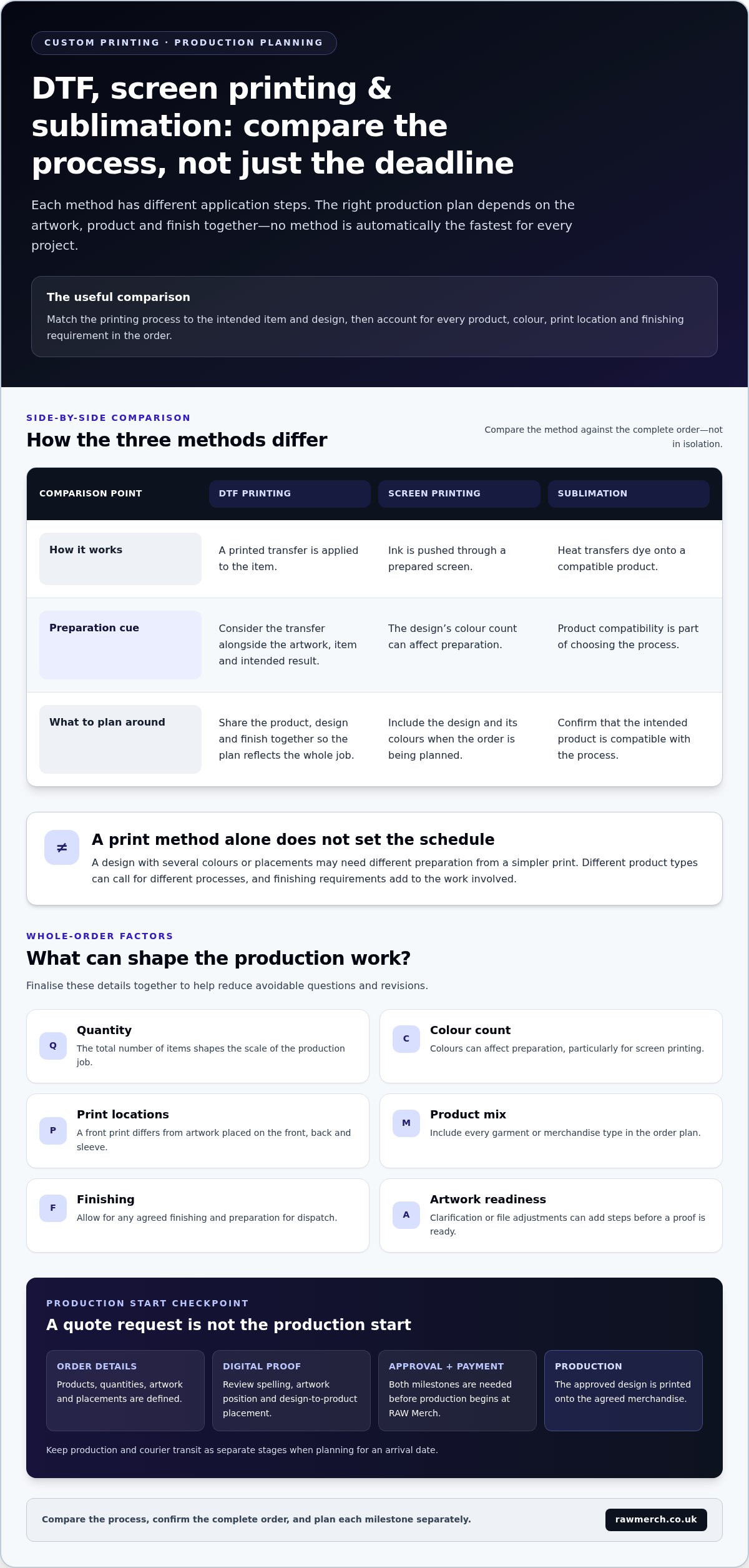
DTF printing applies a printed transfer to the item, while screen printing pushes ink through a prepared screen. Sublimation uses heat to transfer dye onto a compatible product. Each method has its own preparation and application steps, so the artwork, item and intended result help determine what is suitable. No method is automatically the fastest for every project.
The order details matter too. A design with several colours or placements may need different preparation from a simpler print, and different product types can call for different processes. Share the intended garment or merchandise, design and finish together so the production plan reflects the whole job.
How Do Artwork and Order Details Affect Production?
Artwork that needs file adjustments or clarification can add steps before a proof is ready. Changes requested after review may require an updated proof, so provide the clearest available file and check the layout carefully. RAW Merch offers file-format guidance, and its vector image guide explains one useful artwork format to consider when preparing a design.
Order details matter just as much. Finalise the quantity, product types, size range, colours, print locations and any finishing before production planning. For example, a run of one T-shirt design is simpler to define than an order split across T-shirts, hoodies and headwear, each with different artwork placements. Clear specifications reduce avoidable questions and revisions.
- Quantity: The total number of items shapes the scale of the production job.
- Colour count: The design’s colours can affect preparation, particularly for screen printing.
- Print locations: A front print alone differs from artwork placed on the front, back and sleeve.
- Product variety: Multiple garments or merchandise types need to be included in the order plan.
- Finishing: Any agreed finishing requirements add work after the print itself.
Share these specifications together rather than sending them in separate updates. That gives the proof and agreed order a consistent reference point. RAW Merch has over 25 years of experience with DTF, screen printing and sublimation for custom clothing and merchandise, helping you prepare a clear brief before production begins. Find out more about RAW Merch’s printing experience.
How Do Printing Options Compare When You Have a Deadline?
A deadline doesn’t automatically make one printing method the right choice. DTF, screen printing and sublimation involve different processes, and suitability depends on the merchandise, artwork and intended result. Compare them against the same product, artwork and order requirements rather than judging a method in isolation.
| Method | Process fit | Order details to consider | Planning considerations |
|---|---|---|---|
| DTF | A printed film transfer is applied to the item. | Consider the garment or product, artwork and planned print locations. | Include transfer application and any finishing in the production plan. |
| Screen printing | Ink is applied through a prepared screen. | Colour count, design and how the order is divided across products can affect preparation. | Allow for screen preparation as well as printing and finishing. |
| Sublimation | Heat transfers dye onto a compatible product or substrate. | The item’s material and the intended design result help determine suitability. | Consider the product, artwork and required finish together. |
This comparison is a starting point, not a promise of a particular production speed. An order with several garment types or print placements can require different preparation from a consistent order, even if both use the same method. Understanding turnaround times for printing means assessing the complete specification before deciding how the work fits your deadline.
Which Printing Method Fits the Product and Design?
Start with the item and the result you want. DTF uses a transfer applied to the product; screen printing requires a prepared screen; sublimation depends on a compatible substrate. The artwork, garment or merchandise, colour requirements and intended use all help determine which process is appropriate. Share these details together so the method suits the project, rather than choosing on speed alone.
If your order combines different products, don’t assume one process will suit every item. A consistent product and design brief gives the production plan a clearer basis. RAW Merch works with DTF, screen printing and sublimation for custom clothing and merchandise, tailoring the process to the order details.
What Does an Express Delivery Option Actually Change?
Courier speed affects the journey after production, not the time needed to print and finish an order. RAW Merch can arrange a 24-hour courier service on request, but that is a delivery option, not 24-hour printing or a guarantee of when the order will be completed.
Plan backwards from the date you need the merchandise. Allow for production first, then account separately for dispatch and courier transit. If your date is fixed, this distinction helps you plan the overall schedule without mistaking faster delivery for a shorter production process. RAW Merch’s merchandise printing brings the printing methods and order requirements into one practical plan.
How Can You Keep a Printing Order on Schedule?
A clear brief and timely decisions make a custom merchandise order easier to plan. Work through the checklist from your required arrival date to proof approval. This gives the production plan a firm set of details to follow and helps you spot missing information before it causes extra questions or changes.
- Confirm your required arrival date. Set the date the merchandise needs to reach you, then plan backwards. Allow separately for production and courier delivery rather than treating them as one stage.
- Define the order. List each product type, the quantity of each and the size breakdown. Include colours, print locations and any finishing requirements.
- Settle the product mix. Decide whether the order includes T-shirts, hoodies, headwear or other merchandise. Finalise these choices before submitting artwork, as changing products can affect how the job is planned.
- Prepare your artwork. Supply the clearest available files and identify which design belongs on each product and location. RAW Merch offers artwork assistance, including file-format guidance, to help you prepare files.
- Share the complete brief. Send the order details together, including your required arrival date. Clear specifications help establish a production plan and keep delivery visible as a separate stage.
- Respond promptly to questions. If a detail needs clarification, provide one consolidated answer to avoid repeated rounds of queries.
- Review and approve the proof. Check the emailed proof against your agreed design and order details. Approve it only when everything is correct, then complete payment so production can begin.
What Should You Prepare Before Requesting a Quote?
Gather the full order picture first: product types, quantities, size breakdowns, colours, print locations and the date you need the goods to arrive. Match your artwork files to the products and placements, and note any questions about file formats. This preparation helps define the job clearly, so production and delivery can be included in the plan without confusing their separate timelines.
If you’re organising merchandise around a release or tour, use this band merchandise planning guide to think through your product mix and order requirements early.
How Can You Prevent Approval Delays?
When the proof arrives, review it against the brief, not from memory. Check the artwork, placement and design details for each product. Gather feedback from everyone involved before replying, then send one clear set of requested changes if anything needs correction. Once the proof is right, approve it and complete payment. These steps need to be completed before production begins at RAW Merch.
Good preparation is practical schedule management. Prepare your printing order with RAW Merch by bringing your product choices, artwork and deadline into one clear brief.
How RAW Merch Manages the Custom Printing Order Timeline
A clear order process helps you see what needs to happen before your custom merchandise enters production. At RAW Merch, the sequence is straightforward: a digital proof is emailed, you approve it, payment is received, and then production begins. Tracking these milestones makes deadline planning more practical.
RAW Merch brings over 25 years of printing and merchandise experience to custom clothing and merchandise orders. Artwork guidance, including file-format support, helps you prepare the design and understand the proof before approving it. The approved proof gives the order a clear version of the design and placement to work from.
What Happens After You Submit Your Order Details?
Once your order details and artwork are ready for review, RAW Merch emails a digital proof. Check that the proposed artwork reflects the agreed design and placement. If something needs changing, raise it before approval so the proof can be updated before production starts.
Production begins after you approve the proof and payment is received. Plan against the full order and your required date, keeping production and delivery as separate stages. There is no single lead time that applies to every custom order, so use the agreed project schedule rather than assuming a set number of days.
How Can RAW Merch Support Your Deadline Planning?
Artwork assistance can help with practical preparation, including file-format guidance. A well-prepared file and careful proof review make it easier to settle the design details before production. If you’re working towards an event, launch or tour, share your required arrival date alongside the product mix and artwork so the order can be planned as a complete project.
After production, RAW Merch uses tracked courier service on all orders. Tracking supports visibility at the delivery stage, but courier transit is separate from printing time. A 24-hour courier service can be arranged on request; it applies to delivery, not production or guaranteed order completion. RAW Merch’s stated service promise is to deliver on time every time, while the production and delivery schedule is specific to your order.
Understanding turnaround times for printing comes down to knowing which milestones are complete and what remains before your merchandise arrives. Share your requirements early, review the proof carefully and plan courier delivery as its own stage.
Discuss a custom merchandise order with RAW Merch and bring your artwork, product details and deadline into the planning process.
Put Your Printing Plan in Motion
Your deadline is easier to manage when you treat it as an arrival date, not simply a dispatch target. Before placing an order, decide what needs to be ready, where it needs to go and how the separate stages fit your schedule. That gives you a practical starting point for planning instead of relying on assumptions about how long printing takes.
Understanding turnaround times for printing means making informed decisions early. Bring your product choices, artwork and required date together, then use the agreed schedule to guide your next steps. If your plans change, share that promptly so the order details and timeline can be reviewed together.
RAW Merch’s printing experience, artwork guidance and delivery options help you plan a custom merchandise order. Discuss your custom merchandise order with RAW Merch and take the next step towards getting your project planned with confidence.
Frequently Asked Questions
How long does custom printing take?
There’s no single schedule for every custom order. Product type, printing method, artwork, quantity, finishing and approval all affect the work involved. An order with several product types and print locations needs a different plan from one with a single design on one item. For understanding turnaround times for printing, use the schedule agreed for your order and account for courier delivery separately.
Does a 24-hour courier service mean my printed order will be ready in 24 hours?
No. A 24-hour service is a courier delivery arrangement, not a promise that custom merchandise will be produced within 24 hours. Production has its own stages, and work begins only after the proof is approved and payment is received. For a launch or event, account for production first, then allow for delivery separately so the courier option isn’t mistaken for a production estimate.
Does production start before I approve the print proof?
No. RAW Merch emails a digital proof for your review, and production starts after you’ve approved it and payment has been received. Check the design against your brief, including details such as spelling, artwork size and placement. For a team order, gather feedback from everyone who needs to sign off before responding. This helps avoid separate rounds of comments after approval.
Can I change my artwork after approving the proof?
You can raise a requested change, but it may affect the project schedule if the approved artwork needs to be reviewed again. The proof is the reference for the print, so check every design version and placement before approving it. If you spot an error later, explain what needs changing as soon as possible. Consolidate feedback first to avoid conflicting edits from different people.
Do weekends and UK bank holidays count towards printing turnaround time?
Don’t assume every calendar day is included in a production or delivery schedule. The dates that apply depend on the agreed plan, so share your required arrival date, especially if it falls near a weekend or UK bank holiday. If merchandise is needed for a Saturday event, plan around the date it must arrive, not just the day the event begins, and include time for courier transit.
Can I combine different products in one custom merchandise order?
Yes, a merchandise project can include different product categories. Provide the full product mix and quantities together to help plan the order. For example, list how many T-shirts, hoodies and headwear items you need, along with their sizes and artwork placements. Different products may call for different materials, print methods or finishing, so setting out the details together gives the schedule a clearer basis.