
The cheapest printing method for your next UK merch run might actually be the one costing you double in hidden setup fees and lost production time. Choosing between screen printing vs dtf uk isn't just about price; it's a tactical decision that affects your brand's reputation. You need prints that survive 50+ washes and colours that match your logo exactly, not a plastic-y finish that peels after one tour. We know the pressure of meeting tight deadlines for events across the UK and the frustration of unexpected costs appearing on your final invoice.
You'll discover the exact break-even point where switching from DTF to screen printing saves you hundreds of pounds. We draw on 25 years of industry experience to show you which method delivers the best hand-feel and durability for your specific order volume. This guide compares setup costs, turnaround speeds, and colour precision to ensure your t-shirts and hoodies look professional from the first wash to the fiftieth. Get ready for a no-nonsense breakdown of 2026 printing standards that prioritises your bottom line and your brand quality.
Key Takeaways
- Pinpoint the exact order volume where screen printing beats DTF on price for your UK merch.
- Learn why Pantone matching is vital for brand logos and when to use DTF for complex, photographic designs.
- Get the facts on wash-fastness so your custom clothing survives 50+ wash cycles without cracking or peeling.
- Use the screen printing vs dtf uk decision framework to avoid hidden setup fees and meet tight tour deadlines.
- Leverage our 25 years of UK production expertise to choose the right tech for your specific budget.
How Screen Printing and DTF Work: The 2026 Tech Breakdown
Understanding the technical mechanics of screen printing vs dtf uk is the first step toward a perfect merch run. These aren't just different machines; they are entirely different philosophies of garment decoration. While one relies on physical pressure and heavy ink deposits, the other uses digital precision and advanced chemistry to bond designs to fabric. In 2026, the gap between these technologies has narrowed, but the choice still depends on your specific goals for durability and feel.
The Screen Printing Process: Tradition at Scale
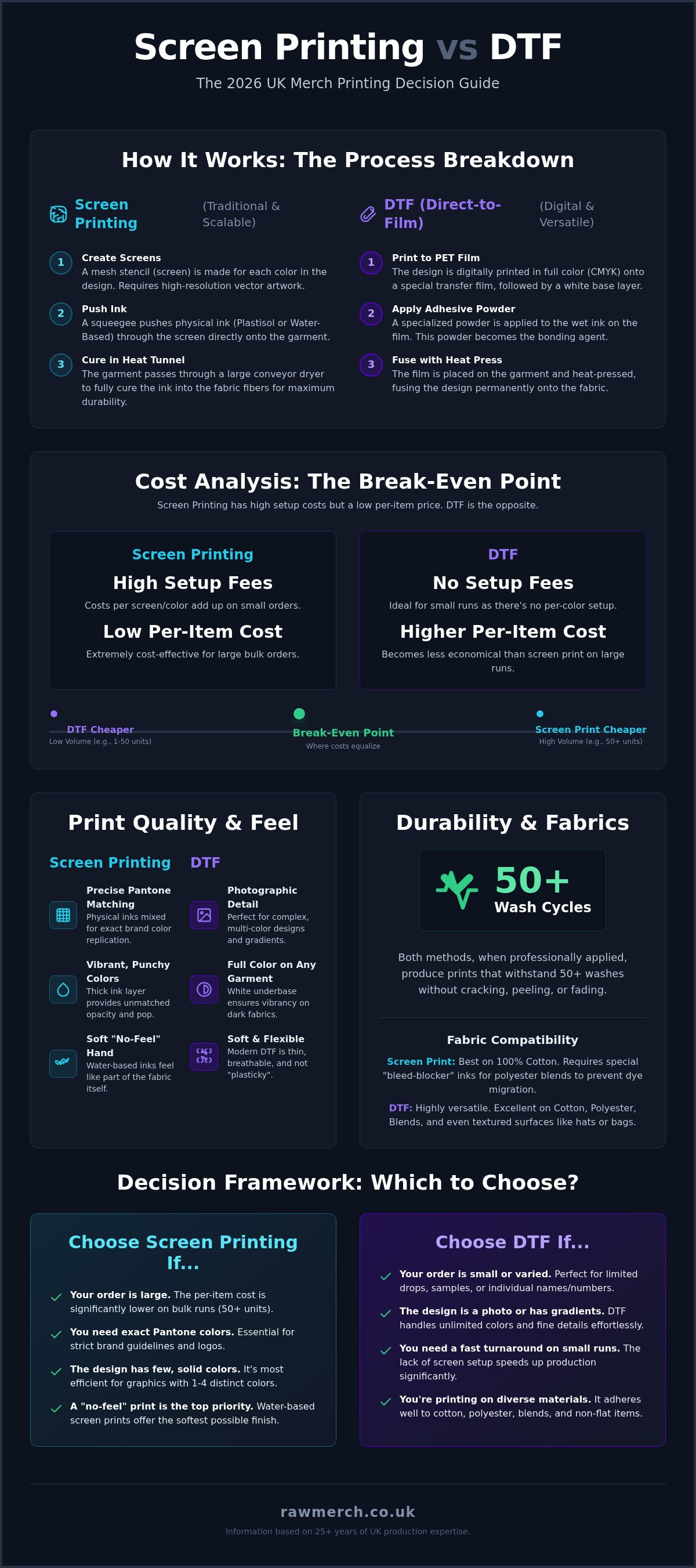
This traditional screen printing process involves pushing ink through a high-tension mesh stencil. It's a mechanical method built for speed and volume. Before we even touch a squeegee, your artwork must be perfect. We require high-resolution vector image files to create the individual screens for each colour in your logo. Mesh counts are vital here. A lower mesh count allows for thick, vibrant plastisol layers, while higher mesh counts are used for intricate details and soft-touch water-based inks. Once printed, the garments pass through industrial heat tunnels. This ensures the ink cures fully into the fibres, providing that legendary durability that UK bands and brands rely on for tour merch.
The DTF Process: Digital Precision for the UK Market
Direct to Film (DTF) has completely disrupted the UK market by offering a digital alternative that finally rivals traditional quality. Unlike the older Direct to Garment (DTG) method, which often struggled with vibrancy on dark hoodies, DTF prints onto a PET film first. We print a CMYK layer followed by a thick white base, then apply a specialised adhesive powder. This powder is the secret to longevity. It creates a flexible, durable bond that doesn't crack easily. Because it's a digital process, there are no screens to burn. This makes it the go-to for complex gradients, photographs, and small-batch runs that need to look professional without the setup overhead.
The "hand-feel" of both methods has evolved significantly over the last two years. In 2026, premium DTF films are thinner and more breathable than ever, losing that plastic-y sticker feel of the past. Meanwhile, screen printing remains the king of the "no-feel" finish when using water-based inks on light fabrics. The curing method makes the difference. Screen printing uses long conveyor dryers for consistency at scale. DTF relies on precision heat presses to fuse the transfer. Both methods now produce professional results that stand up to the rigours of the UK high street and repeated washing.
Detail, Vibrancy, and Feel: Comparing the Visual Results
Visual impact is where the battle of screen printing vs dtf uk really heats up. If you've ever held a high-end band shirt, you know the difference between a print that sits on the fabric and one that feels like part of it. Screen printing remains the industry benchmark for Pantone colour matching. We mix physical inks to hit your exact brand specs. This ensures every hoodie in a 500-unit run looks identical. Digital methods are catching up, but they still struggle to replicate the sheer depth of a solid, screen-printed plastisol.
Vibrancy and Colour Matching
When it comes to band merchandise, design complexity often dictates the tech. Screen printing excels at solid colours that pop, especially on heavy cotton. However, DTF is the undisputed king of photorealistic designs. It handles intricate gradients and high-detail photographs that would require twelve or more screens in a traditional setup. We ensure colours stay true on black hoodies by using a dense digital white underbase. This prevents the garment colour from muddying the design, which is a common failure in cheaper digital prints.
Fabric Compatibility and Dye Migration
Fabric choice changes everything. While 100% cotton is the gold standard for both methods, many UK brands use polyester blends for sportswear or workwear. This is where dye migration becomes a risk. In synthetic fabrics, the garment dye can bleed into the print during the curing process. We maintain strict sustainability and safety standards in our facility to manage these chemical reactions safely and effectively. Screen printing usually handles these blends better with specialized bleed-blocker inks. For smaller accessories like custom bobble hats, DTF often provides a cleaner finish on textured surfaces where a screen might struggle to make flat contact.
The hand-feel test is the final hurdle for most clients. Older DTF transfers felt like a thick, rubbery sticker. Modern industrial DTF is surprisingly soft, though it still lacks the ultimate breathability of water-based screen printing. If you're printing large solid blocks of colour, screen printing will feel heavier on the chest. If your design is open and detailed, DTF will feel lighter and more flexible. If you are unsure which visual style fits your brand, view our clothing printing options to see which method suits your artwork. Ultimately, the choice in the screen printing vs dtf uk debate depends on whether you value Pantone precision or photographic detail.
The Break-Even Point: Cost Analysis for UK Bulk Orders
Price is often the deciding factor for any UK merch run. In 2026, the financial landscape of screen printing vs dtf uk is shaped by rising energy costs and the need for faster production cycles. You shouldn't just look at the total at the bottom of your quote. You need to understand how the money is distributed between labour, materials, and setup fees. One method rewards volume, while the other rewards complexity. Choosing the wrong path for your specific order size can lead to paying double the necessary unit price.
Screen printing relies on a high initial setup cost. We have to create physical films, prepare mesh screens, and perform colour separations for every unique ink in your design. If you're only printing 10 shirts, these setup fees make the unit price astronomical. However, once the press is running, the cost of ink and labour per garment is very low. DTF flips this model. There are no screens to burn or films to output. Your digital file goes straight to the printer. This eliminates setup fees entirely, but the "per-print" cost of the PET film and adhesive powder remains constant regardless of how many you order.
The 50-piece rule is our standard benchmark for the UK market. For orders under 50 units, DTF is almost always the more economical choice. Once you cross the 50-unit threshold, the setup fees for screen printing begin to "dilute" across the larger batch. At 100 units or more, screen printing becomes significantly cheaper per garment, especially for designs with fewer colours. We've seen many UK brands lose their margins by choosing DTF for bulk runs simply because they were afraid of the initial setup invoice.
When Screen Printing Wins on ROI
ROI is highest when you lean into the strengths of the traditional press. If you have a simple 1 or 2 colour logo and need 100+ hoodies, screen printing is the undisputed winner. The unit price drops sharply as your quantity increases. Another hidden benefit is the cost of re-runs. We often keep screens on file for high-volume clients. This means your second and third orders can bypass the initial setup hurdles, making repeat tour merch or staff uniforms even more cost-effective over time.
When DTF is the Smarter Financial Choice
DTF is the financial saviour for small batches and complex artwork. If your design features six or more colours, the setup fees for screen printing would be prohibitive for anything less than a massive bulk order. DTF doesn't care if your logo has two colours or twenty; the price remains the same. It's also the perfect tool for sampling. You can see a finished garment without committing to the full cost of screen preparation. This prevents expensive mistakes before you pull the trigger on a larger production run. Avoid the per-colour setup trap by using digital film for your most intricate, multi-coloured creative visions.
Durability and Sustainability: The 2026 Perspective
Longevity is the ultimate test of value for any garment. In the screen printing vs dtf uk debate, durability often decides whether your customers become repeat buyers or one-time critics. You need a print that survives the rigours of industrial washing machines and high-heat dryers. Most professional UK merch runs now aim for a minimum of 50 wash cycles before any visible degradation occurs. Achieving this requires more than just good machines; it requires a deep understanding of ink chemistry and bonding temperatures.
Longevity and Wear-and-Tear
Screen printing ink bonds with the fabric for a lifetime finish because the liquid ink penetrates the garment fibres before curing. This creates a permanent weld between the design and the cotton. DTF relies on a high-performance adhesive layer that sits on the surface. While modern DTF is incredibly resilient, you must prevent peeling by ensuring the heat-press pressure and temperature are perfectly calibrated during production. Industrial workwear often fares better with screen printing due to its resistance to the harsh chemicals used in commercial laundering.
While traditional plastisol ink offers a heavy-duty shield that resists abrasion, modern digital film provides superior elasticity that prevents cracking on high-stretch athletic fabrics. This flexibility is a major win for sportswear brands that need their logos to move with the athlete without snapping or distorting over time.
Eco-Friendly Merch Production
Sustainability is no longer a luxury in the UK market; it is a requirement. We've seen a massive move toward phthalate-free and water-based inks in UK screen printing to reduce chemical runoff. These water-based alternatives offer the softest hand-feel while meeting strict environmental standards. DTF faces different challenges, primarily regarding the plastic waste generated by the PET transfer film. However, recycling programmes for these films are finally becoming more accessible for UK-based production facilities.
RAW Merch leverages 25 years of industry experience to optimise every production run. We minimise ink waste and streamline our curing processes to reduce our UK landfill impact and energy consumption. This seasoned approach ensures you get high-quality merch without an unnecessary environmental footprint. If you need gear that stands the test of time, order your clothing printing from a team that understands the balance between durability and eco-responsibility.
Choosing Your Method: The RAW Merch Decision Framework
Making the final call on screen printing vs dtf uk doesn't have to be a gamble. You've seen the technical differences, the visual results, and the cost implications. Now, you need a clear path forward. Your choice should balance your immediate budget with the long-term quality your brand deserves. In 2026, the best decision is the one that aligns your artwork's complexity with your total order volume.
The Ultimate 'Which One?' Checklist
Use this simple framework to decide your production path. We look at two main factors: quantity and complexity. This ensures you never overpay for setup or sacrifice design detail.
- Volume: If you're ordering 50 or more units of the same design, screen printing offers the best ROI. For small batches, samples, or one-offs, DTF is the clear winner.
- Complexity: Does your design have six or more colours or photographic gradients? DTF handles this effortlessly. Stick to screen printing for 1 to 3 colour logos where Pantone precision is non-negotiable.
- Deadlines: DTF is often faster for urgent UK turnarounds. There are no screens to prepare or dry, so we can move to the pressing stage much quicker than traditional methods allow.
- Speciality Finishes: If your brand requires neon inks, glitter, or metallic textures, screen printing is your only option. Digital films cannot yet replicate the physical texture of these speciality additives.
Expert Support for Your Next Project
You don't have to guess which method is right. Our team reviews every piece of artwork that comes through our UK facility. We leverage 25 years of industry experience to recommend the best method for your specific budget. We'll tell you straight if your design is better suited for high-mesh screen printing or industrial DTF. This expert oversight prevents costly mistakes and ensures your merch is ready for the merch desk or the retail shelf without delay.
We specialise in complex fulfillment for UK tours and large-scale events. Whether you're a band heading out on a 20-date run or a business launching a new uniform line, we manage the logistics from our UK-based production hub. This means faster shipping and tighter quality control compared to overseas competitors. We don't just print shirts; we protect your brand's reputation with every squeegee pull and heat press cycle. Our seasoned experts are ready to guide you through the process from start to finish.
Ready to see the difference professional UK printing makes for your brand? GET A CUSTOM QUOTE for your 2026 merch today. Let's build something durable together.
DOMINATE YOUR NEXT MERCH RUN
Choosing between screen printing vs dtf uk is a tactical decision that defines your brand's quality and your project's profitability. You now have the framework to avoid hidden setup fees and select the right durability for your specific fabric. Remember that the 50-piece rule remains the gold standard for UK bulk orders. Use traditional screens for high-volume Pantone precision and digital film for complex, small-batch creative visions. Both methods deliver professional results when executed with the right technical expertise.
We are ready to bring your vision to life with speed and precision. Let's get your gear on the road.
Frequently Asked Questions
Is screen printing better quality than DTF?
Quality depends entirely on your specific design goals. Screen printing provides unmatched colour depth and Pantone accuracy for bold, solid logos. DTF offers superior resolution for complex, photographic artwork that traditional screens can't easily replicate. Both methods produce professional, retail-ready results when handled by our seasoned experts.
Which printing method is more durable for t-shirts?
Screen printing is traditionally more durable because the ink penetrates the fabric fibres directly. However, modern industrial DTF uses advanced adhesive powders that survive 50+ wash cycles without cracking or peeling. For heavy-duty workwear or high-intensity tour merch, screen printing remains the industry standard for long-term wear.
What is the minimum order quantity for screen printing in the UK?
We typically recommend a minimum of 25 units for screen printing to offset the initial setup costs. Because each colour requires a unique screen, smaller runs become expensive per garment. If you need fewer than 25 items, DTF is the most cost-effective path for your custom UK merch.
Does DTF printing feel like plastic on the skin?
Modern DTF transfers are significantly thinner and more flexible than older heat transfers. While you can feel the print on the surface, it doesn't have the heavy, rubbery texture of the past. If you want a completely "no-feel" finish, water-based screen printing on light garments is the better choice for your brand.
Can you screen print complex multi-colour photographs?
Yes, we use a process called CMYK or simulated process printing to recreate photographs with screens. This requires high-level expertise and multiple screens, making it best for large bulk orders. For smaller runs of photographic art, the screen printing vs dtf uk debate usually ends with DTF being the faster and cheaper option.
Why is screen printing more expensive for small orders?
The cost comes from the intensive setup process. We have to create physical films, coat screens with emulsion, and calibrate the press for every colour in your design. These labour and material costs are fixed. They are much higher per shirt when spread over a small batch of ten or twenty garments.
Is DTF printing eco-friendly compared to traditional methods?
Both methods have different environmental impacts. Screen printing can use eco-friendly, water-based inks but requires water for screen cleaning. DTF produces less ink waste but generates plastic waste from the PET carrier film. We focus on reducing our UK production footprint by optimizing every run to minimize material loss.
Which method is faster for a tight event deadline in the UK?
DTF is generally faster for urgent deadlines. Since there are no screens to burn or dry, we can move from your digital file to the finished garment almost immediately. This makes it the ideal choice for last-minute event merch or quick-turnaround promotional items produced in our UK facility.