
Staring at your design and worried it’ll end up a blurry, plasticky mess on your new tees? Concerned the print will crack after a few washes, or that you’ll overpay for your order? You’re not alone. Choosing the right custom print method is the most critical decision for your merchandise, and the big debate often boils down to one key question: screen printing vs dtf.
You want results, not confusing technical jargon. This is your no-nonsense guide to making the right call. We're cutting through the noise to give you the straight facts on what really matters-the feel, the finish, the cost per item, and the long-term durability. We'll show you which method is king for bold, simple designs in bulk and which one champions full-colour, complex artwork for smaller runs. By the end, you'll confidently select the perfect print for your project, your design, and your budget. Let’s get it right.
The Quick Verdict: Screen Printing vs DTF at a Glance
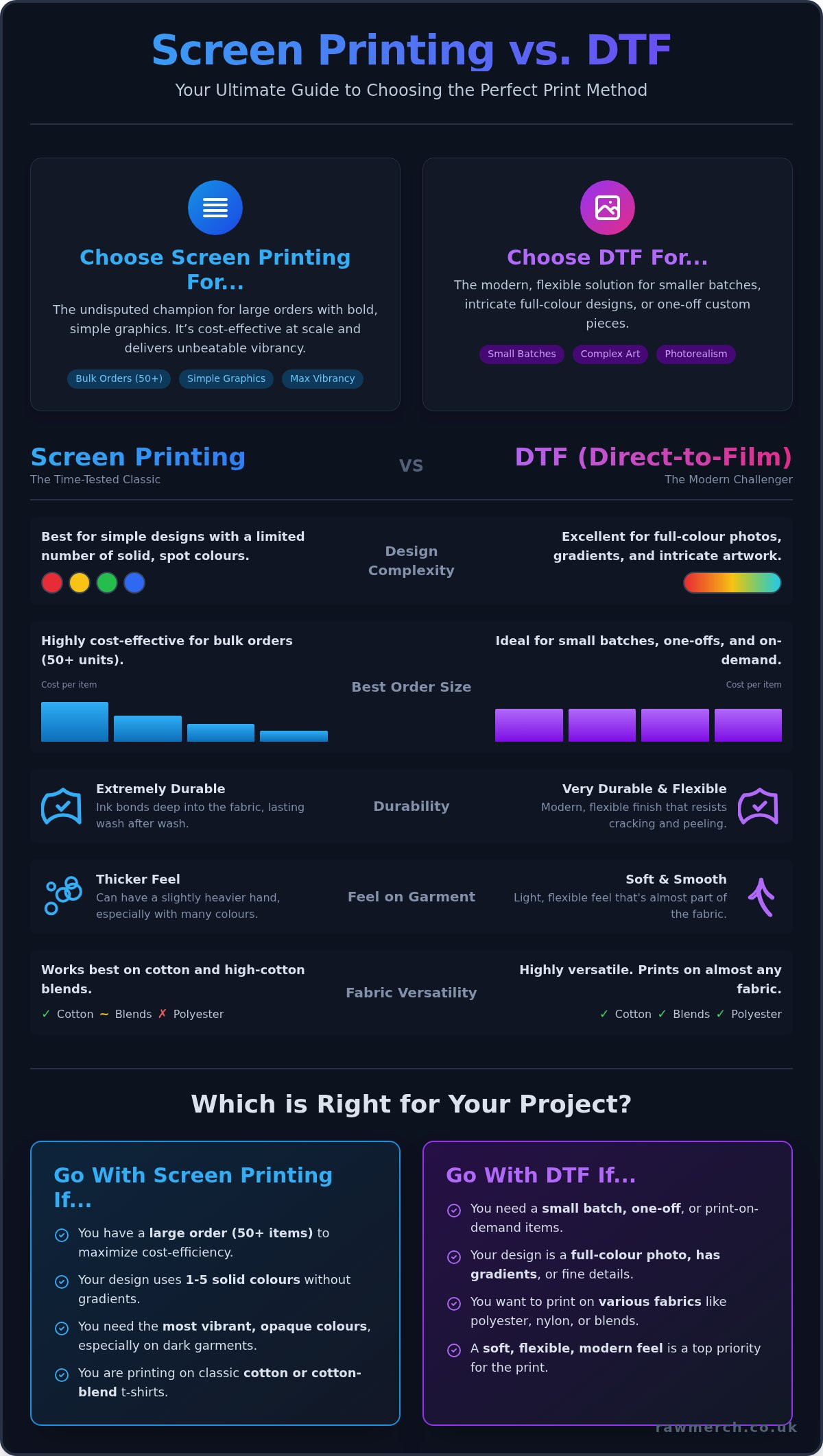
Stuck choosing your print method? The screen printing vs dtf debate is simpler than it looks. Here’s the bottom line: For large orders (think 50+ items) with bold, simple graphics, screen printing is the undisputed champion. It’s cost-effective at scale and delivers unbeatable vibrancy. For smaller batches, intricate full-colour designs, or one-off custom pieces, DTF (Direct-to-Film) is your modern, flexible solution. The best choice isn't about which is superior-it's about what your project demands.
What is Screen Printing? The Time-Tested Classic
Screen printing is the industry standard for a reason. The process involves pushing ink through a stencilled mesh screen directly onto the fabric. A separate screen is created for each colour in your design, which is why it's perfect for graphics with a limited colour palette. For a deeper dive into the technicals of what screen printing is, its history goes back centuries. The result is a print with incredibly rich, vibrant colours and a durable finish that's built to last wash after wash.
What is DTF (Direct-to-Film)? The Modern Challenger
DTF is a game-changing digital printing technology. We print your design-complete with unlimited colours, gradients, and fine details-onto a special transfer film. This printed film is then applied to your garment using a commercial heat press, bonding the design permanently to the fabric. This method removes the colour limitations of traditional printing, making it the perfect choice for photorealistic images, complex logos, and vibrant, multi-coloured artwork on almost any type of fabric.
At-a-Glance Comparison Table: Screen Print vs DTF
| Feature | Screen Printing | DTF (Direct-to-Film) |
|---|---|---|
| Design Complexity | Best for simple designs with limited, solid colours. | Excellent for complex, full-colour, and photorealistic designs. |
| Best Order Size | Cost-effective for bulk orders (50+ units). | Ideal for small batches, one-offs, and on-demand printing. |
| Durability | Extremely durable. Ink bonds deep into the fabric. | Very durable with a modern, flexible finish that resists cracking. |
| Feel on Garment | Can have a slightly thicker feel, especially with many colours. | Soft, smooth, and flexible feel, almost part of the fabric. |
| Colour Vibrancy | Unmatched vibrancy and opacity, especially on dark garments. | Bright, accurate colours with excellent consistency. |
| Fabric Versatility | Works best on cotton and cotton blends. | Highly versatile. Works on cotton, polyester, blends, and more. |
Decision Point 1: Your Design's Complexity & Colours
The first and most important question is: what does your artwork look like? The choice in the screen printing vs dtf debate often comes down to the number of colours and the level of detail in your design. One method excels with bold simplicity, while the other thrives on complexity. We get the job done right, whichever you choose.
QUICK VERDICT:
- For 1-5 solid colours: Choose Screen Printing.
- For photos, gradients, or many colours: Choose DTF.
When Screen Printing Wins: Bold Graphics & Spot Colours
Screen printing is the undisputed champion for designs with a limited colour palette. Think bold logos, striking text, and graphics using one to five solid colours. We use 'spot colours'-individual inks mixed to a precise shade, guaranteeing perfect Pantone matching for your brand. This process lays down a thick, opaque layer of ink, resulting in incredibly vibrant, punchy colours that last. It’s the classic choice for band merch, staff uniforms, and any design that needs to make a powerful, clean statement. It handles crisp lines perfectly, though extremely fine text can be a challenge.
Ideal for screen printing: Bold logos with few colours, like this classic band merch design.
When DTF Excels: Full-Colour Photos, Gradients & Intricate Art
Got a full-colour photograph, a complex illustration with smooth gradients, or incredibly fine details? DTF is your answer. With Direct-to-Film printing, there are no colour limitations. It works like a high-end printer, capable of reproducing millions of shades with total precision. The setup is the same whether your design has one colour or one thousand, making it perfect for photorealistic images and intricate artwork. This flexibility is a key reason behind the positive market trends for DTF printing, as it opens up huge creative possibilities. DTF excels at reproducing very fine lines and small, crisp text that might be lost in other processes.
Perfect for DTF: Full-colour photographic prints with complex details and gradients.
Decision Point 2: Order Quantity & Your Budget
When it comes to screen printing vs dtf, your budget and the number of items you need are two of the most critical factors. These two methods have fundamentally different cost structures. One rewards bulk orders with unbeatable value, while the other offers incredible flexibility for small quantities. Understanding this difference is key to making the right choice.
The Economics of Screen Printing: Go Big or Go Home
Screen printing involves a significant upfront setup process. For every single colour in your design, a separate screen must be coated, exposed, and prepared. Each screen carries a setup cost, typically around £20-£30. A four-colour design means a setup fee of £80-£120 before a single garment is printed.
This initial investment is why screen printing is not cost-effective for small runs. For an order of just 10 shirts, that setup fee makes the price per item skyrocket. However, for large orders, the magic happens. That same setup cost gets divided across 100, 500, or 1000+ items, causing the per-unit price to plummet. It’s the undisputed champion for large-scale projects like band tour merchandise, festival staff gear, and company-wide uniforms.
This production model is why large-scale printing is so efficient. In other markets, for example, production hubs like Grupo Mirazul coordinate entire networks of digital, screen printing, and signage workshops to manage complex, high-volume orders.
The Flexibility of DTF: Perfect for Small Batches & Samples
Direct to Film (DTF) printing flips the script entirely. As a digital process, it has virtually no setup costs per design. We print your artwork directly onto a special film, which is then heat-pressed onto the garment. This streamlined method, detailed by industry authorities like FESPA on how DTF printing works, means the price for one t-shirt is practically the same as the price for the tenth.
This makes DTF the perfect, budget-friendly choice for small quantities. It's ideal for:
- Testing a new design for your brand (1-5 items)
- Creating personalised one-off gifts
- Outfitting a small team or club (5-25 items)
DTF gives you total freedom to order exactly what you need, when you need it. Need a small batch? Get a quick DTF quote here.
So, where’s the tipping point? As a general rule, the break-even point is around 25-30 items. If your order is smaller than that, DTF will almost always be your most cost-effective option. Once you go above that number, the powerful economies of scale from screen printing make it the smarter financial choice.
Decision Point 3: Feel, Durability & Fabric Choice
A great design is only half the story. The way a print feels, how it holds up in the wash, and the fabric it’s printed on are what separate professional merch from the rest. This is a critical part of the screen printing vs dtf decision, defining the final quality of your custom clothing.
The 'Feel' on the Shirt: Soft Hand vs. Smooth Finish
Screen printing presses ink directly into the fabric fibres. This creates the classic ‘soft hand’ feel that becomes part of the shirt itself. For an even softer, more breathable finish that you can barely feel, water-based inks are the ultimate choice, delivering a premium, retail-quality result.
DTF, on the other hand, creates a thin, flexible layer that sits precisely on top of the fabric. Forget the thick, plastic-like prints of the past. Modern, high-quality DTF is incredibly smooth, sharp, and moves with the garment without cracking or feeling stiff.
Durability & Wash Care: Which Print Lasts Longer?
Here’s the bottom line: when done by professionals, both methods produce incredibly durable prints. Your choice depends on the look you want over time.
A screen print is built to last the lifetime of the garment. It ages with the shirt, often softening and developing a subtle vintage character after years of washing. DTF prints are rigorously tested and rated to withstand 50+ washes with exceptional colour vibrancy and no peeling when cared for correctly.
For maximum lifespan from either print, follow these simple rules:
- Wash inside out on a cool cycle.
- Avoid harsh detergents and bleach.
- Do not tumble dry. Hang dry for best results.
Fabric Compatibility: Cotton, Polyester & Blends
This is where the differences between the two methods become crystal clear. Screen printing is the undisputed king for 100% cotton and cotton-rich blends. It’s the perfect match for classic band tees, heavyweight hoodies, and canvas tote bags.
DTF offers unmatched versatility. It adheres brilliantly to a huge range of materials, making it a problem-solver for tricky garments. This includes cotton, polyester, nylon, spandex, and complex blends. This makes DTF the go-to solution for customising polyester sportswear, hi-vis workwear, or any specialty item where screen printing isn't an option.
The Final Verdict: A Checklist for Your Project
Deciding in the screen printing vs DTF debate doesn't have to be complicated. The best choice always comes down to your specific design, order quantity, and the type of garment you're using. We've boiled it all down to a simple checklist to help you identify the right path for your project.
Choose Screen Printing If You Have...
Screen printing is the undisputed champion for bulk orders and designs with bold, solid colours. It’s a classic for a reason, delivering a durable, professional finish that integrates with the fabric. Go with screen printing for that authentic feel.
- An order of 25+ identical items (the more you print, the lower the cost per item).
- A design with 1-5 solid colours, like a band logo or company branding.
- A need for precise Pantone colour matching to keep your brand consistent.
- A preference for a classic, soft-to-the-touch feel on cotton t-shirts and hoodies.
Choose DTF If You Have...
Direct-to-Film (DTF) offers incredible versatility, especially for complex artwork and smaller quantities. It's the modern solution for getting vibrant, detailed prints on almost any fabric, from cotton to synthetics.
- A small order, a one-off sample, or a run where every garment is unique.
- A full-colour photograph, detailed illustration, or a design with gradients.
- A need to print on tricky materials like polyester, sportswear, or nylon.
- A design packed with many colours and fine, intricate details that need to be sharp.
Still Not Sure? Let the Experts Guide You.
Your job is to have a great idea. Our job is to make it a reality. With over 25 years of experience in both printing methods, we know exactly how to make your artwork look its absolute best. We analyse every design to determine the optimal printing method for quality, durability, and cost-effectiveness.
Forget the technical details. We handle the hard work so you can focus on what matters. We know what you want, and we deliver on time, every time. Your custom merch is in safe hands.
Ready to get started? Upload your design and let us handle the rest!
Your Project, Your Print: The Final Verdict
Choosing between these two powerhouse printing methods comes down to your project's specific needs. For large runs with simple, bold colours, screen printing delivers that classic, durable finish at a fantastic price point. When your design is full of intricate details and a spectrum of colours, or you need a smaller quantity, the vibrant precision of DTF is your champion.
The real winner in the screen printing vs dtf showdown is the method that brings your vision to life perfectly. You don't have to make that call alone. With over 25 years of industry experience, we are masters of both techniques. We provide the straightforward, expert advice you need to get a result you'll love, without any fuss.
We are the seasoned experts who get the job done right and on schedule. We deliver on time, every time. Ready to create something incredible?
Got Your Design Ready? Get a No-Obligation Quote Today!
Frequently Asked Questions
Is DTF better than screen printing?
Neither method is better; they are suited for different jobs. When considering screen printing vs dtf, the choice depends on your design and order size. DTF is perfect for highly detailed, multi-colour designs and small batches, offering stunning vibrancy with no minimum order. Screen printing is the undisputed champion for large runs (25+ items) with fewer colours. It’s incredibly cost-effective at scale and offers a classic, durable finish that soaks into the fabric.
Does DTF printing crack or peel off after washing?
No. A professionally applied DTF print is extremely durable and flexible. The adhesive bonds the ink directly to the fabric fibres, creating a print that can withstand dozens of washes without cracking or peeling. To maximise its lifespan, we always recommend washing the garment inside out on a cool cycle and avoiding tumble drying. This ensures your custom merchandise looks great for years to come and protects the print's integrity.
Which printing method is more environmentally friendly?
Both methods have environmental considerations. Screen printing, particularly when using modern water-based inks, can be a sustainable choice as it produces less plastic film waste. However, the DTF process uses significantly less water than traditional screen cleaning methods and its on-demand nature helps reduce garment overproduction. We are committed to using the most responsible practices possible for every order, regardless of the method you choose for your project.
Can you feel the DTF print on the shirt?
Yes, you can feel a DTF print on the garment. It has a smooth, soft-touch finish that sits on top of the fabric, similar to a very thin and flexible layer. While it's more noticeable than a screen print that soaks into the material, modern DTF technology creates a lightweight and pliable result. It is far superior to old-school heat transfers and is very comfortable to wear without feeling heavy or stiff.
What is the minimum order quantity for screen printing at RAW Merch?
Our minimum order quantity for screen printing is 25 units per design. This is because the screen printing process involves a detailed setup for each colour in your artwork, including creating the screens themselves. This initial preparation makes it most cost-effective for larger batches. For orders under 25 items or those with complex, full-colour designs, we typically recommend our DTF printing service, which has no minimum order requirement.
How do I need to prepare my artwork file for printing?
For the sharpest possible print, we need high-quality artwork. The best format is a vector file (AI, EPS, or PDF). If you only have a raster image (like a JPEG or PNG), please ensure it is saved at a minimum of 300 DPI at the exact size you want it printed. Unsure if your file is ready? Don't worry. Send us what you have, and our expert team will review it and advise on the next steps.