

You've just paid for a box of brand-new band tees, but the thought of selling them fills you with dread. Price them too high, and they'll gather dust on the merch table. Price them too low, and you're practically paying fans to take them. Even worse, you could end up losing money after the venue takes its cut. This is a common nightmare for bands across the UK, but getting your pricing band merchandise strategy right doesn't have to be a guessing game. It’s the difference between funding your next recording and packing up unsold stock at the end of the night.
Forget the complicated spreadsheets and the guesswork. This guide is your no-nonsense roadmap to profitability. We’ll give you a simple, reliable formula to calculate the perfect price for every t-shirt, hoodie, and tote bag. You'll learn how to account for every single cost-from the printing bill to the venue’s percentage and UK tax-so you can set prices that are fair for your fans and fantastic for your bank balance. Get ready to turn your merch table into a powerful, sustainable income stream that fuels your music career.
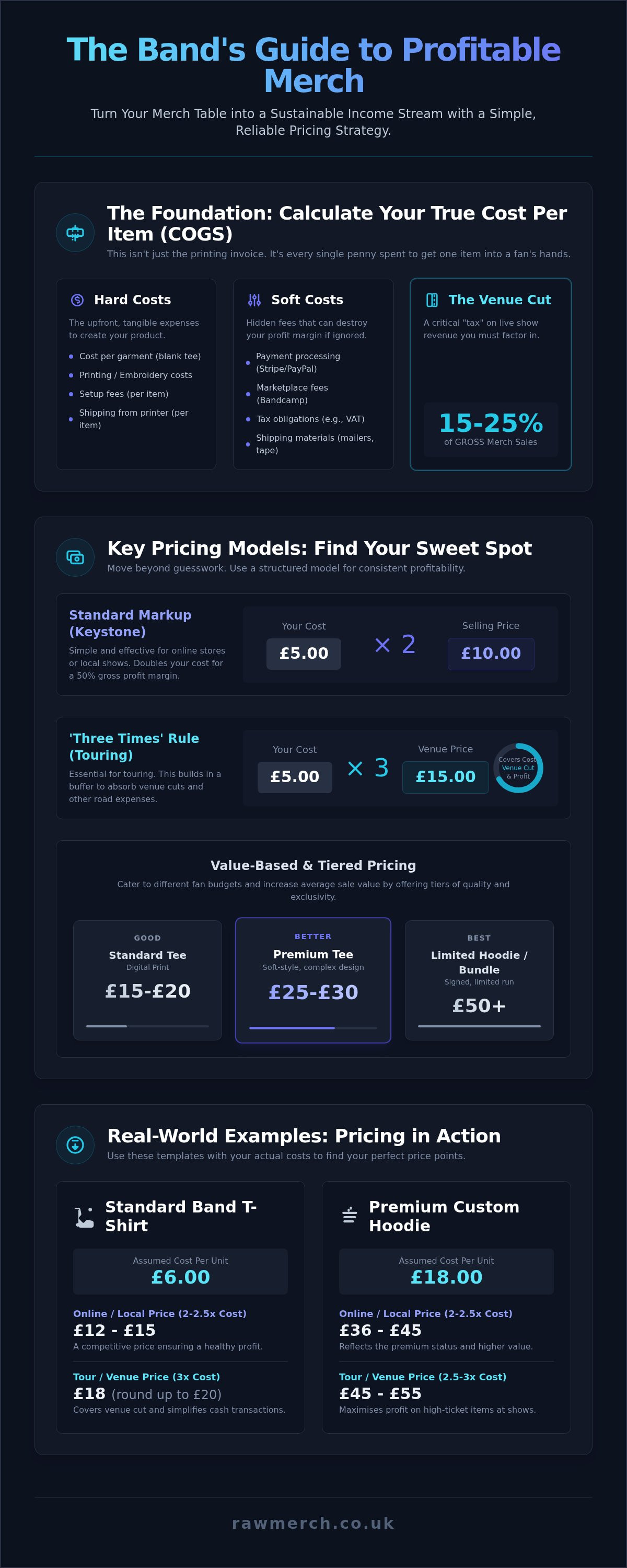
The Foundation: Calculate Your True Cost Per Item
Effective pricing band merchandise starts with one non-negotiable step: calculating your true cost per item. This isn't just the figure on your printer's invoice. It's every single penny you spend to get one t-shirt into a fan's hands. Get this wrong, and you lose money. It’s that simple.
This total investment is known as your 'Cost of Goods Sold' (COGS). It is the bedrock of any smart cost-plus pricing model and the most important figure you'll calculate. Let's break down every potential cost so there are no surprises.
Hard Costs: The Obvious Expenses
These are the upfront, tangible costs you pay to create your product. They are the easiest to track but must be calculated on a per-item basis. Tally them up to find your base production cost.
- Cost per garment: The price of the blank t-shirt, hoodie, or beanie itself (e.g., £4.50).
- Printing costs: Your charge for screen printing, DTF, or embroidery (e.g., £2.00 per print).
- Setup fees: Some printers charge a one-off fee for creating screens. Divide this by your total number of items to get the per-item cost.
- Shipping from printer: The cost to get the box of merch delivered to you, divided by the number of items inside.
Soft Costs: The Easily Forgotten Expenses
These hidden costs can destroy your profit margin if ignored. They apply more to online sales but are crucial for accurate accounting. Don't get caught out.
- Payment processing fees: Stripe and PayPal take a cut, typically around 2.9% + 30p per transaction in the UK.
- Marketplace fees: Selling on Bandcamp? They take a percentage (usually 10-15%).
- Tax obligations: If your band is VAT registered, you need to account for it.
- Shipping materials: The cost of mailers, tape, and labels for every online order adds up.
The Venue Cut: The Gig Economy
Selling merch on tour? The venue wants a piece of the action. This is a critical factor for pricing band merchandise sold at shows. Most venues take a percentage of your gross merch sales, typically ranging from 15-25%. Always confirm the rate with the promoter beforehand. This isn't a cut of your profit; it's a direct tax on your total revenue that you must factor into your at-venue price.
Key Pricing Models: From Simple Markup to Strategic Tiers
Once you have your true cost per item nailed down, it's time to pick a pricing model. Don't just pull a number out of thin air. The goal is to find that sweet spot between maximum profit and a price your fans are happy to pay. A structured approach to pricing band merchandise is essential for long-term success. For a deeper dive into the marketing fundamentals behind this, Berklee's guide to merch strategy offers a solid framework. Let's break down the most common models used by successful artists.
The Standard Markup Model (Keystone Pricing)
This is the simplest, most direct method. You take your cost per item and double it. It’s that easy. For example, if a t-shirt costs you £5 to produce, you sell it for £10. This model guarantees a 50% gross profit margin on each sale before factoring in other costs like shipping or taxes. It’s a solid baseline and a great starting point for any band just getting started.
The 'Three Times' Rule for Touring Bands
When you're on the road, the game changes. Venues often take a cut of your merch sales (typically 10-25%). That's where the 'three times' rule comes in. You simply triple your cost per item. That same £5 t-shirt is now priced at £15. This robust model builds in a crucial buffer to absorb venue fees, credit card processing costs, and any other unexpected tour expenses, ensuring you still walk away with a healthy profit.
Value-Based & Tiered Pricing
The most advanced strategy for pricing band merchandise moves beyond simple cost calculation. It's about pricing based on perceived value. A standard band logo tee has one value, but a limited edition, screen-printed tour poster signed by the band? That has a much higher value. You can leverage this by creating tiers:
- Good: A standard, digitally printed t-shirt (£15-£20)
- Better: A premium, soft-style tee with a more complex design (£25-£30)
- Best: A limited run hoodie or a signed vinyl bundle (£50+)
This 'good, better, best' approach caters to different fan budgets and dramatically increases your average sale value. It empowers fans to choose how much they want to support you while maximising your revenue.
Real-World Examples: Pricing Your Core Merch Line
Theory is great, but let's get practical. Applying these pricing models to your core products is where you turn costs into cash. We've laid out some common examples using typical costs to make the calculations crystal clear. Use these templates as your guide for pricing band merchandise confidently.
Remember: these are examples. Always substitute these numbers with your actual costs from your supplier to find your perfect price point.
Pricing a Standard Band T-Shirt
The t-shirt is the undisputed king of band merch. It's your bread and butter, so pricing it right is crucial. Let's assume your cost for a quality garment with a two-colour screen print is £6 per unit.
- Standard Markup (2x-2.5x): This puts your online or local show price at £12 - £15. This is a solid, competitive price that ensures a healthy profit.
- Tour Price (3x Rule): At a festival or on tour, fans expect higher prices. A 3x markup sets the price at £18 - £20. We recommend rounding to a whole number like £20 for easy cash transactions at a busy merch desk.
Pricing a Custom Hoodie
Hoodies are a premium item with a higher perceived value and a fantastic profit margin. Don't sell yourself short here. If your all-in cost for a custom hoodie is £18 per unit, your pricing strategy should reflect its premium status.
- Standard Markup (2x-2.5x): Your base price should be between £35 - £40. This delivers a great return while remaining attractive to dedicated fans.
- Tour Price (3x Rule): On the road, you can confidently price hoodies at £45 - £50. Fans looking for a high-ticket souvenir are prepared to pay for quality.
Pricing Non-Apparel Items (Posters, Stickers, Totes)
Smaller items are essential for fans on a budget and can have some of the best margins. For these, a simple 2x or 3x rule doesn't always work. A higher markup is standard, an approach that aligns with many models for profit-focused merch pricing that help maximize return on lower-cost goods.
- Stickers & Badges: With a low unit cost (e.g., £0.50), you can apply a 4x-5x markup. Selling them for £2 or £2.50 is common and effective.
- Posters: Remember to include the cost of a protective tube. If a poster costs £2 and the tube is £1, your total cost is £3. A selling price of £8-£10 is perfectly reasonable.
- Tote Bags: These are a brilliant mid-range product. Treat their pricing similarly to a t-shirt. A £5 cost per tote can easily translate to a £12-£15 selling price.
Need quality blanks for your next run? See our product range.
Advanced Tactics: Adjusting Prices and Maximizing Profit
You’ve calculated your costs and set your base prices. Now it’s time to get strategic. Static pricing can leave a significant amount of money on the table. The most successful bands treat their merch table like a proper retail operation, using smart adjustments and offers to boost total sales. This is the final, crucial step in pricing band merchandise for maximum profit, separating amateur efforts from pro-level business.
Online Store vs. Live Show Pricing
Of course, an online store is only effective if your fans know about it. This is where a cohesive digital marketing strategy comes into play, a service that professional agencies like AHS Digital provide to help bands reach their audience online.
Choosing the right support for your digital presence is a business decision in itself. Whether you opt for a freelancer or a dedicated agency depends on your band's goals and budget, a choice that digital specialists like Royaletiger help businesses navigate.
The Power of Bundles and Deals
Bundles are your best tool for increasing the average transaction value. Why sell one item when you can sell two or three? By packaging items together for a slight discount, you encourage fans to spend more while feeling like they've secured a great deal. This is also a fantastic way to move older or slower-selling stock.
- The Classic Bundle: Offer a t-shirt (£25) and a CD (£10) together for £30.
- The Small Item Deal: Create a '3 for £5' offer on stickers, badges, or plectrums.
- The Full Package: Bundle a hoodie, t-shirt, and vinyl for a premium price that still feels like a value purchase.
Psychological Pricing: The £.99 Effect
Major retailers have used this tactic for decades because it works. Pricing an item at £19.99 instead of £20 makes it feel significantly cheaper to the human brain. This "charm pricing" is highly effective for your online store, where customers have more time to consider a purchase. However, at a busy merch desk with a long queue, stick to whole numbers like £15 or £20. It makes handling cash much faster and keeps the sales flowing smoothly.
Mastering these advanced tactics will transform your merch operation into a serious revenue stream. Getting the products right is the first step. If you need high-quality, custom gear that your fans will love, get in touch with RAW Merch. We deliver on time, every time.
Turn Your Merch Into Money: Final Thoughts
Getting your pricing right is the key to a profitable merch table. It starts with the fundamentals: calculating your exact cost per item. Once you know your numbers, you can confidently choose a model for pricing band merchandise that values your brand and gives your fans a fair deal. Smart pricing isn't just a one-time task; it’s an ongoing strategy to fuel your music.
A great strategy needs a great product. That’s where we come in. With over 25 years of experience printing for UK bands, we provide expert advice on garments, print types, and profitability. We know what it takes to succeed, and we deliver on time, every time. You have the vision, we have the expertise to make it happen.
Got your pricing strategy sorted? Get a no-obligation quote for your next merch run!
Frequently Asked Questions About Pricing Band Merchandise
What is a good profit margin for band merchandise?
A solid goal is a 200-300% markup on your cost price. This ensures you cover all your expenses and make a healthy profit. For example, if a high-quality t-shirt costs you £8 to produce, you should be selling it for £20 to £25. This margin gives you room to cover venue cuts, taxes, and other hidden costs while still funding your next project. Don't undersell your brand; price for value and sustainability.
Should my prices include VAT? How does that work?
In the UK, you must register for VAT if your taxable turnover exceeds £85,000 in a 12-month period. If you're below this, you don't have to charge it. For simplicity at the merch stand, it's best to set a final price that is inclusive of VAT if you are registered. For example, price a shirt at a round figure like £25, rather than £20.83 + VAT. This makes transactions faster and easier for your fans.
How do I handle the venue's cut of my merch sales?
Most UK venues take a commission, often called a 'hall fee', which is typically 10-25% of your gross sales. You must factor this into your pricing from the start. If a venue takes 20%, you need to increase your prices to protect your profit margin. Always confirm the venue's percentage in writing beforehand so there are no surprises at the end of the night. Build this cost directly into your pricing strategy to ensure you're never out of pocket.
Is it better to order more items to get a lower unit cost?
Ordering in bulk reduces your cost-per-item, which is a key factor in pricing band merchandise for maximum profit. However, it's a calculated risk. Don't order 500 shirts if you can only realistically sell 100 on a tour. You'll be left with dead stock and a cash flow problem. Start with a conservative order for a new design. Once you know an item is a bestseller, you can confidently place a larger, more cost-effective order next time.
How much should I charge for shipping from my online store?
You must charge what it actually costs to ship. Weigh a packaged t-shirt and check rates on Royal Mail or other UK couriers. A standard UK delivery for a shirt might cost around £3-£4. Offer both standard and tracked options for your customers. Don't absorb shipping costs unless you've built it into a higher item price. Transparent, accurate shipping fees are professional and ensure you aren't losing money on every online sale you make.
What's the best way to handle payments at a live show?
You need to accept both cash and card. No excuses. Get a reliable card reader like a SumUp or Zettle device - they're essential for modern shows. Make sure it's fully charged and you have a solid mobile data signal. For cash, bring a lockable cash box and a float with plenty of £5 notes and £1 coins. Being able to take any payment type means you will never miss a sale. It's that simple.
Should I offer discounts on older merchandise?
Absolutely. Old stock is tied-up cash. Bundling an older shirt with a new EP or offering it at a discounted price like "2 for £30" is a smart move. It clears space for new designs and gives fans a great deal. This strategy is an important part of a flexible sales plan. Use discounts strategically at the end of a tour or during online sales to convert that old inventory back into cash for your band.