

Sustainable merchandise isn't a niche choice anymore; it's the high-performance standard your fans expect in 2026. If you are investing in organic cotton t-shirt printing, you need results that look sharp and stay durable through every wash. You likely worry that switching to eco-friendly fabrics means sacrificing print quality or getting caught in greenwashing. It's a common challenge to balance environmental ethics with the need for a retail-quality finish that your customers will actually wear.
This guide will help you master the technical and environmental benefits of organic fabrics to build a premium, sustainable merchandise line. We'll show you how to navigate the latest GOTS 8.0 standards and the June 2026 OEKO-TEX updates without overcomplicating your production process. You will learn how to choose the best printing methods for organic fibers, verify your supply chain, and secure cost-effective bulk pricing for your brand or band.
Key Takeaways
- Master the GOTS 8.0 framework to ensure your merchandise meets the highest environmental and social standards for 2026.
- Discover why the smoother surface of organic combed cotton allows for better ink absorption and sharper detail than conventional fabrics.
- Compare premium blanks from brands like Stanley/Stella and Anthem to find the ideal base for your organic cotton t-shirt printing.
- Learn how to optimize your artwork files to match the high-quality texture of sustainable garments for a retail-ready finish.
- Streamline your production process by leveraging decades of technical expertise in bulk custom clothing printing.
Why Organic Cotton T-Shirt Printing is the New Industry Standard
Organic cotton t-shirt printing is no longer a luxury add-on. It is a fundamental requirement for brands that want to survive in 2026. This process starts long before the ink hits the fabric. It begins with the seed. Organic cotton is grown without synthetic pesticides or fertilizers. This protects the soil and the farmers. When we talk about organic printing, we mean a holistic chain of custody. Every step must meet strict environmental and social criteria.
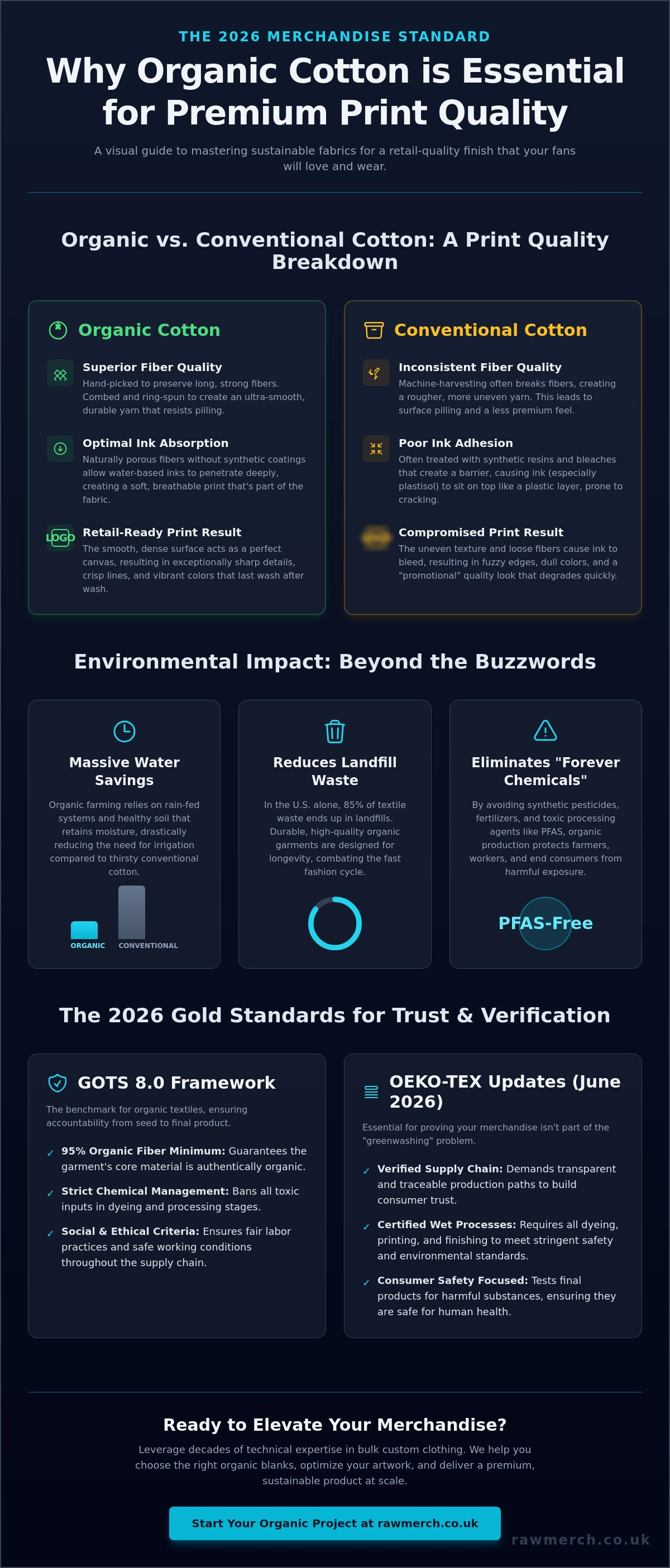
The Global Organic Textile Standard (GOTS) version 8.0 is the benchmark for 2026. To carry the "organic" label, a garment must contain at least 95% organic fibers. This version has tightened the rules on traceability and chemical management. It's about accountability. Fans and customers now look for these certifications to verify that their merchandise isn't just a marketing claim. They want the premium feel of combed organic fibers. These fibers offer a smoother, more durable surface for high-end clothing printing compared to standard promotional cotton.
The Environmental Impact: Beyond the Buzzwords
Conventional cotton production is notoriously thirsty. Organic farming uses significantly less water because it relies on rain-fed systems and healthy soil that retains moisture. By choosing organic cotton t-shirt printing, you're also eliminating "forever chemicals" from your supply chain. States like California and Colorado have already implemented strict PFAS bans in 2026. Staying ahead of these regulations is vital for your brand's compliance.
Consider the waste problem. In the U.S., 85% of the 17 million tons of annual textile waste ends up in landfills. Organic garments are designed for better end-of-life management and longevity. This shift reduces the carbon footprint per garment by avoiding energy-intensive synthetic fertilizers. It also ensures worker safety by removing toxic chemicals from the dyeing and printing stages.
Brand Perception and Retail Value
Consumers are smarter than ever. As of May 2026, average retail prices for clothing have risen by 3.2% annually. Customers are willing to pay more, but they demand proof of value. The "greenwashing" trap is real. To avoid it, you must use suppliers who understand the June 2026 OEKO-TEX updates. These new rules require all wet processes, including dyeing and printing, to be certified for renewals. You can't just claim sustainability; you have to prove it through your supply chain.
Using high-quality organic blanks from trusted names like Stanley/Stella or Continental Clothing builds instant trust. It shows you care about the details. This commitment to quality fosters long-term customer loyalty. Fans don't just want a shirt. They want a piece of merchandise that represents their values and lasts for years. When you provide a retail-quality product that stands up to the wash, you secure your reputation as a leader in the sustainable space.
Organic vs. Conventional Cotton: How Fabric Impacts Print Quality
The physical structure of your garment determines the sharpness of your design. Organic cotton t-shirt printing relies on a superior canvas to achieve retail-grade results. Conventional cotton is often harvested using machines that break the fibers, leading to a rougher texture. In contrast, organic cotton is typically hand-picked. This preserves the fiber length and integrity. When these long fibers are combed, they create a flat, consistent surface that is perfect for high-detail artwork.
Ink absorption is the next critical factor. Organic fibers are naturally more porous. They haven't been coated in the synthetic resins or "size" often found in mass-produced conventional blanks. This allows pigments to penetrate deeper into the yarn rather than sitting on the surface. The result is a print that feels like part of the fabric, not a plastic sticker on top. For brands looking for a framework for evaluating sustainability, the physical durability of the garment is just as important as the growing method. Organic cotton stands up to repeated washing because the fibers haven't been weakened by harsh chlorine bleaches.
Fibre Density and Print Clarity
Ink Compatibility: Water-Based vs. Plastisol
Choosing the right ink is essential for maintaining the eco-credentials of your project. Water-based inks are the natural partner for organic cotton. They soak into the fibers to create a "soft-hand" feel that matches the premium touch of the fabric. Traditional plastisol inks use PVC and phthalates, which can feel heavy and stiff. They also contradict the sustainability goals of most organic lines. If you need vibrant colors on dark fabrics, modern Discharge or Direct to Film (DTF) methods can provide excellent opacity while remaining compliant with current standards. If you are ready to start your next project, explore our professional clothing printing options to see how we handle these technical challenges.
Pre-treatment is another area where organic cotton excels. While conventional cotton might have residual natural oils or chemical residues that interfere with bonding, organic cotton is cleaner. This leads to better adhesion and fewer production errors. You get a more reliable result across the entire bulk order, ensuring every fan receives a high-quality product.
Choosing the Best Eco-Friendly Blanks and Printing Methods
Selecting the right blank is the foundation of successful organic cotton t-shirt printing. You cannot simply pick any shirt and expect a retail-grade result. You need a base that complements your chosen decoration method. The best organic garments provide a smooth, consistent surface that allows inks to bond effectively. This ensures your designs stay vibrant and don't crack after a few washes.
Top Organic Blanks for 2026
Stanley/Stella Creator 2.0 is the current industry benchmark. It features a 180 GSM weight that provides a substantial, premium feel. The surface is exceptionally smooth, making it the top choice for intricate screen prints and high-detail work. It's the shirt your fans will keep for years.
Continental Clothing offers the Salvage range for brands focused on circularity. This range mixes 60% recycled organic cotton with 40% recycled polyester. It has a unique texture that works perfectly with bold, graphic designs. It's a strong statement for any brand prioritizing waste reduction.
Anthem Organic provides a cost-effective entry point for large-scale promotions. If you are outfitting a massive event or a fast-moving tour, Anthem offers a soft, durable finish without a high price tag. It maintains all the necessary organic certifications while keeping your bulk costs manageable.
Selecting Your Decoration Method
- Screen Printing: This is the king for high-volume orders. When we use water-based inks on organic cotton, the result is a soft-hand finish. The ink penetrates the fibers rather than sitting on top. It is the most durable option for band merch that needs to survive a long tour.
- DTF Printing: Direct to Film (DTF) is the solution for complex, full-color logos. It handles gradients and fine details that traditional screen printing might struggle to capture. It works beautifully on organic hoodies and heavier tees where the fabric can support the transfer.
- Embroidery: For a tactile, high-end look, embroidery is the way to go. It is particularly effective on heavy-weight organic cotton (220 GSM+) and headwear. It adds a physical dimension to your brand that fans can feel.
Don't overlook the "Retail-Ready" checklist. Most premium organic blanks come with tear-away labels. This allows you to add custom neck prints easily. A custom neck print replaces the manufacturer's tag with your own logo and sizing information. It's a small detail that significantly increases the perceived value of your merchandise. Finding the sweet spot between price and quality is about knowing your audience. We help you navigate these choices to ensure your project stays on budget and on schedule.
Best Practices for Designing Sustainable Merchandise
Your choice of fabric is only half the battle. High-quality organic cotton t-shirt printing requires artwork that respects the material. Premium garments deserve premium files. If your design is low-resolution, the final product will look unprofessional regardless of the fabric quality. You must align your creative vision with the technical requirements of sustainable production to get the best results.
Vector files are the gold standard for this process. They use mathematical paths rather than pixels, meaning your logo stays crisp at any size. On organic textures, which often have a more distinct natural grain than synthetic blends, vector lines provide the cleanest edge. We also recommend using "Negative Space" in your designs. By allowing the fabric to show through parts of the artwork, the garment stays breathable and uses less ink. This creates a lighter, more comfortable shirt that fans will actually want to wear in 2026.
Preparing Your Artwork Files
Vector images are essential for professional screen printing because they allow for precise color separations without any loss of detail. If you are using complex gradients or photographic elements, Direct to Film (DTF) is the better choice, but these still require high-quality source files. All raster images must be 300 DPI at the actual print size to prevent pixelation and blurry edges. For brand consistency, always provide Pantone references. This ensures that your corporate or band colors remain identical across different batches and garment colors. Sharp artwork is the difference between a "promo" tee and a retail-ready product.
Sustainable Design Trends for 2026
Minimalist branding is a dominant trend for 2026. Using less ink is a practical way to create a more eco-friendly product. It reduces chemical use and keeps the fabric soft. Many brands are now opting for earth-tone palettes, matching their ink colors to the natural dyes of organic fabric. This creates a cohesive, high-end aesthetic that resonates with environmentally conscious consumers. Consider unique placements to make your merch stand out:
- Nape Prints: Small logos on the back of the neck add a subtle, premium touch.
- Chest Pockets: Printing just above or on a pocket provides a classic, understated look.
- Hem Tags: Adding a small woven or printed tag at the bottom hem increases the perceived retail value.
Ready to bring your vision to life? Start your project today by exploring our range of custom t-shirts & hoodies and get a professional result that lasts.
Consistency is key for brand longevity. When you combine smart design with technical precision, you create merchandise that survives the "disposable" culture. Your fans will appreciate the attention to detail, and your brand will benefit from a product that stays in their wardrobe for years, not weeks.
Bulk Organic Printing with RAW Merch: Quality at Scale
Success in organic cotton t-shirt printing requires more than just a good design. It demands a production partner with the infrastructure to handle large-scale orders without compromising on technical precision. At RAW Merch, we bring 25 years of UK printing expertise to your sustainable project. We aren't a high-margin print-on-demand service; we are professional bulk specialists. Our team understands that brands and touring bands need reliability, fast turnaround times, and retail-quality results that protect their reputation.
Quality control is at the heart of our operation. We perform rigorous testing for print wash-fastness on all organic batches. This ensures that your pigments stay locked into the combed cotton fibres, preventing the fading or cracking common with low-quality suppliers. You get a product that looks as good after the fiftieth wash as it did on the first day of the tour. We take pride in our long-standing industry tenure, and we use that experience to ensure your creative vision is executed perfectly every time.
The Professional Bulk Workflow
Getting your project started is straightforward and efficient. You can request a custom quote that accounts for significant bulk discounts, ensuring your sustainable line remains profitable. We provide clear, honest timelines for large-scale organic orders across the UK. If you need to see and feel the quality before committing to a full run, we offer a sample service. This allows you to verify the fabric weight and print finish firsthand. We move quickly from initial discovery to final delivery, keeping your project on schedule and under control.
End-to-End Merch Solutions
We do more than just clothing printing. For touring bands and growing brands, we offer comprehensive fulfillment and distribution services. We can handle storage and tour logistics, taking the heavy lifting off your hands so you can focus on your fans. Our finishing services include custom labelling and neck prints to ensure your product is truly retail-ready. We don't believe in unnecessary complications. We provide the grounded, hardworking support you need to scale your brand with confidence.
Building a sustainable merchandise line shouldn't be a gamble. Trust a specialist who prioritizes execution and scheduling. Whether you are outfitting a global tour or launching a new retail collection, we have the capacity and the knowledge to deliver. Let's build something durable together. Reach out to our team today to discuss your specific requirements and see how we facilitate high-performance results for our clients.
BUILD YOUR SUSTAINABLE LEGACY TODAY
Transitioning to eco-friendly merchandise is a strategic investment in your brand's longevity. You now have the technical knowledge to navigate fabric densities, ink compatibility, and the latest industry certifications. Professional organic cotton t-shirt printing is about more than just a label; it is about delivering a durable, retail-quality product that resonates with your audience. By aligning your design process with high-performance sustainable fabrics, you ensure every garment reflects your brand's commitment to quality.
We are ready to facilitate your vision with precision and reliability. RAW Merch combines over 25 years of industry experience with a deep specialty in band and business merchandise. Our UK-based production and fulfillment center is designed to handle bulk orders with efficiency and care. We prioritize your schedule and your results, removing the complexity from sustainable production. Trust a partner who understands the physical nature of your product and the logistical demands of your business.
Ready to go green? Get your bulk organic printing quote today!
Let's get to work on your next sustainable collection. Your fans are waiting for a product they can trust.
Frequently Asked Questions
Is organic cotton really better for t-shirt printing?
Organic cotton provides a superior printing surface because the fibers are typically hand-picked rather than machine-harvested. This process preserves fiber length and integrity. When these long fibers are combed, they create a flat, consistent surface. This allows for sharper detail and better ink adhesion compared to conventional cotton. It results in a retail-quality finish that your fans will appreciate and wear for years.
What is the difference between GOTS and standard organic cotton?
GOTS (Global Organic Textile Standard) is a complete certification that covers the entire supply chain from harvesting to labeling. While standard organic cotton refers only to the farming methods, GOTS ensures that social responsibility and strict chemical management are maintained throughout the manufacturing process. It is the gold standard for verifying true sustainability in 2026 and protects your brand from greenwashing claims.
Does organic cotton shrink more than regular cotton after printing?
High-quality organic garments don't shrink more than standard cotton if they are properly cared for. Most premium organic blanks are pre-shrunk during the manufacturing process to maintain their shape and fit. Always wash at low temperatures and avoid high-heat drying. This ensures the garment stays true to size and the print remains intact over hundreds of wash cycles without distortion.
Can I use any design for organic t-shirt printing?
You can use most designs, but high-resolution vector artwork yields the best results. The smooth, combed surface of organic cotton is excellent for capturing fine lines and intricate details. We recommend avoiding heavy, solid blocks of ink where possible to maintain the natural breathability of the fabric. This approach makes organic cotton t-shirt printing more effective and comfortable for the end user.
What is the minimum order quantity for bulk organic printing?
Minimum order quantities depend on your chosen garment and the specific decoration method. We specialize in bulk custom clothing printing for brands and bands, so we scale our processes to handle large runs efficiently. Contact our team with your specific requirements to receive a tailored quote. We focus on providing cost-effective solutions for large-scale projects without sacrificing the quality of the final product.
Is screen printing or DTF better for organic garments?
Both methods work exceptionally well on organic fibers, but they serve different purposes. Screen printing is the most cost-effective choice for high-volume orders with simple, bold designs. Direct to Film (DTF) is the superior option for complex, full-color graphics and photographic elements. We help you choose the method that best suits your artwork, budget, and the specific texture of your chosen organic blank.
How do I care for my organic printed t-shirt to make it last?
Wash your garments at 30 degrees Celsius and always turn them inside out before cleaning. Avoid tumble drying, as high heat can damage both the organic fibers and the print over time. These simple steps preserve the soft-hand feel of the fabric and keep your designs looking sharp. Proper care ensures your sustainable merchandise lasts long enough to become a vintage favorite in any wardrobe.
Are the inks used in organic printing also eco-friendly?
We use water-based inks and compliant transfers that align with modern sustainability standards. These inks are free from the harmful phthalates and PVC found in traditional plastisol. Using eco-friendly inks is a critical part of organic cotton t-shirt printing because it ensures the entire product meets the environmental expectations of your customers. It guarantees a safe, sustainable, and high-performance result for your brand.