
A sold-out merch drop can still be a production problem. Limited edition merch drops build excitement through exclusivity, but the launch only works if the products, quantities and delivery plan are ready to meet demand.
It’s easy to get caught between ordering too much and selling out too quickly. Add artwork approvals, print-method decisions, promotion and fulfilment, and a one-off release can become difficult to coordinate. A clear plan makes each decision more manageable, from choosing apparel or promotional items to setting realistic production milestones.
This guide shows you how to plan a drop with confidence. You’ll learn how to match products and print methods such as screen printing, DTF and sublimation to your design and audience, estimate quantities using relevant evidence, and organise fulfilment and distribution for a smoother customer experience. With more than 25 years of merchandise production experience, RAW Merch can help bring the practical stages together, so your launch has a solid plan behind the hype.
Key Takeaways
- Set the audience, purpose and release limits before announcing limited edition merch drops, so customers understand the offer.
- Choose apparel or promotional merchandise to suit the campaign and audience, rather than picking products just because they’re trending.
- Compare screen printing, DTF and sublimation against the artwork, product and material before settling on a production method.
- Use relevant sales and audience evidence to guide quantities, then plan promotion, order handling and dispatch.
- Bring product choices, artwork, quantities and timing together in a clear production brief, with fulfilment planned alongside manufacturing.
Why plan a limited edition merch drop before announcing it?
A limited-edition drop is a planned release with a defined product range and a clear limit: a sales window, a production quantity, or both. That boundary gives fans and customers a reason to pay attention, but it doesn’t guarantee sales. The release still needs to suit its audience, and the production plan must support the terms you promote.
Evergreen merchandise is intended to remain available over time, so it calls for an ongoing approach to stock and replenishment. A drop is tied to a particular moment or limit. It needs a focused campaign, with production and order handling planned around the stated dates or quantity. The drop format has strong roots in streetwear and the drop model, where a defined release can make a product feel connected to a moment or community.
What makes a merch release genuinely limited?
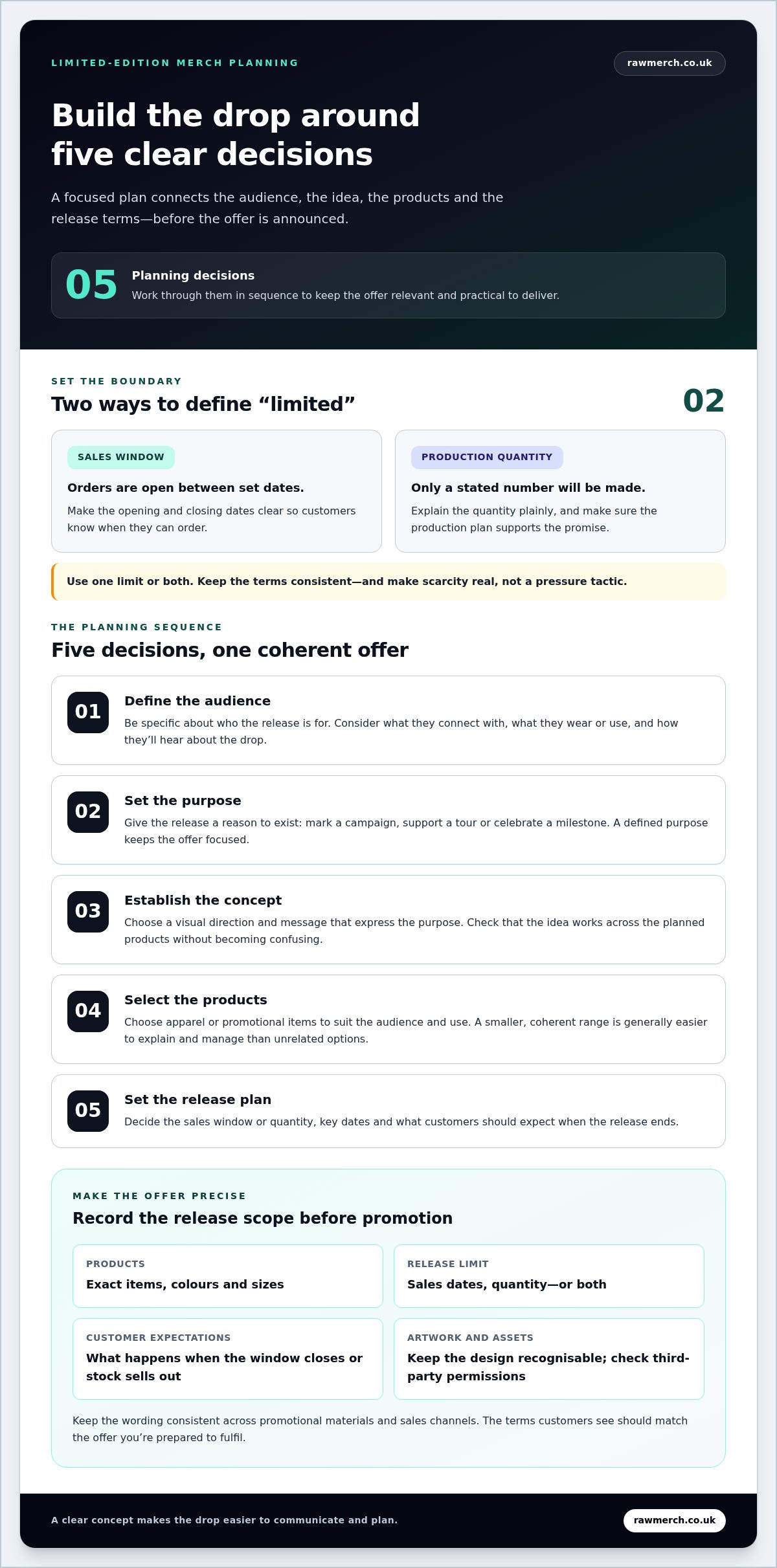
Choose what “limited” means before promoting the release. With a fixed sales window, customers can order only between specified opening and closing dates. With a fixed production quantity, only a stated number will be made. You can use one limit or both, but explain the terms plainly so customers know what to expect before ordering.
Record the scope in a simple release plan: products, available colours and sizes, quantity or sales dates, and key order details. Keep the wording consistent across promotional materials and sales channels. Scarcity should be real, not a pressure tactic. Don’t claim stock is nearly gone if it isn’t, or say a release will never return unless that’s genuinely the plan.
Who benefits from a limited merch release?
A drop can suit bands, creators, event organisers and businesses with a defined audience and a clear reason to bring people together around merchandise. It might mark a tour, a milestone, a campaign or a seasonal moment. Custom T-shirts, hoodies, headwear and promotional items can all work when they fit the audience and purpose.
For bands, merchandise can connect a release with the live experience and give fans a tangible way to show their support. If you’re building the wider merch plan, explore this band merchandise planning guide. Whatever the occasion, define why the drop matters before setting its limits. A clear purpose helps you plan a focused campaign without treating scarcity as a substitute for genuine audience interest.
How to shape the concept, audience, and offer for your merch drop
A strong concept makes decisions easier. Before choosing garments or writing launch copy, work through this sequence. It helps keep limited edition merch drops relevant to the audience and practical to deliver.
1. Define the audience. Be specific about who the release is for. Consider what they already connect with, what they wear or use, and how they’ll hear about the drop.
2. Set the purpose. Give the release a clear reason to exist, such as marking a campaign, supporting a tour or celebrating a milestone. A defined purpose keeps the offer focused.
3. Establish the concept. Choose a visual direction and message that express that purpose. Check that the idea can carry across the planned products without becoming confusing.
4. Select the products. Pick apparel or promotional items that make sense for the audience and use. A smaller, coherent range is generally easier to explain and manage than a collection of unrelated options.
5. Set the release plan. Decide the sales window or quantity, key dates and what customers should expect when the release ends. Shopify’s guide to how to launch a limited drop offers further ideas for organising a campaign around a defined release.
Choose a drop idea your audience can understand
Start with a genuine reason to make the merchandise, then connect it to an audience interest or need. A tour design might reflect the live experience. A campaign release might use a consistent visual cue across a T-shirt, hoodie and promotional item. The goal isn’t to copy a passing trend. It’s to make the product feel like a natural part of the story you’re telling.
Keep the core artwork recognisable across the range, while adapting its placement or scale to suit each product. Before production, make sure you have permission to use any third-party names, logos, images or other protected artwork. A clear concept is easier to communicate when the rights and assets are in order.
Set the offer and release boundaries
Write down the exact products, colour options and sizes you intend to offer. Then set the sales window or quantity limit before drafting promotional copy. This helps align the promise customers see with the offer you’re prepared to fulfil.
Be clear about what happens when the window closes or stock sells out. State whether the release ends, orders close on a set date, or the stated quantity is the full run. Clear terms help customers make an informed decision and give your campaign a consistent message.
Once the concept and offer are defined, explore custom merch production with RAW Merch to connect your product choices and release plan with a production brief.
How to choose merch products and printing for a limited run
The right print method depends on the design and product, not just the quantity. For limited edition merch drops, assess the artwork, garment material, intended use and order details together. A method that suits a bold design on a T-shirt may not be the best fit for detailed artwork, headwear or a different fabric.
Screen printing, DTF, or sublimation: what should guide the choice?
Each process has different strengths. Use this comparison to narrow down what to discuss for the specific product and artwork.
| Method | What to consider | Suitability |
|---|---|---|
| Screen printing | Ink is applied through screens, so the number of colours, design shapes and print area affect production planning. | Often a practical option for clear, defined artwork, especially when the design can be separated into distinct colours. Consider the artwork and run details together. |
| DTF | The design is printed onto transfer film and applied to the garment. Artwork detail, coverage and the feel of the printed area matter. | Can suit detailed, multicolour artwork. Assess how the transfer will work with the garment material, placement and finish you want. |
| Sublimation | Heat transfers dye into the material, making fabric composition and the product surface key factors. | Typically suited to polyester or polyester-rich fabrics with a light-coloured surface. Check that the product and artwork suit the process. |
Don’t choose on artwork alone. Consider how the garment feels against the skin, whether it’s intended for everyday wear or an event, the size range you need, and where the design will sit. A large front print, a smaller chest design and artwork on headwear each raise different placement and production considerations. RAW Merch uses screen printing, DTF and sublimation, matching the process to the project’s requirements.
Prepare clean, production-ready artwork before the order moves forward. If you need help understanding file formats, read this vector image guide for merch artwork.
Which merch products fit your audience and campaign?
Start with the product your audience is most likely to wear or use. Custom T-shirts offer a straightforward apparel option. Hoodies and sweatshirts can suit cooler weather or a more substantial release. Headwear can add variety, but its available print area may limit how much detail the design can carry.
Supporting merchandise can extend the campaign beyond clothing. Stickers, badges, drinkware or banners may complement apparel or serve a different purpose at an event. Keep the range focused. Every extra product adds artwork, material and order details to manage, so include it only if it strengthens the offer. A cohesive range is easier to explain and gives production decisions a clear direction.
How to plan quantities, launch timing, and fulfilment
A strong campaign needs a delivery plan behind it. For limited edition merch drops, estimate demand carefully, set customer expectations early and map the work from finished artwork to dispatch. Treat sales estimates as planning assumptions, not promises. Audience interest can guide a quantity, but it can’t guarantee how many people will order.
How should you estimate a limited drop quantity?
Use evidence that relates to this release, rather than a broad follower count alone. Review past merchandise sales, engagement with similar content, event attendance and the promotion you plan to run. A drop promoted to an engaged mailing list may reach a different audience from one relying mainly on occasional social posts.
Estimate the allocation by product and size using any past order patterns you have. If the drop is new, write down your assumptions and avoid treating audience reactions as confirmed purchases. Allow operational flexibility for customer-service questions, exchanges or stock discrepancies. Keep records of what’s available, what has been ordered and what remains to be dispatched.
Consider how orders will be produced. Made-to-order production can reduce the need to hold finished stock, but customers may wait while their items are produced, so communicate the process and delivery expectations clearly. Holding stock can support dispatch from ready inventory, but leaves you managing storage and the risk of unsold sizes or products. Choose the approach that fits the campaign, customer expectations and fulfilment plan.
What belongs on a merch-drop timeline?
Work backwards from your intended launch and the delivery expectations you’ll communicate. Add time for each stage, and keep production and campaign tasks moving in parallel where practical.
- Artwork readiness: Finalise and check the files, product choices, sizes and quantities.
- Production planning: Coordinate the order and align the production schedule with the launch and dispatch plan.
- Campaign preparation: Prepare product information, promotional content, order details and clear delivery expectations before announcing the drop.
- Order handling and dispatch: Plan how orders will be recorded, packed and sent, and how customer questions will be managed.
Don’t publish delivery expectations until they fit the production and dispatch plan. After merchandise is produced, fulfilment and distribution can coordinate storage, merchandise management and shipping, connecting finished goods with the orders they need to reach.
RAW Merch brings more than 25 years of industry experience, alongside fulfilment and distribution support, to help coordinate production and operational stages. Plan production and fulfilment for your merch drop.
How RAW Merch can help bring a limited edition merch drop to life
A clear production brief turns the campaign idea into practical decisions. It gives the production team a useful picture of what you want to make, how the merchandise will be used and when it needs to be ready. For limited edition merch drops, that clarity connects the offer, artwork, production method and fulfilment plan from the start.
What to include in a useful production brief
Bring the key details together in one place. Your brief can include:
- Audience and purpose: Who the drop is for and what it marks, supports or celebrates.
- Products: The requested product categories, such as T-shirts, hoodies, headwear or promotional items.
- Artwork and garment preferences: Include the artwork files and describe the intended look, garment preferences and print placement.
- Known requirements: Note preferred colours, size range and any other product details that will shape the order.
- Schedule and fulfilment: Share the target launch date, production milestones, expected order handling and whether you need fulfilment and distribution support.
Specific information helps clarify decisions early. If some details are still open, identify them as decisions to resolve rather than presenting assumptions as final requirements.
Turn the plan into the next practical step
Before moving into production, check that the offer boundaries are clear, the quantity estimate is based on reasonable audience evidence, and the artwork and product suit the planned print method. Screen printing, DTF and sublimation each bring different considerations, so the design, material and order requirements all matter. RAW Merch’s experience with these methods helps connect the production choice to the brief.
Plan the journey after production, too. Fulfilment and distribution can coordinate merchandise management, storage and shipping, so finished stock and incoming orders are part of the same operational plan. Set out how you expect orders to be handled and delivered, then align those expectations with the campaign schedule.
With more than 25 years of industry experience, RAW Merch brings practical production knowledge to merchandise projects from planning through fulfilment. Bring your audience, product choices, artwork, quantity assumptions and target dates together in a clear project brief.
Discuss your limited-edition merch drop with RAW Merch.
Turn your merch drop plan into action
Limited edition merch drops work best when excitement is backed by clear decisions. Define who the release is for, keep the product offer focused, and match the print method to the artwork and product. Then build a realistic schedule for production, order handling and delivery. Use audience evidence to guide quantity estimates rather than treating sales as guaranteed.
A well-prepared brief brings those choices together: the concept, product range, artwork, quantity assumptions and fulfilment approach. RAW Merch has more than 25 years of experience producing custom merchandise, with screen printing, DTF and sublimation capabilities to support different project requirements. Fulfilment and distribution services can also coordinate the work after production is complete.
Ready to move from idea to production plan? Discuss your limited-edition merch drop with RAW Merch. Bring your concept and key decisions to plan the next step.
Frequently Asked Questions
How do you create a limited edition merch drop?
Start by defining who the release is for and why it matters to them. Choose a focused product range, prepare the artwork and select a production method that suits the products and design. Set a genuine limit, either a clear sales window or a stated quantity, then plan promotion, order handling and fulfilment. Use audience evidence to guide stock decisions, and explain the offer terms clearly without assuming every item will sell.
How many items should you make for a limited merch drop?
There’s no single quantity that works for every drop. Use relevant sales history, audience engagement, event attendance and planned promotion to form a reasoned estimate. Account for the range of products, sizes and colour options, and treat the estimate as an assumption rather than a sales forecast. If you’re holding stock, decide how you’ll manage remaining items when the sales window ends or the campaign concludes.
What is the best printing method for limited edition merch?
The best method depends on the item, material, artwork, print coverage and production requirements. Screen printing, DTF and sublimation each suit different project conditions, so no one process is right for every order. Consider the intended look and feel alongside the product, then assess the artwork and merchandise requirements before confirming production. This helps align the printing choice with the finished item you want to offer customers.
Can you sell limited edition merch as made to order?
Yes, made-to-order sales can align production with confirmed orders and reduce the need to hold finished stock. Set a clear order window and explain what happens after it closes, including production and delivery expectations. Plan how orders will move into production and fulfilment once ordering ends. Only communicate dispatch expectations that your production schedule can support, so customers understand the process before they place an order.
How do you create urgency without misleading customers?
Build urgency around a genuine limit, such as a clearly stated order window or a defined production quantity. Explain what the limit means and keep promotional messages consistent with the actual offer. Don’t claim that stock is nearly gone unless that’s accurate. A clear release date and a relevant reason for the merchandise can give customers a reason to pay attention without relying on false scarcity or pressure.
What products work well for a limited merch drop?
Choose products that suit the audience, design and campaign. Custom T-shirts, hoodies, sweatshirts and headwear can form the apparel offer, while stickers, badges, drinkware or banners may complement it. Consider how each item will be used and whether the artwork suits its material and print area. A focused range is often simpler to explain, produce and manage than a set of unrelated products.
How can a merch fulfilment service help with a drop?
A fulfilment service can support the work after production, including merchandise storage, stock management and shipping orders. RAW Merch offers fulfilment and distribution services for clients who want support coordinating these logistics. Plan this alongside the campaign, not after orders arrive. Consider expected order handling and customer communication, then make sure the delivery expectations you publish fit the production and fulfilment plan.