

What if the best way to increase merchandise sales isn’t to promote more products, but to make the right offer to the right buyers? If your merchandise attracts attention but orders are inconsistent, you’re not alone. It can be difficult to predict what people want, then coordinate stock, sales channels and fulfilment without adding friction.
This guide shows you how to increase merchandise sales with a practical plan built around your audience and their buying occasion. You’ll learn how to choose products with a clear purpose, present them so buyers can assess their value, and promote them without relying on guesswork or blanket discounts.
We’ll also cover how to connect sales channels with stock, production and delivery, so completing an order feels straightforward and gives customers a reason to buy again. From custom T-shirts and hoodies to promotional merchandise, the product and production method need to work together. RAW Merch brings over 25 years of industry experience in printing, fulfilment, storage and distribution to merchandise projects from production through to delivery.
Key Takeaways
- Learn how to increase merchandise sales by matching products to your audience, buying occasion and purchase setting.
- Build a focused product range that’s easier to present and manage, instead of expanding without a clear reason.
- Make each offer easier to assess with consistent product images, useful descriptions, sizing details and a clear call to action.
- Compare online, event and promotional sales routes, then smooth the path from product discovery to payment and delivery.
- Use a simple scorecard to spot what’s working, identify fulfilment issues and shape a stronger next campaign.
How to increase merchandise sales starts with knowing your buyer
A bigger catalogue doesn’t automatically create more sales. A focused offer starts with understanding who is likely to buy, what they need and what would make them choose your merchandise. Fans, event attendees, employees and promotional-product buyers have different motivations, budgets and buying situations. Treating them as one audience can lead to products that attract attention but miss the reason someone is ready to purchase.
Your audience and the occasion also shape practical decisions. A fan may want clothing that shows their connection to a band, while an employee needs a uniform suited to their role. At a live event, portability and quick product selection matter. For a promotional campaign, visibility and usefulness may carry more weight. Consider price sensitivity too: use past orders and customer feedback to understand what buyers expect to spend and what value they need to see, rather than assuming the same offer works for everyone.
How do you identify the people most likely to buy your merchandise?
Start with evidence you already have. Review past orders, customer questions and feedback. Look for repeated product requests, common occasions and signs that buyers value belonging, usefulness, identity or participation in an event. Keep observations separate from assumptions. If the data is limited, test one focused offer with a defined audience and learn from the response before widening the range.
Use this short audit to identify your best-fit buyers and the clearest sales opportunity:
- Group your buyers: Separate fans, event attendees, employees and promotional-product buyers.
- Identify the motivation: Note whether each group is buying for identity, practical use, belonging or participation.
- Pin down the occasion: Record where and when the purchase is likely to happen, and what might affect the decision.
- Check the evidence: Compare your assumptions with orders and feedback. Choose one unanswered question to test.
Match merchandise to the buying occasion
The sales setting changes what helps a buyer decide. An online shop needs clear product information and images that make the item easy to assess. At a live event, customers may value a straightforward choice and merchandise they can carry comfortably. Workplace purchases call for practical consideration of how a uniform will be worn, while promotional campaigns benefit from items suited to the intended audience and message. Product presentation matters across these settings; visual merchandising describes how presentation can help attract and engage customers.
For band-specific planning, see this band merchandise guide. Being clear about the buyer and buying moment makes it easier to shape a relevant offer and decide what to test next. That’s the practical starting point for how to increase merchandise sales.
Choose merchandise buyers want before expanding your product range
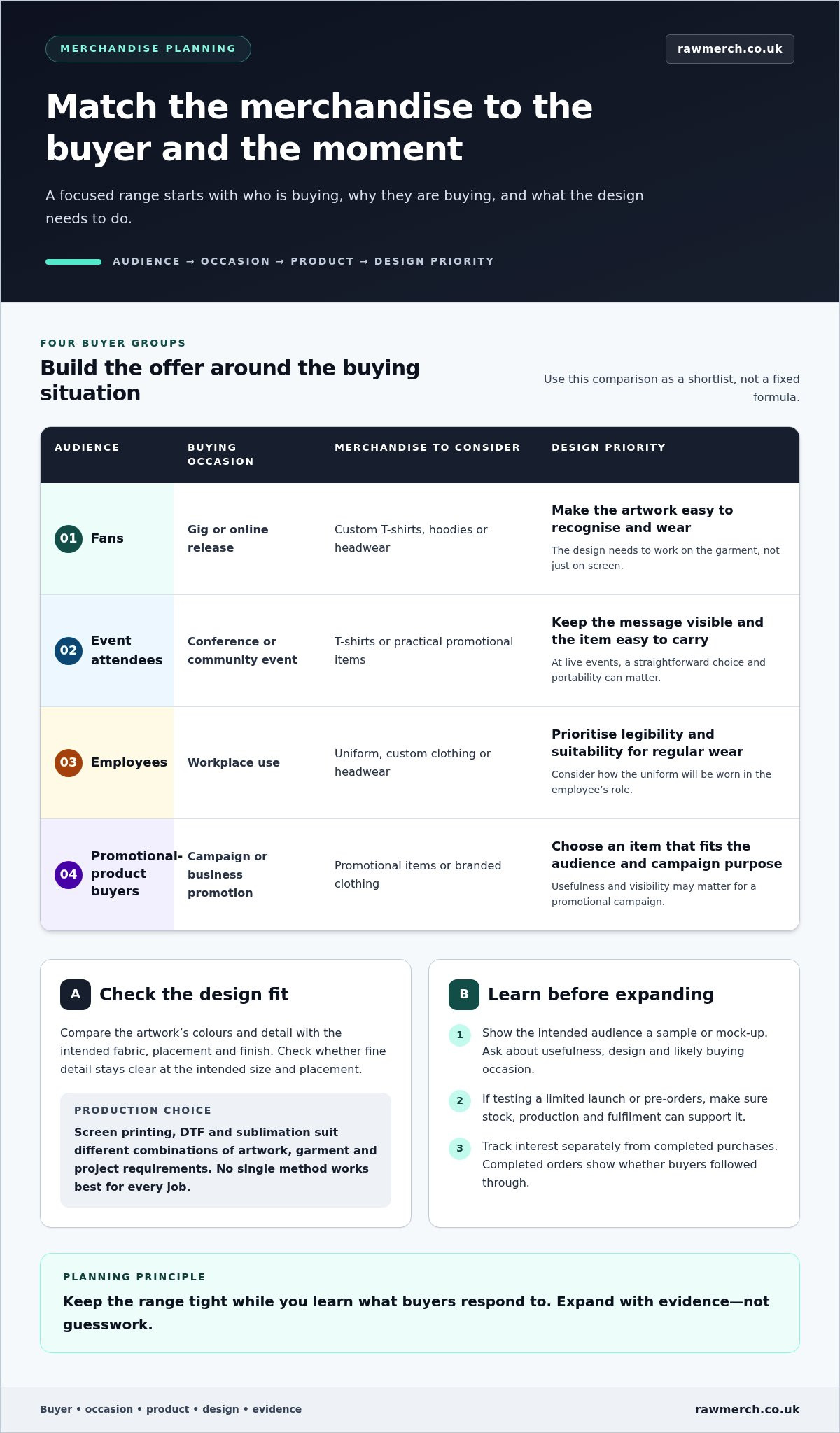
A focused range is easier to explain, promote and manage than a catalogue built on guesswork. Start with a few products that suit your audience and buying occasion. Compare how useful they are, how often they might be worn or used, and whether the design will be clear on the finished item. A product that looks appealing in a mock-up still needs to work in production.
| Audience | Occasion | Merchandise categories to consider | Design priority |
|---|---|---|---|
| Fans | Gig or online release | Custom T-shirts, hoodies or headwear | Make the artwork easy to recognise and wear |
| Event attendees | Conference or community event | T-shirts or practical promotional items | Keep the message visible and the item easy to carry |
| Employees | Workplace use | Uniform, custom clothing or headwear | Prioritise legibility and suitability for regular wear |
| Promotional-product buyers | Campaign or business promotion | Promotional items or branded clothing | Choose an item that fits the audience and campaign purpose |
Use this as a shortlist, not a fixed formula. The right choice depends on what buyers value and what the design needs to achieve. If the artwork relies on fine detail, check whether it will remain clear at the intended size and placement. For clothing, consider wearability alongside visibility: the design needs to work on the garment, not just on screen.
How can you test a merchandise idea before scaling it?
Show the intended audience a sample or mock-up, then ask focused questions about usefulness, design and likely buying occasion. If you run a limited launch or take pre-orders, make sure your stock, production and fulfilment plan can support it. Track expressions of interest separately from completed purchases. Attention is useful feedback, but completed orders show whether buyers followed through.
Select decoration and products to fit the design
Screen printing, DTF and sublimation suit different combinations of artwork, garment and project requirements. Consider the design’s colours and detail, the intended fabric, placement and finish. No single method works best for every job. Artwork format matters during production preparation too: vector artwork can be useful when a design needs to scale for different merchandise applications. This vector image guide explains why vector artwork can be useful for merchandise printing.
Keep the range tight while you learn what buyers respond to. As orders and feedback build, use that evidence to decide whether to add another product or refine the design. When considering RAW Merch custom clothing and merchandise, assess how the product, decoration method and audience fit together before expanding your offer.
Promote merchandise with a clear message and a buying reason
Promotion works best when buyers quickly understand three things: who the merchandise is for, what it offers and why it’s relevant now. A custom T-shirt linked to a release, for example, gives fans a clear context. A uniform item answers a practical workplace need. Make the reason specific, then repeat the same core message across sales channels so people recognise the offer and know what to do next.
Strong promotion isn’t just a catchy post. It connects product presentation to a simple route to purchase. Use consistent photos, describe the item clearly, include relevant sizing details and make the next step obvious. Avoid relying on constant discounts. Useful context, such as the purpose of the design or the event it relates to, can give buyers a reason to care without making claims the product can’t support.
Create product pages and campaign messages that answer buyer questions
Give buyers enough accurate information to make a decision. Explain the product, its purpose and design details without overstating materials or features. Use clear product photography that helps shoppers judge colour, scale and decoration. For clothing, include sizing information and explain how to choose an option. Make ordering instructions, delivery information and any stated terms easy to find, so uncertainty doesn’t interrupt the purchase.
Keep the core message consistent wherever it appears, then adapt the format to the channel. Use this checklist to coordinate a campaign:
- Social channels: Show the product in context, state who it’s for and link the post to a clear next step.
- Email: Lead with the buying reason, include essential product details and direct readers to the relevant offer.
- Event signage: Use a short message, legible product information and clear instructions for ordering or buying at the event.
- Partner channels: Give relevant collaborators consistent product details and a straightforward message to share with their audience.
Give buyers a reason to act now
Timing can make an offer more relevant. Connect a launch to a genuine event, release, seasonal moment or campaign deadline, and explain why the merchandise belongs in that moment. A limited run can encourage action only if the production and sales plan genuinely supports that limit. Don’t imply scarcity to manufacture urgency.
Make sure the promotion and fulfilment plan tell the same story. Before a campaign goes live, check that product options, checkout steps and delivery information are clear. This gives interest a straightforward path to a completed purchase. A clear message, useful product context and honest timing make how to increase merchandise sales a practical campaign question, not a reason to reach for another discount.
Improve the buying journey across online shops and in-person sales
A sale depends on more than a good product. Buyers need a clear route from first seeing it to choosing an option, paying and receiving their order. Each channel creates different demands, so match the sales route to your audience and plan how orders will be handled before promotion begins.
Which merchandise sales channel fits your audience?
Online shops suit buyers who want to browse and order at a convenient time. Make product options, sizing, payment steps and delivery information easy to find. Live events put merchandise in front of people already gathered around a band, organisation or shared experience. Plan how buyers will view the products, choose an option and take their purchase away or arrange delivery. Business and promotional orders often serve teams, campaigns or wider promotional activity, so clear order details and coordination matter.
Map the steps from discovery to delivery. Check each one from a buyer’s perspective:
- See the item: Is it easy to find, and do the images show the product and its decoration clearly?
- Select an option: Are sizing, colours and other choices explained without ambiguity?
- Place and pay for the order: Are the checkout or ordering instructions straightforward?
- Receive the merchandise: Are delivery expectations and relevant order details clear?
Unclear sizing, confusing options, weak product images or missing delivery details can interrupt this journey. Review the path on the device and in the setting your buyers are likely to use. Fix the step where people pause or need to ask for basic information.
Make fulfilment part of the customer experience
Plan storage, stock visibility, packing and distribution before a campaign brings in orders. Without a clear process, it can become harder to know what is available and keep fulfilment organised. RAW Merch provides merchandise fulfilment, storage, management and distribution services to help businesses and bands coordinate these practical tasks.
Set delivery expectations clearly and make sure campaign dates fit the production and fulfilment plan. A promotion should not create a promise that the operational schedule can’t support. Connecting the sales channel to stock handling and delivery makes the journey more dependable for buyers, whether orders come from an online shop, an event or a business campaign. That joined-up planning is central to how to increase merchandise sales.
RAW Merch production and fulfilment support brings these practical steps together as part of a merchandise operation.
Measure merchandise sales and build a repeatable growth plan with RAW Merch
Sales data helps you decide what to repeat, improve or stop. A short scorecard can show whether buyers are finding the offer, completing orders and receiving their merchandise smoothly. Review the same measures for each campaign, using a consistent time period and the same definitions. This makes comparisons more useful than relying on impressions or memory.
Which merchandise sales measures should you track?
Start with qualified product-page visits, completed orders and conversion. Divide completed orders by qualified visits to see how often interested visitors buy. Then add product-level demand, repeat purchases, customer feedback and fulfilment issues. Together, these measures show where a campaign is working and where it needs attention.
- Orders and conversion: Record visits and completed purchases for each product or campaign.
- Product performance: Compare which items attract orders, and note patterns in the options buyers choose.
- Repeat purchases and feedback: Look for returning customers and recurring comments or questions.
- Fulfilment issues: Track stock, packing or distribution problems that could affect the customer experience.
Read the measures together. High page interest with few completed orders may point to unclear product details or a difficult ordering step. Strong orders alongside recurring fulfilment problems signal that the next plan needs operational attention, not just more promotion. Use customer feedback to add context before changing the range.
Turn results into the next merchandise campaign
Keep what has clear evidence behind it: products buyers choose, messages that lead to orders and channels that reach the intended audience. Where practical, change one major element at a time, such as the product, campaign message or sales channel. Compare like with like over a consistent period, then use the result to shape the next offer. Avoid treating a brief spike in attention as proof of lasting demand.
Build production and distribution into the next plan from the start. RAW Merch’s screen printing, DTF and sublimation capabilities support different design and product requirements, while its fulfilment services help manage storage and distribution. With over 25 years of industry experience, RAW Merch helps businesses and bands connect merchandise production with the practical work of getting orders out.
A repeatable scorecard makes how to increase merchandise sales a process you can refine with evidence, rather than a fresh guess each time. RAW Merch production and fulfilment services support the production and distribution planning behind a campaign.
Turn your merchandise plan into steady progress
Stronger merchandise sales start with a clear picture of your buyer. Choose products that suit their needs and buying occasion, then make the offer easy to understand and simple to order. Track completed purchases, repeat orders and fulfilment issues so your next campaign builds on evidence, not guesswork.
That’s the practical approach to how to increase merchandise sales: connect the right audience and offer with clear promotion, a smooth buying journey and dependable fulfilment. RAW Merch brings over 25 years of experience in custom clothing and promotional merchandise production, with screen printing, DTF and sublimation options, plus fulfilment and distribution services.
Plan your next merchandise project with RAW Merch. Start with one focused offer, learn from the response and build from there. A clear plan gives your next campaign a stronger foundation.
Frequently Asked Questions
How can I increase merchandise sales?
To increase merchandise sales, match your offer to a specific audience and buying occasion, then make it easy to understand and order. Start with products that suit buyers’ needs rather than expanding your range without evidence. Use clear product information and promotion, then review completed orders, repeat purchases and fulfilment issues after each campaign. Those results can guide what to keep, improve or test next.
What merchandise products sell best?
The products that sell best depend on the audience, purpose and buying setting. Custom T-shirts, hoodies and headwear may suit fans or event attendees, while uniforms serve workplace needs and promotional items can support business campaigns. Treat these as options to evaluate, not guaranteed bestsellers. Review past orders and customer feedback, then test the most relevant products before committing to a broader range.
How do I promote merchandise online?
Promote merchandise online with consistent product images, accurate descriptions, clear sizing or option details, and a direct route to order. Explain who the item is for and why it’s relevant now, such as a release or campaign. Share the offer through relevant social channels and email, and make delivery information easy to find. Track product-page visits and completed orders to see whether interest turns into purchases.
How can a band sell more merchandise at gigs?
Make gig merchandise easy to notice, browse and buy. Choose items that connect with the band and the event, display them clearly, and keep product choices and prices easy to understand. Plan stock, payment and how buyers will take their items away. Promote the merchandise before and during the event, then review which products sold and what fans asked about to inform the next gig.
Does adding more merchandise products increase sales?
Not necessarily. Adding products without evidence can make the range harder to promote and manage, while leaving buyers unsure what to choose. First check order patterns, questions and feedback for signs of unmet demand. Test a relevant product idea with the intended audience, and compare completed purchases with expressions of interest. Expand when the results and your production and fulfilment plans support it.
How can I sell merchandise without holding too much stock?
Reduce stock risk by using past orders and audience feedback to guide quantities, and consider testing interest before placing a larger production order. A limited launch or pre-order can help gauge demand, provided you can meet the commitments and communicate delivery expectations clearly. Keep the initial offer focused, monitor purchases by product and option, then use the results to plan future stock more carefully.
How can fulfilment help increase merchandise sales?
Fulfilment can support sales by making storage, stock management, packing and distribution easier to coordinate. A clear process helps orders move from purchase to delivery and can reduce avoidable confusion as order activity grows. RAW Merch provides merchandise fulfilment and distribution services for businesses and bands. Pair operational planning with clear delivery information so your campaign creates expectations your fulfilment plan can support.