

Let's cut through the noise. You're looking for sustainable merchandise that truly reflects your brand's values, but the world of greenwashing makes it almost impossible to know who to trust. Finding a reliable partner for eco-friendly t-shirt printing uk shouldn't be this hard. You need quality, you need a great choice of garments, and you need proof that 'eco' doesn't mean compromising on vibrant, durable prints-especially when you're ordering in bulk. Settling for questionable claims or poor results isn't an option for a brand that cares.
To see how premium materials translate into a finished product, many brands look to established names for inspiration. For instance, the collections from SAINT RMAN showcase the kind of retail-quality graphic and oversized tees that can be achieved with the right fabric choices.
This is your complete 2026 guide. We're getting straight to the point, breaking down what truly makes a t-shirt sustainable, from certified organic materials to non-toxic, water-based inks. Forget the confusion. By the end of this article, you’ll have the confidence and knowledge to choose the right UK printing partner and create custom merch that looks incredible and aligns perfectly with your values.
Key Takeaways
- Understand that 'eco-friendly' goes beyond the label; it’s a combination of sustainable materials, non-toxic inks, and ethical production.
- Learn why the type of ink matters as much as the fabric and discover the modern, sustainable alternatives to traditional Plastisol.
- Choose the perfect sustainable garment for your project with a direct comparison of top eco-fabrics for print quality, feel, and durability.
- Use our expert checklist to vet partners for eco-friendly t-shirt printing uk, ensuring your supplier's promises match their practices.
What Does 'Eco-Friendly' T-Shirt Printing Really Mean in 2026?
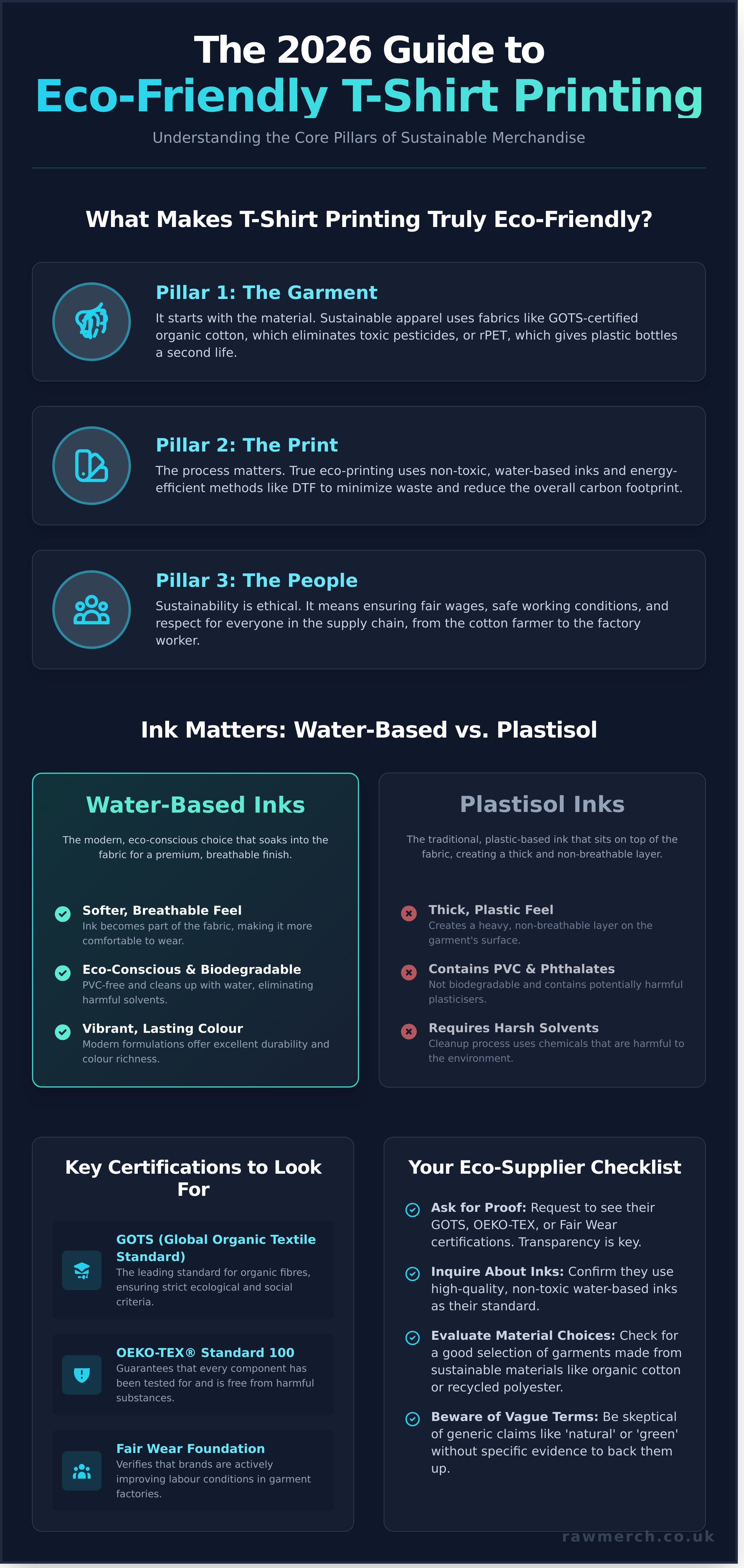
The term 'eco-friendly' gets thrown around a lot. But when it comes to custom merchandise, it’s more than just a buzzword. Genuine eco-friendly t-shirt printing UK providers focus on a complete system, not just one "green" feature. It’s a rock-solid commitment that covers the materials, the printing process, and the people behind the product. We break it down into three core pillars.
- Pillar 1: The Garment. It all starts with the t-shirt itself. Sustainable apparel is made from materials like GOTS-certified organic cotton, which uses less water and no toxic pesticides, or recycled fabrics like rPET, which gives plastic bottles a second life as quality clothing.
- Pillar 2: The Print. The way your design is applied matters. While traditional textile printing methods often relied on harsh chemicals, the focus now is on water-based inks that are free from harmful solvents. This is combined with energy-efficient machinery to reduce the carbon footprint of every single print run.
- Pillar 3: The People. True sustainability is also ethical. It means ensuring every person in the supply chain, from the cotton farmer to the factory worker, is treated with respect. This includes fair wages, safe working conditions, and a total ban on forced or child labour.
Key Certifications to Look For
Labels and certifications are your proof. They cut through the noise and guarantee a product meets strict standards. When you're sourcing your next batch of custom tees, look for these gold-standard accreditations:
- GOTS (Global Organic Textile Standard): The top certification for organic fibres, covering ecological and social criteria.
- OEKO-TEX® Standard 100: Guarantees every component of the textile has been tested for harmful substances.
- Fair Wear Foundation: Verifies that brands are working to improve labour conditions in their garment factories.
Spotting Greenwashing a Mile Away
Don't get caught out by vague marketing. Real eco-friendly t-shirt printing is backed by facts, not feelings. Be wary of brands that use generic terms like 'natural' or 'green' without providing any evidence. A common trick is promoting one eco-friendly t-shirt while the rest of their production process remains unchanged. Always ask for specifics. Demand to see the certifications. A transparent supplier will have the answers ready.
Beyond the Blank: A Deep Dive into Sustainable Inks & Printing Methods
You’ve chosen the perfect organic cotton t-shirt. But what about the design printed on it? The ink and printing method are just as crucial for creating truly sustainable merchandise. Traditional inks can contain harmful chemicals, while inefficient processes waste resources. We get it. You want quality results without the environmental compromise.
Water-Based Inks vs. Plastisol
For decades, Plastisol inks have dominated the industry. They are durable and produce vibrant, opaque colours. The problem? They are plastic-based, containing PVC and phthalates which are not biodegradable and require harsh solvents for cleanup. They sit on top of the fabric, creating a thick, less breathable print.
The future is water-based ink. This is the gold standard for brands and businesses serious about eco-friendly t-shirt printing uk. Here’s why:
- Softer Feel: The ink soaks into the fabric, creating a soft, unnoticeable feel.
- Breathable Prints: Your design breathes with the garment, making it more comfortable to wear.
- Eco-Conscious: They are PVC-free, biodegradable, and can be cleaned with water, eliminating the need for harmful chemicals.
For brands that demand both a premium finish and genuine sustainability, water-based inks deliver the perfect result.
How Printing Techniques Impact Your Carbon Footprint
The right ink is only half the battle. The printing technique you choose directly affects your brand's environmental footprint. Making smart choices here is essential for meeting the broader UK textile industry climate targets and reducing waste.
Screen Printing: This classic method is a workhorse for large orders. When paired with modern water-based inks and eco-friendly screen cleaning processes, it becomes a powerful and sustainable option for bold, simple designs.
DTF (Direct-to-Film) Printing: A game-changer for efficiency. DTF technology prints designs onto a film that is then heat-pressed onto the garment. This process uses the exact amount of ink needed for the design, drastically reducing waste. It’s perfect for intricate, multi-colour jobs, offering incredible detail with minimal environmental impact.
Sublimation: The go-to choice for 100% polyester garments. Sublimation uses heat to turn solid ink directly into a gas, which then bonds with the fabric fibres. This waterless process creates zero ink waste and results in a permanent, vibrant print that will never crack or fade.
Choosing Your Canvas: A Guide to Sustainable T-Shirt Materials
Your design is only half the story. The garment you print on is the foundation of your eco-friendly merchandise, and this choice impacts everything from feel and durability to the final print quality. A great design on an unsustainable t-shirt misses the point entirely. Making a conscious material choice is a critical part of the growing movement towards more sustainable UK textile manufacturing. We'll break down the best materials for the job so you can make the right call.
Organic Cotton: The Popular Champion
Organic cotton is the go-to for premium, comfortable apparel. Grown without harmful pesticides or synthetic fertilisers, it's better for the soil, the farmers, and the wearer. It also uses significantly less water than conventional cotton. Its ultra-soft, smooth surface creates the perfect canvas for screen printing and DTG, delivering sharp, vibrant, and long-lasting designs. For guaranteed authenticity, always look for garments with GOTS (Global Organic Textile Standard) certification. Sourcing these fabrics from major global producers often involves complex international trade; companies like RENSAT assist with the import and export declarations required for seamless movement between the UK, EU, and India.
- Best For: Retail-quality brand merch, band t-shirts, and everyday premium wear.
- Print Quality: Excellent. Provides a smooth, stable surface for crisp detail.
Recycled Polyester (rPET): Giving Waste a New Life
This is performance with a purpose. Recycled polyester (rPET) is produced from post-consumer plastic bottles, diverting waste from our landfills and oceans. It’s a tough, durable, and moisture-wicking fabric that requires far less energy to create than virgin polyester. It's the ideal base for sportswear, workwear, and is also perfect for achieving the popular 'heathered' or marled look in custom clothing.
- Best For: Athletic apparel, team kits, workwear, and sublimation printing.
- Print Quality: Ideal for sublimation, which bonds dye directly to the fibres for a permanent, no-feel finish.
Other Sustainable Fabrics: Hemp & Blends
Beyond the top two, other fantastic options exist. Hemp is an environmental powerhouse-it grows incredibly fast with very little water and naturally enriches the soil it grows in. It produces a uniquely textured, highly durable t-shirt that gets softer with every wash. For a balanced option, consider blends. An organic cotton/recycled polyester mix combines the softness of cotton with the durability and performance of rPET, giving you the best of both worlds in a single garment.
Ultimately, the right material ensures your design not only looks incredible but lasts for years, reducing waste. Making an informed choice is the first and most important step in creating truly effective eco-friendly t-shirt printing UK.
Your UK Eco-Printing Checklist: How to Vet a Supplier
Choosing a printing partner is the most critical step in your journey. Your vision for sustainable merch is only as good as the team executing it. A genuine eco-friendly printer doesn’t just use the right buzzwords-they prove it with their process. Use this checklist to separate the experts from the amateurs and find a supplier that truly walks the talk.
Print-on-Demand vs. Bulk Printing: Which is Greener?
This is a common question with a clear answer. Print-on-demand (POD) is great for testing designs without holding stock, but it's not the greenest choice. Each order is printed and shipped individually, creating a much larger carbon footprint per item. For established brands, events, or businesses serious about sustainability, bulk printing is the superior option. It consolidates production and delivery into a single, efficient process, drastically reducing emissions and waste.
The 5 Questions to Ask Any Potential Printer
Don't just take their word for it. A professional partner will have clear, confident answers to these questions. This is how you vet a supplier for genuine eco-friendly t-shirt printing uk services and ensure they match your standards.
-
1. Can you show me your sustainable garment catalogue and certifications?
Look for credentials like GOTS, Oeko-Tex, and Fair Wear Foundation. A serious supplier will have a curated range of high-quality, ethical blanks ready to go. -
2. What types of eco-friendly inks do you use as standard?
The answer should be water-based inks. They are free from harmful chemicals and plastics like phthalates, making them the only real choice for sustainable screen printing. -
3. Are you based in the UK and do you handle printing in-house?
Outsourcing and long-distance shipping add unnecessary transport emissions. A UK-based, in-house operation gives you complete quality control and a lower carbon footprint. -
4. What do you do to minimise waste in your production process?
Ask about their ink management, screen reclaiming processes, and use of recycled or plastic-free packaging. The details matter and show a true commitment. -
5. Can you provide examples of eco-friendly prints you've done for other clients?
A portfolio of high-quality, sustainable work is the ultimate proof. It shows they have the experience to deliver the professional results you need, on time.
Why RAW Merch is Your Partner for Eco-Friendly Print Runs
Choosing the right partner for your sustainable merchandise is crucial. When it comes to eco-friendly t-shirt printing UK brands can trust, RAW Merch stands out. With over 25 years of hands-on experience, we’ve perfected the art of high-quality, sustainable printing. Because we handle everything in-house at our UK facility, we have complete control over the entire process. This means we guarantee exceptional quality and deliver on time, every time.
We focus on what matters: durable, vibrant prints that feel as good as they look. Our primary use of premium water-based inks ensures a super-soft finish that won’t crack or fade, all while being significantly kinder to the planet than traditional plastisol inks.
Our Commitment to Sustainable Production
We take the guesswork out of going green. Our expertise in providing eco-friendly t-shirt printing services means we give you clear, no-nonsense advice to help you make the best choice for your brand. We are committed to a transparent and responsible supply chain:
- Certified Garments: We offer a curated selection of apparel from top-tier brands holding globally recognised certifications like GOTS (Global Organic Textile Standard) and Fair Wear.
- Smarter Bulk Orders: Our experience with large print runs allows us to optimise production, significantly reducing waste and lowering the per-item carbon footprint.
- Honest Guidance: We'll guide you through the options, explaining the benefits of organic cotton, recycled materials, and water-based inks so you can be confident in your decision.
YOU WANT IT, WE CREATE IT - Sustainably
Your vision deserves a printing partner who takes sustainability as seriously as you do. Whether you're a band on tour, a growing business, or a brand building a conscious collection, we deliver premium eco-friendly merchandise that makes a statement. We know what you want, and we deliver it.
Ready to get started? Let’s create something incredible together.
GET A NO-OBLIGATION QUOTE FOR YOUR ECO-FRIENDLY MERCH!
Bring Your Eco-Friendly Vision to Life
As we've explored, choosing sustainable merchandise in 2026 is about more than a label. It’s about making informed decisions on everything from GOTS-certified organic cotton to the vibrant, water-based inks that bring your designs to life. It means finding a partner who is transparent, experienced, and genuinely committed to reducing environmental impact. When you're ready to invest in high-quality eco-friendly t-shirt printing uk, you need a team that delivers on its promises.
At RAW Merch, we are that team. With over 25 years of dedicated UK printing experience, we cut through the noise to provide straightforward, reliable service. We use planet-friendly water-based inks as standard and our extensive catalogue includes a wide range of GOTS and Fair Wear certified garments. We know what you want, and we deliver it on time, every time. Your vision, created sustainably.
Don't compromise on quality or your values. Let's create merchandise that makes a statement and a difference.
GET YOUR ECO-FRIENDLY T-SHIRT QUOTE TODAY!
Frequently Asked Questions
Is screen printing eco-friendly?
It can be. Traditional methods often use plastisol inks and harsh cleaning chemicals, which are not environmentally friendly. However, modern eco-conscious screen printing uses water-based inks. These inks are free from harmful PVC and phthalates, making them a much more sustainable choice. We champion this method, ensuring our process reduces environmental impact while delivering a vibrant, high-quality print for your custom merchandise.
What is the most sustainable fabric for a printed t-shirt?
Organic cotton is a top contender. It’s grown without toxic pesticides and uses significantly less water than conventional cotton, protecting soil and workers. Other excellent choices include recycled polyester (rPET), which gives plastic bottles a new life, and innovative fabrics like TENCEL™ Lyocell. We source the best sustainable garments to ensure your final product is premium quality and has a lower environmental footprint. We help you make the right choice.
How much more does eco-friendly t-shirt printing cost?
The price difference is smaller than you might think. Typically, choosing an organic cotton t-shirt and water-based inks might increase the cost by just 10-25% per unit compared to standard options. For example, a standard tee might be £5, while its organic equivalent could be around £6-£6.50 on a bulk order. This small investment delivers a superior product, a powerful brand message, and a much lower environmental impact.
Are water-based inks as durable as traditional inks?
Absolutely. Modern water-based inks are engineered for performance and longevity. Once properly cured, they bond directly with the fabric fibres. This creates a soft, breathable print that won't crack, peel, or fade over time. They offer excellent wash-fastness and maintain their vibrant colour for the life of the garment. You get a premium, long-lasting finish without the harsh chemicals of plastisol. We guarantee a quality result every time.
What is the difference between organic and conventional cotton?
The difference is huge, from the farm to the final fabric. Conventional cotton is a pesticide-heavy crop that can damage soil and water systems. In contrast, organic cotton is grown without synthetic pesticides or fertilisers, using non-GMO seeds and natural farming methods. This results in healthier soil, cleaner water, and a safer environment for farm workers. Choosing organic for your merchandise is a clear statement about your brand's commitment to quality and sustainability.
Can you print on recycled polyester t-shirts?
Yes, we can. Recycled polyester (rPET) is a fantastic sustainable choice, especially for sportswear and performance apparel. We use specialised techniques like sublimation printing or specific water-based inks designed for synthetic fabrics to get the job done right. This ensures a vibrant, durable print that becomes part of the fabric itself and won't fade or wash out. If you have a vision for custom recycled merchandise, we have the expertise to make it happen.
What is the minimum order for eco-friendly t-shirts?
Our minimum order quantity (MOQ) depends on the printing method you choose. For screen printing with eco-friendly inks, our minimum is typically 25 units per design. This allows us to set up the process efficiently and offer you the best possible price. We provide flexible solutions for eco-friendly t-shirt printing in the UK, so for smaller runs or different requirements, contact our team. We'll give you a precise, no-obligation quote for your project.