

A phone grip can keep your brand in view, but only if the design works at a small size and suits the people receiving it. Choosing custom pop sockets for phones means thinking beyond a logo: consider the grip’s intended use, the artwork’s printable area and the role the item will play in your campaign.
“Pop socket” is often used to describe phone grips generally, while PopSockets is a specific brand. For a promotional brief, use the term that accurately describes the product you intend to source. Then focus on the practical questions: who will receive it, what should the design communicate, and how will it fit into a wider merchandise order?
This guide covers how to plan a phone-grip campaign, prepare artwork for a compact print area and review a digital proof before production. RAW Merch produces custom clothing and promotional merchandise, and provides artwork format guidance and digital proofs to support branded merchandise projects. Those same planning steps can help you create a clear brief for a phone-grip campaign.
Key Takeaways
- Match custom pop sockets for phones to the campaign, whether they’re for an event, customer gifts, staff merchandise or branded retail.
- Keep the design focused. Prioritise one logo or message and use strong contrast to help it stand out in a compact print area.
- Compare options against your audience, available design space, intended use and order requirements before settling on a direction.
- Build a clear brief with your campaign purpose, artwork and quantity, then review the digital proof carefully before production.
- Consider how a phone grip could complement a wider merchandise programme. RAW Merch offers bulk-order discount tiers across product lines.
Why choose custom pop sockets for phones as branded merchandise?
A phone grip gives someone a place to hold their phone, and branded artwork can bring a campaign into everyday routines. But visibility alone doesn’t make an item useful. A good campaign starts by matching the product to its recipient and giving it a clear role, such as an event giveaway, customer gift or item in a retail range.
“Pop socket” is often used casually to mean a phone grip, while PopSockets is also the name of a specific brand. In a branded merchandise brief, distinguish between the general product category and a named brand. This keeps the product description accurate and helps everyone involved assess the same type of item.
Which campaigns suit branded phone grips?
Start with who will receive the merchandise and how you plan to distribute it. For an event, consider whether the item suits the audience and is practical to hand out. For staff merchandise, think about how it fits with a wider branded kit or uniform. For a customer gift, make sure the item feels relevant to the relationship and carries a message recipients will recognise.
Phone grips can also be considered as part of a retail range. In that case, the design should appeal to people choosing to buy merchandise, not just people receiving a giveaway. Bands and touring projects can coordinate phone accessories with other items in their range. The band merchandise guide offers more context on planning merchandise around a music project.
What should a branded phone grip achieve?
Set a specific campaign objective before choosing the artwork or quantity. An event campaign might aim to build awareness among attendees, while a customer gift programme could focus on engagement with existing customers. If the item is intended for merchandise sales, consider how it fits the wider range and why the audience would choose to buy it.
Define the intended recipient and the setting where they are likely to use the item. A staff gift for a team that uses phones throughout the working day has a different context from a giveaway for event visitors. That information helps shape the message, design and distribution plan.
- Awareness: Put a recognisable brand or campaign identity at the centre of the design.
- Engagement: Tie the design to a specific audience, event or customer relationship.
- Merchandise sales: Make the grip feel like a considered part of a coordinated range.
A useful phone grip gives recipients a practical reason to keep it close, while its branding can keep your campaign visible during everyday use. That connection is strongest when the audience, message and distribution plan all support the same purpose.
How artwork and design affect custom phone grip results
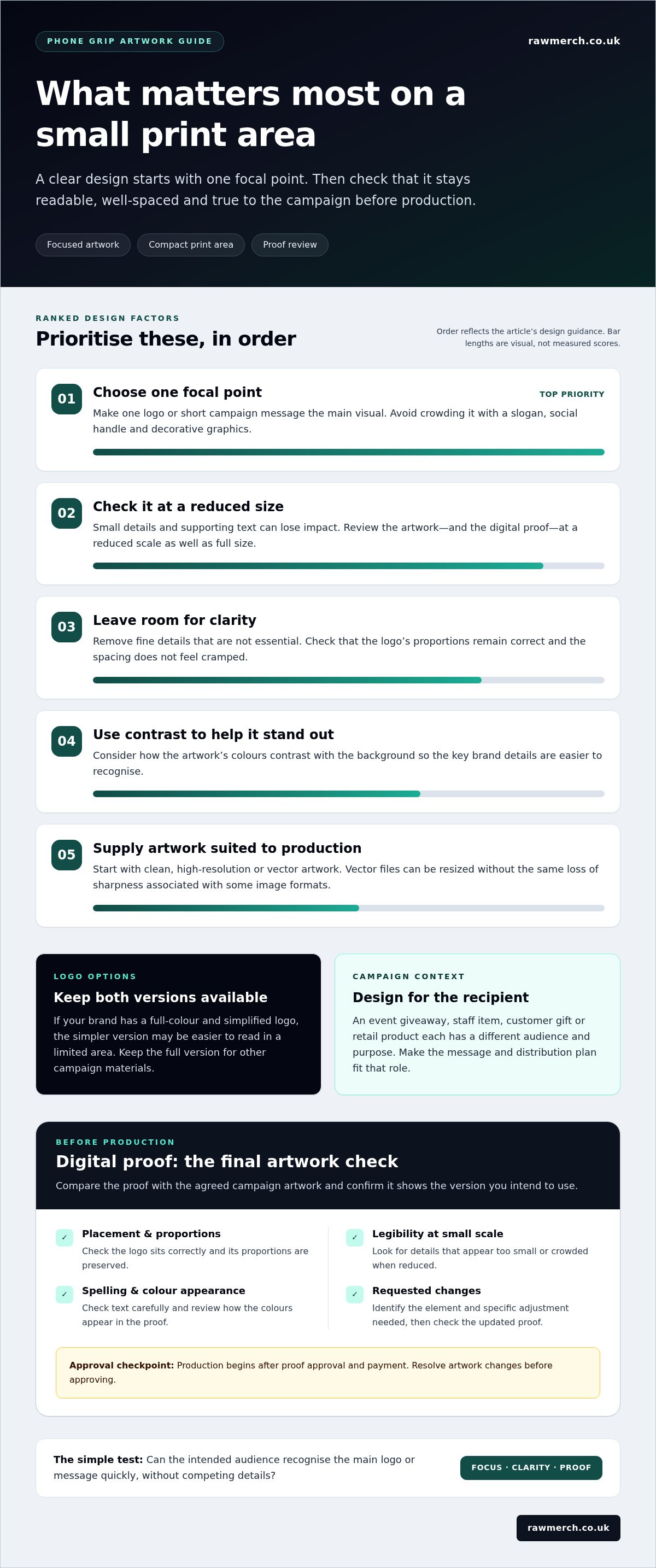
A phone grip has a compact print area, so artwork that looks clear on a laptop screen may lose impact when reduced. For custom pop sockets for phones, keep the design focused. One logo or short campaign message is generally easier to recognise than several competing elements. Strong contrast between the design and its background can also help key details stand out.
Decide what someone should notice first. If the logo is the priority, give it room instead of crowding it with a slogan, social handle and decorative graphics. Tiny supporting text can be difficult to read at a small size. A clean design gives the main brand element more space to register.
File type matters, too. Vector artwork can be resized without the same loss of sharpness associated with some image formats. If you’re unsure what to supply, the vector image guide explains how vector files work in merchandise printing. RAW Merch also provides artwork format guidance to help prepare a campaign file for production.
How should you prepare a logo for a small print area?
Start with a clean, high-resolution or vector version of your logo. Remove fine details that aren’t essential at a reduced size, and check that the proportions remain correct and the spacing doesn’t feel cramped. Consider how the colours will contrast with the background. Include the artwork and relevant campaign details in your brief so the design can be reviewed in context.
If your brand has both a full-colour and simplified logo, keep both versions available. The simpler option may be easier to read in a limited area, while the full version can remain in use across other campaign materials. Aim for consistency without trying to fit every brand element onto one small item.
What should you check on a digital proof?
Use the digital proof as your review point before production. Check the logo’s placement and proportions, spelling, colour appearance and overall legibility. Compare it with the campaign artwork and confirm that the proof shows the version you intend to use. Review it at a reduced scale as well as at full size on screen. This can reveal details that look too small or crowded.
Be specific when requesting changes. Identify the element and the adjustment needed, such as moving the logo or correcting a line of text. Review the updated proof carefully. Production begins after proof approval and payment, so resolve artwork changes before approving.
- Focus: Keep the logo or message as the main visual element.
- Clarity: Check spacing, proportions and contrast at a small scale.
- Approval: Compare the proof with the agreed campaign artwork before signing it off.
A considered artwork file and careful proof review help keep the order aligned with your brief. For a branded merchandise project, RAW Merch’s artwork guidance can help you prepare the supplied design for the next production step.
How to compare custom pop sockets for phones before ordering
Compare options against the campaign you’re planning, not just the product image or headline description. For custom pop sockets for phones, first set out what you already know: the audience, purpose, distribution plan and required quantity. Then identify the product details you need to assess, such as size, materials and compatibility. This makes the brief practical and avoids assuming that every grip suits every phone, case or use.
Which buying criteria matter for a branded order?
Assess who will receive the item, what the campaign should achieve, how you’ll distribute the order and how many recipients you need to plan for. Then consider whether your logo will remain recognisable at the final print scale. Include proof review and delivery planning in your comparison so the option fits both the design and the campaign schedule.
Audience fit: Does the item make sense for the intended recipients and campaign purpose?
Design space: Can the core logo or message stay clear at the product’s final scale?
Use case: Is the grip intended for an event, staff or customer merchandise, or a retail range?
Ordering needs: Does the option align with your quantity, proof-review process and delivery plan?
Keep specification-dependent details separate from your general requirements. Attachment method, dimensions, materials, case fit and charging compatibility can differ between products. Don’t treat one listing’s details as universal. Compare the selected product’s specifications with the intended use, and avoid relying on assumptions in the campaign brief.
How do marketplace listings differ from a coordinated merchandise order?
Marketplace listings can be useful for browsing individual designs and seeing different approaches to personalisation. Product details and fulfilment can vary by seller and listing, so you may need to review each option separately. A coordinated order starts with one brand brief and considers how artwork, quantity, proof approval and delivery fit together. The campaign’s scale and purpose should guide which approach makes sense.
Marketplace purchase: Browse individual listings and compare the product and fulfilment details shown for each one. This can suit a personal, one-off purchase or a specific gift.
Coordinated branded order: Set a shared campaign purpose, prepare artwork for the selected print area, and plan the quantity around recipients and distribution. Digital proof review gives the team a chance to assess the proposed layout before approval.
For a brand campaign, consider how the grip will sit alongside other merchandise and whether the artwork and distribution plan support the same identity. For a single personalised gift, individual design preference may matter more. Make that distinction early, then compare options against the right priorities.
Finish with a short decision record: campaign purpose, audience, required quantity, artwork status, product specifications to evaluate and delivery plan. This gives everyone involved a shared basis for comparing phone grips and keeps the final choice tied to the project rather than appearance alone.
How to plan and order custom phone grips with confidence
A clear order starts with a useful brief, not a guess at product details. For custom pop sockets for phones, set out the campaign requirements first, then work through artwork, proof approval, payment and production in sequence. Keep the selected grip’s product specifications separate from the established ordering steps. This makes the project easier to manage without assuming every option is the same.
What information belongs in the project brief?
Give the project a practical starting point. Describe who the grips are for, what the campaign should achieve, how you intend to distribute them and your preferred quantity. Share the logo, available artwork, brand colours and any essential wording. If the item will sit alongside other merchandise, include that context so the project can be planned as part of a consistent campaign.
Include your target delivery window to support planning, but keep it distinct from a confirmed production or dispatch date. Product details depend on the selected specification. A concise brief separates what you’ve already decided from the details that still need to be evaluated for the chosen item.
- Campaign: Audience, purpose and distribution plan.
- Artwork: Logo, brand colours and essential message.
- Order: Preferred quantity and target delivery window.
What happens after artwork submission?
RAW Merch emails a digital proof for approval. Review it against the agreed campaign artwork, including the layout and any supplied wording. Resolve any changes before approving the proof. Once you approve it and payment is received, production begins.
Orders are sent using a tracked courier service. Tracking lets you follow the shipment, while the target delivery window in your brief supports project planning. Keep event dates and distribution plans visible as you organise the order, and allow for the production and shipping steps when setting your schedule.
Before approving any custom-made item, note that it can’t be returned unless it’s faulty or the print doesn’t match the agreed proof. That makes careful proof review an important part of the order, not just a final formality. Confirm that the approved design is the version you want produced.
The sequence gives your team clear checkpoints: define the campaign, submit the artwork and project details, review and approve the proof, arrange payment, then move into production and tracked shipping. RAW Merch’s custom merchandise experience, artwork guidance and digital proofs support a practical route from brief to finished order.
Explore custom merchandise with RAW Merch and take your campaign from brief to a coordinated order.
How RAW Merch supports your custom pop socket campaign
A branded phone-grip campaign is part of a wider merchandise project. It needs to suit the campaign, carry artwork that represents your organisation and move through approval into production. RAW Merch produces custom clothing and promotional merchandise, with over 25 years of experience in printing and the merchandise industry. For a phone-grip campaign, that broader merchandise experience can support the artwork and order-planning stages.
Keep the campaign purpose and audience at the centre of your brief. RAW Merch provides artwork format guidance and digital proofs, giving you practical checkpoints as the design moves towards production. Separately, assess product-specific details such as materials, attachment and phone compatibility against the intended use.
What RAW Merch brings to a branded merchandise project
RAW Merch’s experience spans custom merchandise and printing, including DTF, screen printing and sublimation. Practical ordering support includes guidance on artwork formats and a digital proof to review before production. If a phone grip is one part of a broader merchandise programme, plan the visual identity and campaign message alongside other branded items instead of treating each piece as a separate design exercise.
Bulk-order discount tiers are available across product lines. This can help when planning a coordinated merchandise order. Product specifications depend on the item selected, while the campaign brief, artwork review and proof approval provide a consistent framework for organising the project.
How to take the next step
Prepare a short campaign brief with the intended audience, purpose, distribution plan, preferred quantity and target timing. Bring together your logo, artwork, brand colours and essential wording. If you’re planning other merchandise as well, note how the phone grip should fit into the wider programme.
Artwork assistance and a digital proof help make the process clear. RAW Merch emails the proof for your review. Check it against your intended design and approve it only when the layout and supplied artwork are right. The order sequence is proof approval, payment, then production. Orders are sent using a tracked courier service.
Before approving, remember that custom-made items can’t be returned unless they’re faulty or the print doesn’t match the agreed proof. Review the proof carefully so the approved design is the version you want produced.
With your brief, artwork, quantity and timing prepared, you’ll have a clear starting point for planning the campaign. Start planning your custom merchandise with RAW Merch and bring your project details into the ordering process.
Turn your campaign idea into a clear next step
The strongest branded merchandise plans begin with a decision: what do you want recipients to remember or do? Use that answer to shape a focused brief for custom pop sockets for phones, then consider how the item fits alongside the rest of your campaign. A consistent approach can help each piece feel like part of the same brand experience, whether you’re preparing for an event, welcoming customers or building a merchandise range.
Before you begin, gather your campaign purpose, audience, preferred quantity, artwork and target timing. A clear starting point makes it easier to move from an idea to a practical order plan. Keep the design focused on the message that matters most, and give your team time to review the proof before production begins.
Ready to put your brief into action? Start planning your custom merchandise with RAW Merch. Bring your idea and artwork together, and take the next step towards merchandise that represents your campaign with purpose.
Frequently Asked Questions
Can custom pop sockets for phones carry a company logo?
A company logo or campaign artwork can form the centre of a branded phone-grip design. The printable area affects how much detail will come through, so prioritise the main brand mark over secondary wording. A logo-led design, for example, is usually easier to read than a logo, slogan, web address and social handles competing for attention. Include the artwork in the brief and review the digital proof before approval.
How do I prepare artwork for a custom phone grip?
Start with a clean, high-resolution logo or design, and choose the version that stays recognisable when reduced. Check that the main colours contrast clearly and remove fine details that could be difficult to make out at a small scale. If the artwork includes a slogan, consider whether it remains readable at the intended size. RAW Merch provides artwork format guidance and emails a digital proof for review before production begins.
Can I order custom phone grips in bulk for an event?
A phone-grip campaign can be planned around an event and its expected audience. Estimate the number of recipients, decide whether the items are giveaways or for retail, and set a target delivery window in your brief. This helps align the quantity with your distribution plan. RAW Merch offers bulk-order discount tiers across product lines, which can support planning a wider merchandise order.
Are custom phone grips compatible with every phone case?
Don’t assume that every grip is compatible with every phone and case. Fit can depend on the accessory’s attachment method and the case material, so include compatibility as a selection requirement if it matters to your recipients. A campaign for people using varied cases needs more careful compatibility planning than one for a defined group. Review the selected product’s specifications before approving the order.
Can a phone grip affect wireless charging?
It can, depending on the phone, charger, grip construction and placement. Don’t assume a grip will work with every wireless charging setup. If recipients are likely to rely on wireless charging, make that a specific requirement when comparing products. Review the selected specification for charging information before approving artwork or moving the order into production. Compatibility is product-dependent, so don’t treat one grip’s performance as universal.
What happens if a custom-made item does not match the approved proof?
RAW Merch’s policy is that custom-made products can’t be returned unless they’re faulty or the print doesn’t match the agreed proof. If you spot a mismatch, compare the item with the approved proof and agreed artwork. Before approval, check spelling, layout and the design version carefully. Keep the proof with your order details so it’s available as a reference for the agreed print.