

Creating killer band merchandise shouldn't be a headache. Yet for many bands, the entire process feels overwhelming. You're worried about tight budgets, the risk of ordering stock that doesn't sell, and a lack of professional design skills. You have the vision, but navigating printing methods and upfront costs can feel like a massive barrier between your music and a vital new revenue stream.
We're here to clear the path. This is your complete, no-nonsense guide to getting the job done right. We deliver the step-by-step plan to design merch you’re proud of, choose the most cost-effective printing options, and build a profitable operation from the ground up. Go from a simple concept to a packed merch table that strengthens your brand and connects with your fans. It’s time to get it made.
Key Takeaways
- Transform your merch from a simple t-shirt into a major revenue stream and a powerful promotional tool for your music.
- Your design is the #1 factor for sales. Prioritise simple, iconic artwork over complex graphics to create items fans will actually buy.
- Select the right printing method for your budget and desired quality. Learn why screen printing remains the industry standard for classic tees.
- A solid sales strategy is crucial. Master the art of the merch table to maximise your profits from every piece of band merchandise.
Why Band Merch is a Non-Negotiable Asset for Musicians
Think your music is your only product? Think again. In today's industry, band merchandise is not just a bonus-it's a core component of your success. Every t-shirt, hoodie, or tote bag sold is more than a simple transaction; it's a walking billboard for your brand. It transforms a passive listener into an active promoter. The iconic band tee has a powerful legacy, and understanding the history of the concert t-shirt reveals just how deeply it connects fans to artists. This connection is your most valuable asset.
Effective merch professionalises your entire operation. When you have a well-stocked merch table at a live show, you're making a bold statement: you are serious about your music and your career. It provides a physical focal point for fan interaction, turning a fleeting concert experience into a lasting memory and transforming your audience from a crowd of individuals into a unified community-your tribe.
The Economics of Band Merch
Let's talk numbers. Streaming services pay fractions of a penny per play, but the profit margins on merchandise are substantial. A quality t-shirt that costs you £7 to produce can easily sell for £20-£25 at a gig. That's pure, tangible profit that goes directly into your pocket. This is the revenue stream that can fund your next recording session, pay for van repairs on tour, or finance a new music video. In an age of digital consumption, offering a physical product creates real-world value that fans are eager to support.
Building Your Brand Identity
Your merch is a visual extension of your sound. It's where your music's ethos, lyrics, and aesthetic come to life. A stark, minimalist design can reflect an atmospheric post-rock band, while a vibrant, chaotic print might perfectly suit a punk act. Use your designs to tell a story, expand on lyrical themes, or create inside jokes with your audience. Owning a piece of your merch gives a fan an exclusive sense of belonging. They aren't just buying a product; they are buying into your artistic universe and proudly displaying their membership in your community.
Planning Your First Merch Drop: Strategy Before You Print
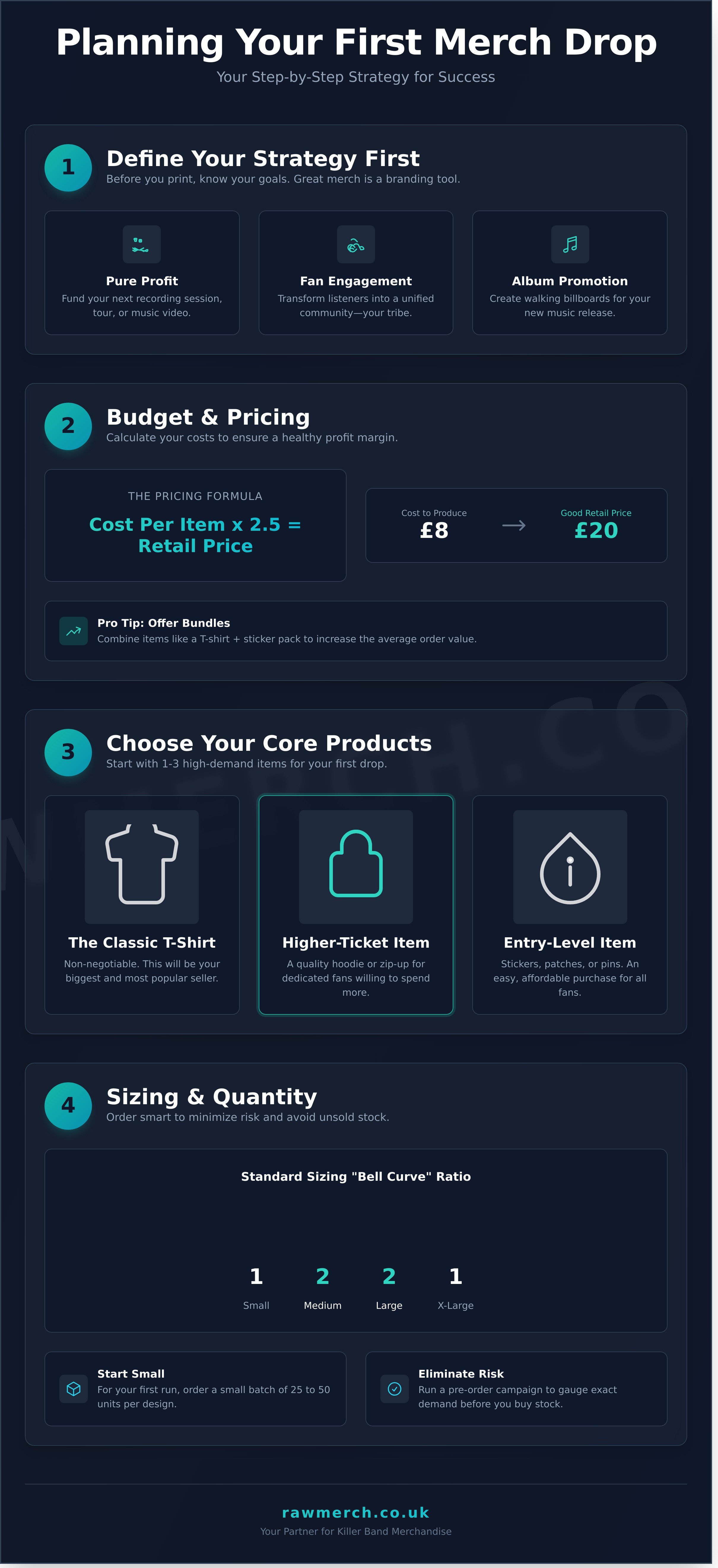
Jumping into your first merch run without a plan is a fast track to a box of unsold t-shirts in your garage. Before you even think about designs, you need a solid strategy. Great merch isn't just about revenue; many experts see merchandise as a branding tool that connects you with your fans on a deeper level. Define your goals clearly: are you aiming for pure profit, fan engagement, or promoting a new album? Knowing this will guide every decision you make.
Setting a Realistic Budget and Pricing
Your budget determines everything. To price correctly, you must calculate your cost-per-item. This includes the blank garment, printing fees, any design costs, and VAT. A simple formula to start with is: Cost Per Item x 2.5 = Retail Price. For example, if a printed t-shirt costs you £8 to produce, a good starting retail price is £20. Hoodies might have a lower markup due to their higher initial cost. Consider offering product bundles (e.g., a t-shirt and a sticker pack for £22) to increase the average order value and give fans a great deal.
Choosing Your Core Products
Don't try to sell everything at once. For your first drop, focus on 1-3 high-demand items that offer something for every fan's budget. Your core product lineup should include:
- The Classic Band T-Shirt: This is non-negotiable. It’s the most popular piece of band merchandise and your biggest seller.
- A Higher-Ticket Item: A quality hoodie or zip-up is perfect for dedicated fans willing to spend more, especially in the UK climate.
- An Entry-Level Item: Stickers, patches, or enamel pins are low-cost for you to produce and an easy, affordable purchase for fans at the merch table.
Not sure where to start? See our bestselling band merch items.
Sizing and Quantity Breakdown
Ordering the right number of sizes is critical to avoid waste. Use the 'bell curve' distribution for standard unisex sizing. A safe ratio for a small run is 1:2:2:1 for sizes Small, Medium, Large, and XL. For your first run, it's smarter to order a smaller batch-think 25 to 50 units per design. This minimises your financial risk. To eliminate risk entirely, consider running a pre-order campaign. You can gauge exact demand and order the precise quantities and sizes needed, ensuring every item is sold.
Designing Band Merch That Actually Sells
Let's get straight to it: your design is the single most important factor for sales. A great design turns a simple T-shirt into a statement, a walking billboard for your music, and a genuine piece of art your fans will be proud to wear. Forget just slapping your logo on a black tee. The goal is to create something so compelling that even people who haven't heard your music want to wear it.
The best designs are often iconic and simple, not cluttered and complex. Think of legendary band logos-they are instantly recognisable from the back of a venue. Your design must connect directly to your music's genre and your band's unique aesthetic. Whether you're a punk act needing a raw, DIY look or an indie band with a minimalist vibe, your design is your visual signature. Also, consider placement. A bold back print, a subtle sleeve detail, or a classic chest design all create a different impact.
Key Principles of Great Merch Design
Getting the fundamentals right is non-negotiable. We've seen thousands of designs, and the ones that sell always follow these core rules. Focus on these points to create powerful, effective band merchandise that connects with your audience.
- Readability: Can someone clearly read your band name from across the room? If the font is too complex or small, you've lost a promotional opportunity.
- Colour Theory: Less is more. A limited colour palette of 2-3 colours often creates a more striking design than a full-colour photo. It's bold, cost-effective to print, and looks professional.
- Garment Colour: Design with the garment in mind. A design created for a white T-shirt will need adjustments for a black one. Ensure your colours have enough contrast to stand out.
- Stay Authentic: It's smart to be aware of trends, but your design must be authentic to your band. Your fans are buying into your identity, not a fleeting fashion trend.
Preparing Your Artwork for Printing
A great idea can be ruined by a poor-quality file. To ensure your merch looks as good in real life as it does on screen, your artwork must be print-ready. This is where technical details matter. Getting it right saves you time, money, and disappointment.
- Vector is King: For most apparel printing, vector files (.AI, .EPS, .PDF) are essential. They can be scaled to any size without losing quality, ensuring crisp, sharp lines. Raster files (.JPG, .PNG) are made of pixels and can look blurry if enlarged.
- Resolution Matters: If you must use a raster image, it must be high-resolution. We require 300 DPI (dots per inch) at the final print size for a quality result.
- Outline Your Fonts: Before sending your file, convert all text to outlines or curves. This turns the text into a vector shape and prevents font substitution errors during printing.
If you're unsure about file preparation, don't worry. Our expert team is here to help you get it right. We know what works, and we deliver on time, every time.
Choosing the Right Printing Method for Your Merch
Once your design is locked in, the next critical step is choosing how to get it onto your products. The printing technique you select directly impacts the final look, feel, durability, and cost of your band merchandise. Understanding the core options is key to making a smart, cost-effective decision that matches your vision and budget. We get the job done right, every time.
Screen Printing: The Classic Choice
Screen printing is the undisputed industry standard for classic band t-shirts, and for good reason. This method pushes ink through a mesh screen onto the garment, creating an incredibly durable and vibrant print that sits on the fabric and lasts wash after wash. It's most cost-effective for bulk orders (think 25+ items) with a limited number of colours, as the cost-per-shirt drops significantly the more you print.
DTF Printing: For Full-Colour Detail
Got a complex, multi-colour design like a photograph or detailed album art? Direct to Film (DTF) printing is your answer. This modern technique prints your design onto a special film, which is then heat-pressed onto the garment. It produces stunning, high-fidelity images with a soft feel and excellent durability. Best of all, there are no minimum order quantities, making it perfect for small runs or testing out new designs.
Embroidery: For a Premium Look
For a high-end, professional finish, nothing beats embroidery. This process stitches your design directly into the fabric, creating a textured, durable, and premium result. It’s the perfect choice for putting your band logo on beanies, caps, polo shirts, and jacket breasts. The process involves a one-time "digitisation fee" to convert your design into a stitch-ready format, a worthy investment for a truly professional look.
Beyond Printing: Garment Selection
The best print in the world won't save a poor-quality garment. The blank apparel you choose is the foundation of your merch. You need to consider fit, material, and brand ethics to ensure your fans get a product they'll love to wear.
- Gildan: A reliable, budget-friendly workhorse perfect for tour merch.
- Stanley/Stella: A premium, eco-conscious choice known for its soft feel and modern fits.
- AS Colour: A top-tier option offering clean, stylish cuts and exceptional quality.
Think about whether you want 100% cotton for breathability or a poly-blend for durability and a softer feel. The right choice makes all the difference.
Confused by the options? We've got over 25 years of experience and know what works. Get a no-obligation quote from our experts!
Selling Your Merch: At the Gig and Online
You’ve designed incredible merch. Now, you need to sell it. Your sales strategy is just as important as your designs, turning your products into profit and connecting you with your audience. You have two key battlegrounds: the live gig and the global online market. Master them both.
Mastering the Merch Table
Your merch table is your physical storefront at every show. It's a direct connection to your most dedicated fans, so make it count. A professional setup shows you're serious and makes buying easy.
The live show is the ultimate point of connection, and that's true for fans everywhere, including those who travel internationally to see their favorite artists. For instance, in a bustling live music market like Japan, dedicated services like Jasumo Tickets have emerged to help international fans secure tickets for major events.
- Presentation is Key: Use good lighting to make your gear pop. Display items clearly on a rail or table. Price everything clearly in GBP (£) - no one should have to ask.
- Accept All Payments: Cash is still an option, but card and contactless are essential in the UK. Get a simple card reader. Don't lose a sale because of payment issues.
- Engage with Fans: This is more than a transaction. It's your chance to chat with fans, thank them for coming, and build a real community around your music.
- Build Your List: Always have a mailing list sign-up sheet or a QR code. It's the single best way to stay in touch with your audience long after the gig ends.
Setting Up an Online Store
An online store works for you 24/7, reaching fans who can't make it to a show. This is your global HQ. Setting it up right is crucial for turning your band merchandise into a steady stream of income.
Platforms like Bandcamp are perfect for integrating music and merch sales. For more powerful, customisable stores, look at Shopify or Music Glue. Whichever you choose, invest in high-quality product photos. Your fans can’t touch the item, so your images must do the selling. Be upfront and clear about your shipping policies and costs within the UK and internationally.
Using a Fulfillment Service
What if you could sell merch without ever having to pack a box or queue at the Post Office again? That’s merch fulfillment. We store your products, and when an order comes in, we pick, pack, and ship it directly to your fan. It’s that simple.
Using a fulfillment service frees you up to focus on what matters: your music. While you’re on tour or writing your next album, we ensure your orders are handled professionally and delivered on time. It's the ultimate way to scale your merch operation without the logistical headaches.
Want to simplify your life? Learn about our fulfillment services. We get the job done right, so you can get back on stage.
Unleash Your Merch Potential
Merchandise is more than just a t-shirt; it’s a powerful connection to your fans and a crucial revenue stream. We've shown how a solid strategy, killer designs, and the right sales channels are non-negotiable. Creating quality band merchandise transforms your sound into something your audience can hold, wear, and champion.
The final step is partnering with a team that gets it right. With over 25 years of industry experience, we are that partner. Our in-house screen printing, DTF, and embroidery services mean your vision is in expert hands. We know what you want, and we deliver on time, every time.
Ready to bring your ideas to life? YOU WANT IT, WE CREATE IT! Get a free quote for your band merch today.
Your fans are waiting.
Frequently Asked Questions About Band Merchandise
How many t-shirts should a new band order for their first run?
For a new band, starting small is the smart move. We recommend an initial order of 50 t-shirts. This minimises your upfront cost and lets you test your design's popularity without being left with unsold stock. A typical size breakdown would be: 5 Small, 15 Medium, 15 Large, 10 XL, and 5 XXL. This focuses on the most common sizes and gives you a solid starting point for your merch table.
What are the most profitable merchandise items for bands?
T-shirts and hoodies are the undisputed champions of profitability. They offer great margins and act as walking billboards for your band. However, don't overlook smaller items. Enamel pins, patches, and tote bags have very low production costs-often just a few pounds per unit-but can be sold for a significant markup. These are perfect for fans who want to show support without buying a more expensive garment.
Can I mix and match different garment colours and sizes in one screen print order?
Yes, absolutely. You can mix and match any combination of garment sizes and colours within a single order. The key thing to remember is that the price is based on a single ink setup. As long as the print design and ink colour stay the same across all items, you can print on black, white, and red shirts all in the same run. Changing ink colour will require a new setup and add to the cost.
What's the average turnaround time for a custom merch order?
We get it, you have deadlines. Our standard turnaround time is 7-10 working days after your artwork has been approved and your invoice is paid. This ensures we have time to source the best garments and deliver the quality you expect. If you have an urgent deadline for a tour or a specific show, contact us directly. We are experts at hitting tight deadlines and will always work to meet your schedule.
Do I need a professional graphic designer to create my merch?
A professional designer is a great asset, but not a requirement. What is essential is a high-quality, print-ready file. Your design must be at least 300dpi at the desired print size, preferably in a vector format (.AI, .EPS) or a layered Photoshop file (.PSD). If you have a great idea but need help with the technical side, our team can advise on the best way to get your artwork ready for production. YOU WANT IT, WE CREATE IT!
What is the difference between DTG and DTF printing?
DTG (Direct-to-Garment) printing works like an inkjet printer, applying ink directly onto the t-shirt. It’s ideal for highly detailed, full-colour designs on 100% cotton. DTF (Direct-to-Film) prints the design onto a transfer film first, which is then heat-pressed onto the garment. DTF is incredibly versatile, producing vibrant prints on a wider range of fabrics, including polyester blends. It is an excellent, durable choice for most custom band merchandise.
How do I handle international shipping for my online store?
For UK-based bands, international shipping needs a clear strategy. Use a reliable courier like Royal Mail International Tracked & Signed to protect you and your customer. Be upfront about costs, which can range from £10 to £25. It's crucial to state on your website that customers outside the UK are responsible for any import duties or customs fees their country may charge, especially for orders going to the EU post-Brexit.